Filtration Supplies

Filtration Supplies Banner

Laboratory filtration plays a critical role in protecting analytical instruments and ensuring clean, reproducible chromatographic results. By removing particulates prior to analysis, filtration helps prevent injector blockages, rising backpressure, and premature column failure.

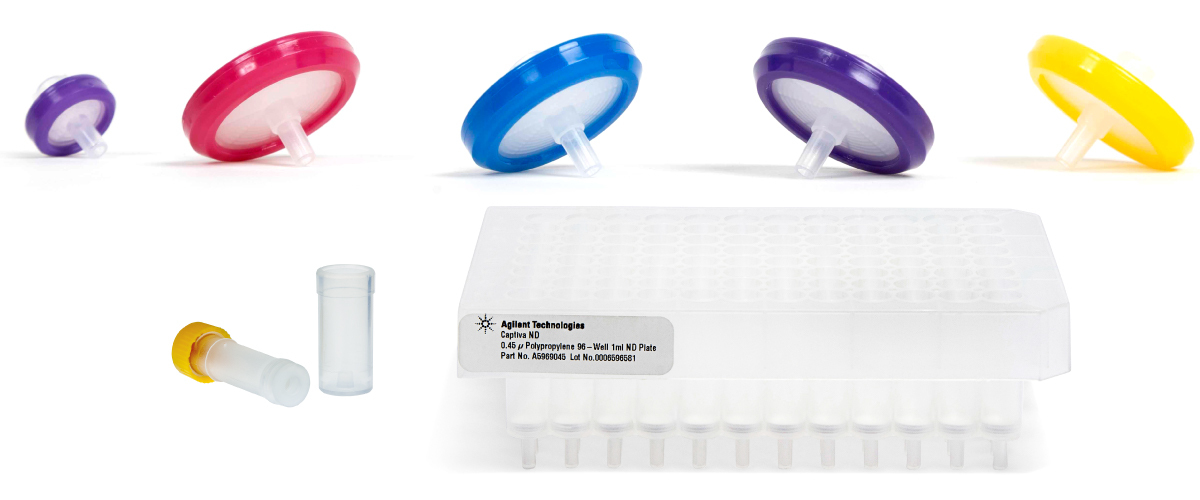
Reducing particulate load increases system uptime while minimizing costly downtime associated with clogged frits and damaged valves. Chrom Tech supplies a broad range of HPLC syringe filters, membrane filters, filter vials, and 96-well filter plates engineered to support routine analysis and high-throughput workflows alike.

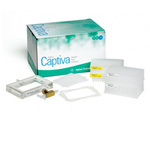
We also feature Agilent Captiva filtration technologies for advanced sample cleanup, providing low extractables, consistent flow characteristics, and enhanced matrix removal for demanding applications.

Whether you’re filtering mobile phases or preparing complex samples, Chrom Tech delivers reliable filtration solutions backed by chromatography expertise. If you need help selecting membrane chemistry, pore size, or format, contact our technical support team for personalized guidance.

Key Definitions â–
Syringe Filters
Disposable filtration devices used to remove particulates from liquid samples prior to HPLC or UHPLC analysis, helping protect columns, injectors, and detectors.
Membrane Filters
Flat filtration membranes available in multiple chemistries and pore sizes, commonly used for mobile phase preparation and bulk solvent filtration.
Filter Vials
Integrated vial-and-filter systems that combine sample filtration and autosampler compatibility into a single step, reducing handling time and sample loss.
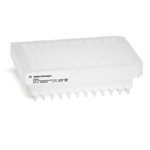
96-Well Filter Plates
High-throughput filtration plates designed for parallel sample cleanup, enabling rapid processing of multiple samples in analytical and bioanalytical workflows.
Captiva Filtration
Advanced sample preparation filters engineered for low extractables and enhanced matrix removal, commonly used for food, environmental, and pharmaceutical analysis.
Frequently Asked Questions â–
Why is filtration important in chromatography?
Filtration removes particulates and contaminants before analysis, protecting columns and valves, reducing backpressure, and improving reproducibility while extending instrument life.
What pore size should I use for HPLC samples?
Most HPLC applications use 0.2 µm filters for mobile phases and samples. A 0.45 µm filter may be sufficient for less sensitive systems or preliminary sample cleanup.
What’s the difference between syringe filters and filter vials?
Syringe filters require a separate syringe to push sample through the membrane, while filter vials integrate filtration directly into the vial—allowing filtration and autosampler loading in a single step.
When should I use 96-well filter plates?
96-well filter plates are ideal for high-throughput laboratories processing multiple samples simultaneously, enabling fast parallel filtration for analytical and bioanalytical workflows.