
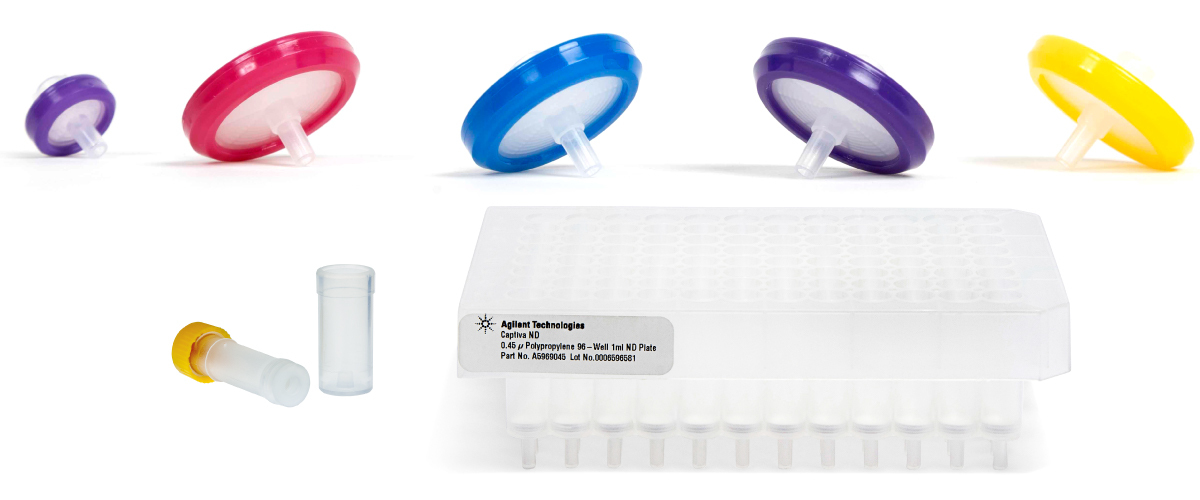
Protect your HPLC system and improve sample consistency with Chrom Tech syringe filters. These single-use filters are designed to remove particulates from liquid samples before injection, helping reduce column fouling, injector blockage, and unwanted variation in chromatographic results.
When choosing a syringe filter, three factors matter most: sample volume, pore size, and membrane compatibility. Membrane choice is especially important because solvent resistance, hydrophobicity, and protein binding vary by material. Matching the membrane to the sample helps improve filtration performance and reduces the risk of sample loss or incompatibility.
1. Syringe Filter Diameter and Sample Volume
Sample volume determines which filter diameter is the best fit. Larger filters offer more membrane surface area and support faster filtration of bigger volumes, while smaller filters are more practical for routine low-volume HPLC work.
- 13 mm filters are intended for sample volumes up to about 10 mL.
- 30 mm filters can handle volumes up to about 200 mL and support faster flow.
For most analytical workflows, 13 mm filters are the standard starting point. For higher-volume filtration, 30 mm filters help improve throughput and membrane life.
2. Syringe Filter Pore Size
Chrom Tech supplies two standard pore sizes for most HPLC syringe filter membranes: 0.45 µm and 0.2 µm.
- 0.45 µm filters are a practical choice for general particulate protection.
- 0.2 µm filters are better when finer particulate removal is needed, such as in UHPLC or more sensitive assays.
Choosing the right pore size helps maintain consistent backpressure and reduces the risk of clogging in more demanding methods.
3. Syringe Filter Membrane Options
Chrom Tech’s syringe filter membrane range includes the most common HPLC choices, each with different strengths:
- Nylon (Blue) – solvent resistant, low extractables, and compatible with aqueous and organic samples, but it binds protein and should be avoided when protein recovery matters.
- PTFE (Red) – hydrophobic and chemically inert, making it a strong option for aggressive organic solvents.
- PVDF (Yellow) – low UV-absorbing extractables and low-protein binding, making it a versatile all-purpose membrane.
- PES (Green) – mechanically strong, low in extractables, and low-protein binding, making it useful for proteins, nucleic acids, and ion chromatography.
- CA (Orange) – very low-protein binding and best suited to aqueous protein-recovery applications; it is not intended for organic compatibility.
- PP (Purple) – hydrophilic with broad chemical compatibility, making it useful for mixed solvent systems.
- Glass Fiber (Dark Purple) – a high-flow prefilter option for larger particulates or more viscous samples.
Which Membranes Work Best for HPLC Applications?
For general HPLC sample prep, the best membrane depends on the solvent and whether protein recovery is important.
Nylon is a practical general-use choice for aqueous and organic filtration when proteins are not a concern. PTFE is best reserved for aggressive organic solvent systems. PVDF and PES are strong choices when low-protein binding is needed, and CA is especially useful for aqueous protein-recovery applications.
This makes membrane compatibility more important than choosing by pore size alone. The membrane should always match the chemistry of the sample first.
Chrom Tech Syringe Filter Ordering Guide
13 mm Filters
| Part Number | Membrane | Pore Size | Diameter | Aqueous | Organic | Low-Protein Binding | Color |
|---|---|---|---|---|---|---|---|
| F13-CA020 | CA | 0.2 µm | 13 mm | ✔ | ✔ | Orange | |
| F13-CA045 | CA | 0.45 µm | 13 mm | ✔ | ✔ | Orange | |
| F13-NY020 | Nylon | 0.2 µm | 13 mm | ✔ | ✔ | Blue | |
| F13-NY045 | Nylon | 0.45 µm | 13 mm | ✔ | ✔ | Blue | |
| F13-PP020 | PP | 0.2 µm | 13 mm | ✔ | ✔ | Purple | |
| F13-PP045 | PP | 0.45 µm | 13 mm | ✔ | ✔ | Purple | |
| F13-PS020 | PES | 0.2 µm | 13 mm | ✔ | ✔ | ✔ | Green |
| F13-PS045 | PES | 0.45 µm | 13 mm | ✔ | ✔ | ✔ | Green |
| F13-PT020 | PTFE | 0.2 µm | 13 mm | ✔ | Red | ||
| F13-PT045 | PTFE | 0.45 µm | 13 mm | ✔ | Red | ||
| F13-PV020 | PVDF | 0.2 µm | 13 mm | ✔ | ✔ | ✔ | Yellow |
| F13-PV045 | PVDF | 0.45 µm | 13 mm | ✔ | ✔ | ✔ | Yellow |
30 mm Filters
| Part Number | Membrane | Pore Size | Diameter | Aqueous | Organic | Low-Protein Binding | Color |
|---|---|---|---|---|---|---|---|
| F30-CA020 | CA | 0.2 µm | 30 mm | ✔ | ✔ | Orange | |
| F30-CA045 | CA | 0.45 µm | 30 mm | ✔ | ✔ | Orange | |
| F30-GF070 | Glass Fiber | 0.7 µm | 30 mm | ✔ | ✔ | Dark Purple | |
| F30-GF120 | Glass Fiber | 1.2 µm | 30 mm | ✔ | ✔ | Dark Purple | |
| F30-NY020 | Nylon | 0.2 µm | 30 mm | ✔ | ✔ | Blue | |
| F30-NY045 | Nylon | 0.45 µm | 30 mm | ✔ | ✔ | Blue | |
| F30-PP020 | PP | 0.2 µm | 30 mm | ✔ | ✔ | Purple | |
| F30-PP045 | PP | 0.45 µm | 30 mm | ✔ | ✔ | Purple | |
| F30-PS020 | PES | 0.2 µm | 30 mm | ✔ | ✔ | ✔ | Green |
| F30-PS045 | PES | 0.45 µm | 30 mm | ✔ | ✔ | ✔ | Green |
| F30-PT020 | PTFE | 0.2 µm | 30 mm | ✔ | Red | ||
| F30-PT045 | PTFE | 0.45 µm | 30 mm | ✔ | Red | ||
| F30-PV020 | PVDF | 0.2 µm | 30 mm | ✔ | ✔ | ✔ | Yellow |
| F30-PV045 | PVDF | 0.45 µm | 30 mm | ✔ | ✔ | ✔ | Yellow |
How to Use a Syringe Filter Properly
To use a syringe filter, draw the sample into a disposable luer syringe, attach the filter, and hold the syringe vertically. Press the plunger slowly to maintain even flow and reduce the risk of membrane rupture. If resistance increases unexpectedly, replace the filter rather than forcing the sample through.
Summary
Choosing the correct syringe filter membrane improves sample cleanliness and helps extend column life. For help selecting the right membrane or diameter for your application, contact Chrom Tech at support@chromtech.com. Chrom Tech’s color-coded membrane system also makes filter identification easier during daily lab use.