
As manufacturers evaluate alternatives to conventional batch processing, continuous process applications are increasingly attractive for improving efficiency, reducing waste, and supporting more scalable production. Continuous flow processing combines chemistry and engineering principles to improve reaction control and help organizations move more effectively from development to production.
One of the most important decisions in building a reliable continuous process system is selecting the right flow chemistry pump. The pump must deliver stable operation, fit the pressure and flow requirements of the process, and remain compatible with the chemistry involved. It also needs to support long-term reproducibility under continuous use.
Why Pump Selection Matters in Continuous Processing
Continuous processing depends on uninterrupted and controlled solvent delivery. A poorly matched pump can create instability, require more maintenance, or limit scalability. A well-matched pump, by contrast, supports consistent performance, easier integration, and more dependable long-term operation.

Source: thechemicalengineer.com
1. Reliability and Maintenance
Reliability is a primary consideration for continuous process applications because these systems often need to run unattended for extended periods. A pump used in continuous service should have a strong record of durability, low downtime, and straightforward maintenance.
Chrom Tech pumps are positioned as dependable solvent delivery systems with strong flow accuracy and minimal gradient delay. For many users, the ideal pump is a reliable workhorse that can support continuous operation without frequent intervention.
To help maximize pump life and reduce leaks or flow inconsistencies, the source content recommends annual replacement of piston seals and check valves. Replacement components can be found in the related products section of each pump webpage or in the product manual for the specific model.
2. Precision and Flow Control
Precise solvent delivery is essential for stable and reproducible continuous processing. One of the key considerations is pulsation. If your application is sensitive to pulsation and requires especially smooth flow, a dual piston pump such as Chrom Tech’s LD or PR class models may be the best fit. These pumps use reciprocating pistons that alternate cycles, helping minimize pulsation and maintain more consistent flow.
For applications that are less sensitive to pulsation, the M1 Series single piston pumps provide reliable performance in a compact format. Users who need additional monitoring and safety features may also consider the LST Class, which the source content notes includes pressure monitoring and a drip tray leak sensor.
3. Chemical Compatibility
The materials used in the pump flow path must be compatible with the solvents and reagents in the process. Chrom Tech pumps are available in PEEK and Stainless Steel, with Titanium and Hastelloy options available for more aggressive chemistries.
If solvent compatibility is uncertain, the source content recommends contacting Chrom Tech’s product specialists before finalizing pump selection.
4. Flow Rate and Pressure Requirements
Continuous process systems depend on steady and controlled flow. For this reason, the source content identifies constant flow pumps as the preferred choice for most applications. Chrom Tech HPLC pumps used as standalone solvent delivery units are described as providing strong precision and control across a wide range of operating conditions.
Below is an overview of flow rate and pressure ranges referenced in the source content for several Chrom Tech pump classes:
Single Piston
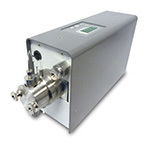
40 mL/500 PSI
Single Piston

Single Piston
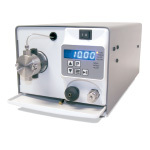
10 mL/6,000 PSI
40 mL/1,600 PSI
Dual Piston
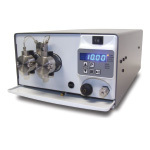
36 mL/6,000 PSI
100 mL/1,000 PSI
100 mL/4,000 PSI
300 mL/1,000 PSI
Constant Pressure
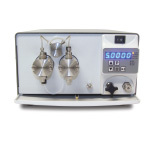
100 mL/5,000 PSI
Solvent viscosity can also affect performance. The source content notes that more viscous fluids may require changes in flow rate or backpressure to support proper operation of check valves and pulse dampeners.
5. Compatibility with Automation Systems
Automation is often an important part of continuous processing. For that reason, the pump should support remote control and communication with the rest of the system. According to the source content, Chrom Tech pumps offer several connection options, including RS-232 serial, Micro USB with hardware driver, and Ethernet.
Many users connect through existing control software, and a free driver is available when software-based operation is needed.
Choose a Pump That Matches the Process
Choosing a pump for continuous process applications involves more than comparing specifications. The right choice depends on how the pump will perform over time in your specific workflow. Reliability, pulsation control, chemical compatibility, pressure and flow range, and automation support all play a role in achieving stable continuous operation.
Whether you are implementing a new continuous flow process or improving an existing system, Chrom Tech offers pump technologies and support options designed to help continuous applications run more smoothly.