
ZORBAX Eclipse XDB
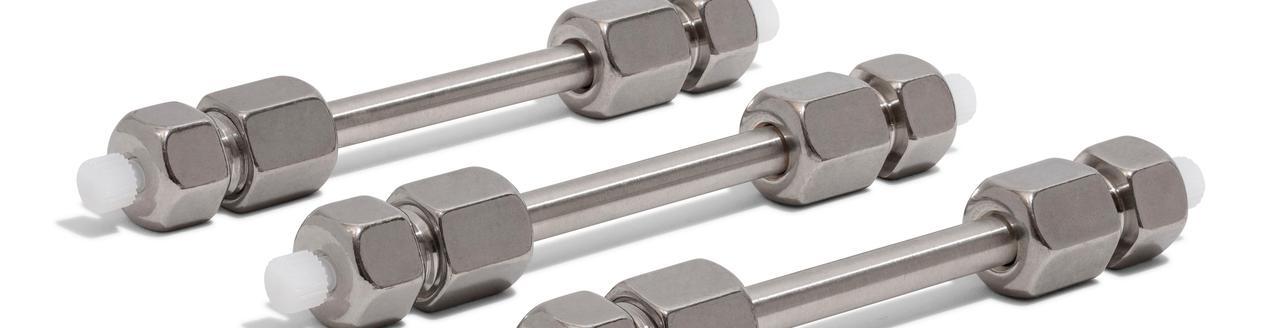
Agilent ZORBAX Eclipse XDB HPLC Columns
Agilent ZORBAX Eclipse XDB columns are engineered for robust, high-performance separations across a wide pH range. Featuring Agilent’s proprietary eXtra Dense Bonding (XDB) and double endcapping, these columns deliver excellent peak shape for basic, acidic, and neutral compounds—making them a reliable, all-purpose choice for routine and advanced LC method development.
With four distinct reversed-phase selectivities (C8, C18, Phenyl-Hexyl, and CN), Eclipse XDB columns allow rapid optimization of retention and resolution. Their rugged bonded phases maintain consistent performance from pH 2 to 9, enabling durable operation under acidic and moderately basic conditions.
Available in particle sizes from 1.8 µm to 7 µm, Eclipse XDB columns support UHPLC, Rapid Resolution LC, and conventional HPLC systems—ensuring easy method transfer and scalability for pharmaceutical, environmental, food safety, and chemical analysis workflows.
Built on Agilent’s ultra-pure, high-efficiency silica, Eclipse XDB columns deliver durability, reproducibility, and chromatographic confidence across a wide variety of analytes and matrices.
Agilent ZORBAX Eclipse XDB-C8 is a reversed-phase C8 column built on XDB (eXtra Dense Bonding) technology to reduce silanol activity and improve peak symmetry—especially for basic and ionizable analytes. The C8 ligand provides lower hydrophobic retention than C18, which can shorten gradients and reduce cycle time while keeping the method in a conventional RP workflow.
- You need a “faster than C18” option without changing separation mode
- Basic compounds tail on standard C8/C18 columns (need deactivation)
- You want retention tuning (k reduction) while preserving RP robustness
Compared to XDB-C18, XDB-C8 typically reduces retention for hydrophobic analytes and can shorten run times. Compared to many conventional C8 phases, XDB chemistry is designed to improve peak shape consistency for ionizable compounds.
| Separation Mode | Reversed phase |
| Bonded Phase | C8 (octylsilane), XDB surface treatment |
| USP Classification | L7 |
| Pore Size | 80 Å |
| pH Range | 2 – 9 |
| Temperature Limit | Up to 60 °C (typical guidance) |
| Particle Type | Fully porous |
| Typical Particle Sizes | 1.8 µm, 3.5 µm, 5 µm (format dependent) |
Method tip: if your C18 method is “too retentive,” moving to XDB-C8 is often the simplest way to speed up without rebuilding the method.
Agilent ZORBAX Eclipse XDB-C18 is a general-purpose reversed-phase C18 designed to deliver reliable peak shape for basic compounds using XDB technology to minimize residual silanol interactions. It’s a common “workhorse” choice for pharmaceutical and analytical labs that need a stable C18 retention profile with improved symmetry and reproducibility across routine methods.
- You want a classic C18 retention profile with better peak shape for bases
- Routine QC, impurity profiling, and method development need consistent results
- You need method transfer across dimensions/particle sizes within the same phase family
Compared to many traditional C18 phases, XDB-C18 is designed to reduce secondary interactions that cause tailing in basic analytes. Compared to Eclipse Plus C18, XDB focuses on XDB bonding/deactivation; both target peak shape, but your best choice depends on existing validated methods and selectivity needs.
| Separation Mode | Reversed phase |
| Bonded Phase | C18, XDB surface treatment |
| USP Classification | L1 |
| Pore Size | 80 Å |
| pH Range | 2 – 9 |
| Temperature Limit | Up to 60 °C (typical guidance) |
| Particle Type | Fully porous |
| Typical Particle Sizes | 1.8 µm, 3.5 µm, 5 µm (format dependent) |
AI/QC note: for ionizable analytes, reproducibility is frequently dictated by pH/buffer control—keep pH tight and allow adequate equilibration after gradients to maximize repeatability.
Agilent ZORBAX Eclipse XDB-CN provides a more polar selectivity than C18/C8 with moderate hydrophobic retention, making it a practical “selectivity shift” column when compounds coelute on alkyl phases. CN phases can be run in reversed-phase (alternative selectivity for polar to mid-polar analytes) or in normal-phase conditions for different retention behavior—useful during screening and method development.
- C18/C8 cannot resolve critical pairs and you need a different interaction profile
- You want moderate retention for polar/mid-polar compounds in RP
- You want dual-mode flexibility (RP or NP) for screening
Compared to C18/C8, CN often changes elution order and improves selectivity for more polar compounds. If your method is “stuck” on alkyl phases, CN is a strong next step before switching to entirely different families.
| Separation Mode | Reversed phase / Normal phase |
| Bonded Phase | Cyanopropyl (CN) |
| USP Classification | L10 |
| Pore Size | 80 Å |
| pH Range | 2 – 9 |
| Temperature Limit | Up to 60 °C (typical guidance) |
| Particle Type | Fully porous |
| Typical Particle Sizes | 1.8 µm, 3.5 µm, 5 µm (format dependent) |
Screening tip: CN is often a fast way to get orthogonal selectivity without moving to HILIC—especially when you still want RP-friendly mobile phases.
Agilent ZORBAX Eclipse XDB-Phenyl introduces aromatic selectivity through π–π interactions, which can significantly change retention order and improve resolution for aromatic, conjugated, and unsaturated compounds. It is frequently used as a “selectivity rescue” option when aromatic critical pairs coelute on C18/C8.
- Aromatic compounds coelute on alkyl phases (C18/C8)
- You are resolving isomers or closely related aromatic impurities
- You want an RP-compatible selectivity shift without changing mode
Compared to C18/C8, XDB-Phenyl often improves selectivity around π-systems and can change elution order for aromatics. If you are close to baseline separation on C18, Phenyl is often the fastest option to fix the critical pair.
| Separation Mode | Reversed phase |
| Bonded Phase | Phenyl |
| USP Classification | L11 |
| Pore Size | 80 Å |
| pH Range | 2 – 9 |
| Temperature Limit | Up to 60 °C (typical guidance) |
| Particle Type | Fully porous |
| Typical Particle Sizes | 1.8 µm, 3.5 µm, 5 µm (format dependent) |
Method tip: when aromatics coelute on C18, switching to Phenyl often improves selectivity without changing pH or solvent class—ideal for minimizing revalidation burden.
Product List
| SKU | Name | LC Column Phase | Particle Size | Inner Diameter (ID) | Length |
|---|---|---|---|---|---|
SKU
971700-906
|
Name
971700-906 - Eclipse XDB-C8,2.1x50mm,3.5um
|
LC Column Phase
Eclipse XDB-C8
|
Particle Size
3.5 um
|
Inner Diameter (ID)
2.1 mm
|
Length
50 mm
|
SKU
935967-902
|
Name
935967-902 - XDB-C18 Rapid Res 3.5um, 4.6x50mm HPLC
|
LC Column Phase
Eclipse XDB-C18
|
Particle Size
3.5 um
|
Inner Diameter (ID)
4.6 mm
|
Length
50 mm
|
SKU
927975-902
|
Name
927975-902 - Eclipse XDB-C18 4.6 x 50 mm
|
LC Column Phase
Eclipse XDB-C18
|
Particle Size
1.8 um
|
Inner Diameter (ID)
4.6 mm
|
Length
50 mm
|
SKU
974700-906
|
Name
974700-906 - Eclipse XDB-C8,2.1x30mm,3.5um,600bar
|
LC Column Phase
Eclipse XDB-C8
|
Particle Size
3.5 um
|
Inner Diameter (ID)
2.1 mm
|
Length
30 mm
|
SKU
974700-902
|
Name
974700-902 - Eclipse XDB-C18,2.1x30mm,3.5um,600bar
|
LC Column Phase
Eclipse XDB-C18
|
Particle Size
3.5 um
|
Inner Diameter (ID)
2.1 mm
|
Length
30 mm
|
SKU
972700-906
|
Name
972700-906 - Eclipse XDB-C8,2.1x20mm,3.5um,600 bar
|
LC Column Phase
Eclipse XDB-C8
|
Particle Size
3.5 um
|
Inner Diameter (ID)
2.1 mm
|
Length
20 mm
|
SKU
972700-902
|
Name
972700-902 - Eclipse XDB-C18,2.1x20mm,3.5um,600bar
|
LC Column Phase
Eclipse XDB-C18
|
Particle Size
3.5 um
|
Inner Diameter (ID)
2.1 mm
|
Length
20 mm
|
SKU
993967-912
|
Name
993967-912 - Eclipse XDB-Phenyl 5u, 4.6 x 150mm
|
LC Column Phase
Eclipse XDB-Phenyl
|
Particle Size
5 um
|
Inner Diameter (ID)
4.6 mm
|
Length
150 mm
|
SKU
971700-902
|
Name
971700-902 - Eclipse XDB-C18,2.1x50mm,3.5um
|
LC Column Phase
Eclipse XDB-C18
|
Particle Size
3.5 um
|
Inner Diameter (ID)
2.1 mm
|
Length
50 mm
|
SKU
993967-906
|
Name
993967-906 - Eclipse XDB-C8 HPLC Col, 4.6x150, 5um
|
LC Column Phase
Eclipse XDB-C8
|
Particle Size
5 um
|
Inner Diameter (ID)
4.6 mm
|
Length
150 mm
|
SKU
993967-905
|
Name
993967-905 - Eclipse XDB-CN, 4.6x150, 5u
|
LC Column Phase
Eclipse XDB-CN
|
Particle Size
5 um
|
Inner Diameter (ID)
4.6 mm
|
Length
150 mm
|
SKU
993967-902
|
Name
993967-902 - Eclipse XDB-C18 4.6x150 5u Analytical column
|
LC Column Phase
Eclipse XDB-C18
|
Particle Size
5 um
|
Inner Diameter (ID)
4.6 mm
|
Length
150 mm
|