PCR Plates
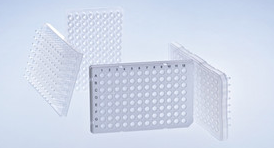
96 Well PCR Plates
- Compatible with automated liquid handlers and high-throughput workflows
- Certified DNase-, RNase-, and human DNA–free for contamination-controlled PCR
- Manufactured without silicone-based mold release agents for maximum purity
Chrom Tech’s 96 well PCR plates are built to deliver consistent performance across qPCR, endpoint PCR, sequencing prep, genotyping, tissue culture, ELISA, immunology, and biochemical assays. Each plate is injection-molded from high-quality, low-extractable plastics to ensure reliable thermal transfer, minimal sample interaction, and excellent well-to-well reproducibility.
These plates feature uniform wall thickness and exceptional dimensional accuracy, ensuring tight sealing with films, foils, and caps during thermal cycling. Their robust design supports compatibility with standard and fast-cycling thermal cyclers while maintaining rigid handling integrity for robotic automation.
Whether used for amplification, detection, or sample preparation, Chrom Tech’s 96 well PCR plates provide the clarity, structural stability, and contamination-free construction required for demanding high-throughput molecular biology workflows.
Looking for More 96-Well Plate Options?
View the complete lineup of polypropylene, deep-well, glass-insert, and specialty plate formats.
Explore All 96-Well PlatesKey Definitions
â–¸PCR Plate
A 96-well microplate specifically engineered to withstand thermal cycling. PCR plates must provide uniform heat distribution and maintain structural integrity through repeated temperature cycles.
qPCR (Quantitative PCR)
A real-time PCR method used to monitor DNA amplification during each cycle, requiring optically clear plates compatible with fluorescence detection.
DNase-/RNase-Free
Indicates that the plate has been manufactured and packaged to avoid contamination by nucleases that could degrade DNA or RNA samples.
Human DNA–Free
Ensures no background human DNA is present in the material — critical for forensic, clinical, and ultra-sensitive PCR applications.
Thermal Cycler Compatibility
The ability of the plate to fit securely in standard or fast-cycling PCR instruments, maintaining consistent thermal contact across all wells.
Well-to-Well Uniformity
Consistent well dimensions and wall thickness across the entire plate, ensuring uniform reaction volumes, heating profiles, and fluorescence detection.
Robotics-Compatible Footprint
Refers to SBS/ANSI-standard dimensions that allow PCR plates to be used with automated liquid handlers and robotic systems without jamming or misalignment.
Silicon-Free Manufacturing
PCR plates produced without silicone-based mold release agents, eliminating potential PCR inhibitors and ensuring cleaner amplification reactions.
Frequently Asked Questions
â–¸Are Chrom Tech PCR plates compatible with standard thermal cyclers?
Yes. Chrom Tech 96-well PCR plates are designed to fit most standard and fast-cycling thermal cyclers. Their uniform wall thickness ensures consistent heat transfer and reliable amplification across all wells.
Why is DNase-, RNase-, and human DNA–free certification important?
This certification prevents nucleic acid degradation and eliminates background contamination, which is essential for sensitive PCR, qPCR, and genotyping workflows.
Do these PCR plates work with automated liquid handling systems?
Yes. All PCR plates follow SBS/ANSI microplate dimensions, making them fully compatible with robotic pipetting systems and high-throughput automation.
Are Chrom Tech PCR plates suitable for fluorescence-based qPCR?
Yes. Many models offer optical-grade clarity and low-autofluorescence plastic, ensuring accurate detection in real-time fluorescence assays. Be sure to match your plate type with your instrument’s optical requirements.
What sealing methods work best for PCR applications?
PCR films, foils, and optical adhesive seals are all compatible. Choose optical seals for qPCR, and airtight or heat-seal options for high-temperature cycling or long-term storage.
What is the difference between clear, semi-skirted, and non-skirted PCR plates?
• Clear plates: Ideal for fluorescence monitoring and qPCR. • Semi-skirted plates: Provide rigidity and compatibility with automated systems. • Non-skirted plates: Offer universal compatibility with most cyclers but less rigidity for robotics.