

Screw thread vials are commonly used not only for LC sample analysis but also for storing standards and solutions. However, understanding the distinction between autosampler vials and storage vials is key to achieving optimal long-term performance.
Autosampler vials are typically 2 mL with a 9 mm screw thread, open top cap, and septa. Storage vials range from 2 mL to 32 mL and use solid top lined caps that provide a more secure, solvent-tight seal for extended storage.

Figure 1. Autosampler Vial Cap vs. Solid Top Storage Cap
Step 1: Choose Between Autosampler Vials and Storage Vials
- Autosampler vials: Designed for injection workflows using open-top caps with septa for needle penetration and repeated injections.
- Storage vials: Designed for long-term storage using solid-top lined caps for stronger sealing, reduced evaporation risk, and better solvent retention.
Step 2: Understand Threading and Why It Impacts Seal Integrity
2 mL Autosampler Vial vs. 2 mL Storage Vial
Both 2 mL autosampler and 2 mL storage vials measure 12 x 32 mm. For LC users who prefer a screw thread vial, Chrom Tech recommends a 9 mm wide-mouth design, offering a 40% larger opening than 8-425 vials—making sample handling easier.
However, for volatile or long-term sample storage (such as standards), the 8-425 vials are preferred due to their tighter seal. With more threads per inch, these vials maintain better closure integrity and reduce evaporation risk.

Figure 2. 8-425 vs 9 mm vs 10-425 Vial Threading
- Need easier pipetting/sample transfer? Choose 9 mm wide-mouth.
- Need maximum seal integrity for storage? Choose 8-425 (more threads per inch, tighter seal).
Step 3: Choose Storage Vial Size and Matching Cap Thread
Large Storage Vial Sizes
Storage vials are sometimes referred to as “dram vials,” a term originating from the traditional pharmacy unit of measure “dram.” Today, a dram vial generally refers to larger storage vials (4 mL and above). As vial volume increases, cap size must scale accordingly.
The tables below provide a quick reference for common screw-cap storage vial sizes and corresponding thread types, plus compatible solid-top lined caps.
| Clear | Amber | Volume | Description | Fits Caps |
|---|---|---|---|---|
| 408213 | 404810 | 2 mL | 12 x 32 mm | 8-425 |
| CTV-4802 | CTV-4802A | 4 mL | 15 x 45 mm | 13-425 |
| CTD-1760 | CTD-1760A | 8 mL | 17 x 60 mm | 15-425 |
| CTD-2595 (144/cs) | — | 32 mL | 25 x 95 mm | 24-400 |
| Part No | Fits Caps | Material | Qty |
|---|---|---|---|
| 536008 | 8-425 mm | PTFE/F217 | 100/pk |
| 536009 | 9 mm | PTFE/F217 | 100/pk |
| 536013 | 13-425 mm | PTFE/F217 | 100/pk |
| 410209-T | 15-425 mm | PTFE | 200/pk |
| 410214-T | 24-400 | PTFE | 100/pk |
Step 4: Choose a Liner Material for Storage Caps
How to Choose a Septa/Liner Material
Solid top caps for storage vials use different liner materials than open-top autosampler caps. This difference reflects their intended purpose—storage caps are often designed for multiple uses and provide superior sealing.
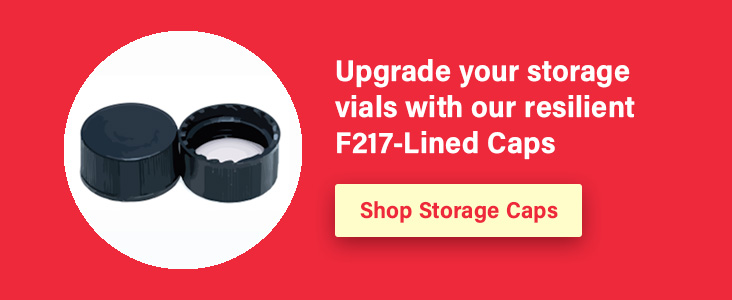
A top recommendation is our F217-lined caps, featuring a polyolefin foam sandwiched between two polyethylene layers. The polyethylene offers broad chemical compatibility, while the foam layer allows the cap to be torqued tightly (up to 20 lbs. of foot pressure) and then rebound to its original shape once loosened, maintaining a reliable seal over time.
For analytical work, PTFE/silicone septa remain the standard choice. The PTFE layer adds chemical inertness to prevent contamination, while the silicone provides resealability. Optional slit septa allow easier autosampler needle penetration, ideal for repeated injections or high-throughput workflows.
Other Specialty Vial Types
Beyond standard HPLC and GC vials, Chrom Tech offers a wide variety of specialty vials for unique applications—including environmental testing, PFAS analysis, and ultra-clean low adsorption vials for trace-level detection. Accessories such as vial racks, crimpers, and decappers are also available. If you’re unsure which vial system best fits your needs, our experienced product specialists are always ready to assist.
Explore the science behind vial selection. Visit the Chromatography Vials hub to learn more.