
Bio SEC-3
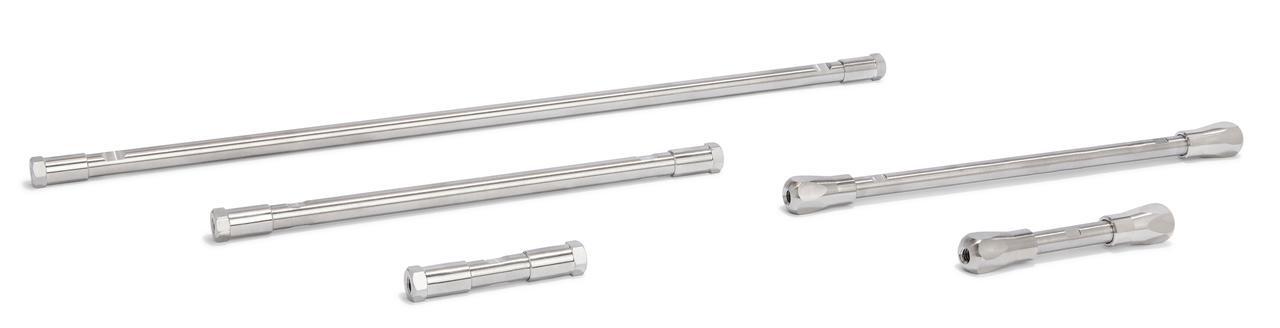
Agilent Bio SEC-3 Columns
Agilent Bio SEC-3 columns are designed for high-resolution size exclusion chromatography of proteins, peptides, and biomolecular complexes—especially when pairing SEC with mass spectrometry (SEC-MS). Built on 3 µm, high-efficiency silica particles, Bio SEC-3 columns deliver sharp, symmetrical peaks and exceptional separation of monomers, aggregates, and fragments.
Engineered for modern bioanalysis, Bio SEC-3 columns are fully compatible with denaturing organic/aqueous mobile phases commonly used in SEC-MS workflows, providing reliable performance whether operating with low-salt MS-friendly conditions or higher-salt SEC buffers. Their mechanical robustness and optimized pore structure enable accurate, reproducible molecular-weight determinations across a wide range of biotherapeutic modalities—including mAbs, ADCs, peptides, and other next-generation biologics.
With full scalability from analytical to preparative dimensions, Bio SEC-3 columns support method development, routine QC, and high-throughput characterization on any LC/MS platform. For labs requiring sensitivity, reproducibility, and dependable molecular-size profiling, Agilent Bio SEC-3 delivers industry-leading performance and confidence.
Agilent Bio SEC-3 columns are high-efficiency size exclusion chromatography (SEC) columns packed with 3 µm silica particles and a hydrophilic diol surface. They are engineered for high-resolution separation of proteins, peptides, monoclonal antibodies, and aggregates under aqueous conditions.
- You need high-resolution aggregate analysis
- You require improved efficiency with 3 µm particles
- You analyze proteins, mAbs, fragments, or biosimilars
- You need reproducible QC performance with minimal adsorption
Compared to polymer-based SEC columns, Bio SEC-3 provides the efficiency advantages of small-particle silica. The diol-bonded surface minimizes secondary interactions while maintaining robust performance in standard aqueous buffer systems.
| Separation Mode | Size Exclusion Chromatography (SEC) |
| Particle Size | 3 µm |
| Surface Chemistry | Hydrophilic diol-bonded silica |
| Pore Sizes Available | Optimized for proteins, peptides, and monoclonal antibodies (varies by molecular weight range) |
| Mobile Phase | Aqueous buffers (phosphate, saline, or compatible systems) |
| Primary Applications | Aggregate quantitation, fragment analysis, biosimilar comparison, protein purity assessment |
Practical note: Maintaining proper ionic strength in the mobile phase is essential to suppress ionic interactions and ensure true size-based separation.
Product List
| SKU | Name | LC Column Phase | Particle Size | Inner Diameter (ID) | Length |
|---|---|---|---|---|---|
SKU
5190-6856
|
Name
5190-6856 - Agilent SEC-3,300A,21.2x50mm
|
LC Column Phase
SEC
|
Particle Size
3 um
|
Inner Diameter (ID)
21.2 mm
|
Length
50 mm
|
SKU
5190-6855
|
Name
5190-6855 - Agilent SEC-3,150A,21.2x50mm
|
LC Column Phase
SEC
|
Particle Size
3 um
|
Inner Diameter (ID)
21.2 mm
|
Length
50 mm
|
SKU
5190-6854
|
Name
5190-6854 - Agilent SEC-3,100A,21.2x50mm
|
LC Column Phase
SEC
|
Particle Size
3 um
|
Inner Diameter (ID)
21.2 mm
|
Length
50 mm
|
SKU
5190-6852
|
Name
5190-6852 - Agilent SEC-3,300A,21.2x300mm
|
LC Column Phase
SEC
|
Particle Size
3 um
|
Inner Diameter (ID)
21.2 mm
|
Length
300 mm
|
SKU
5190-6851
|
Name
5190-6851 - Agilent SEC-3,150A,21.2x300mm
|
LC Column Phase
SEC
|
Particle Size
3 um
|
Inner Diameter (ID)
21.2 mm
|
Length
300 mm
|
SKU
5190-6850
|
Name
5190-6850 - Agient Bio SEC-3 100A, 21.2x300mm
|
LC Column Phase
SEC
|
Particle Size
3 um
|
Inner Diameter (ID)
21.2 mm
|
Length
300 mm
|
SKU
5190-6848
|
Name
5190-6848 - Agilent Bio SEC-3, 300A, 4.6x50mm, guard
|
LC Column Phase
SEC
|
Particle Size
3 um
|
Inner Diameter (ID)
4.6 mm
|
Length
50 mm
|
SKU
5190-6847
|
Name
5190-6847 - Agilent Bio SEC-3, 150A, 4.6x50mm, guard
|
LC Column Phase
SEC
|
Particle Size
3 um
|
Inner Diameter (ID)
4.6 mm
|
Length
50 mm
|
SKU
5190-6846
|
Name
5190-6846 - Agilent Bio SEC-3, 100A, 4.6x50mm, guard
|
LC Column Phase
SEC
|
Particle Size
3 um
|
Inner Diameter (ID)
4.6 mm
|
Length
50 mm
|
SKU
5190-2504
|
Name
5190-2504 - Agilent SEC-3, 100A, 4.6x150mm
|
LC Column Phase
SEC
|
Particle Size
3 um
|
Inner Diameter (ID)
4.6 mm
|
Length
150 mm
|
SKU
5190-2503
|
Name
5190-2503 - Bio SEC-3, 100A 4.6x300mm, 3um Column
|
LC Column Phase
SEC
|
Particle Size
3 um
|
Inner Diameter (ID)
4.6 mm
|
Length
300 mm
|
SKU
5190-2502
|
Name
5190-2502 - Agilent SEC-3, 100A, 7.8x150mm
|
LC Column Phase
SEC
|
Particle Size
3 um
|
Inner Diameter (ID)
7.8 mm
|
Length
150 mm
|