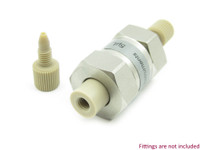
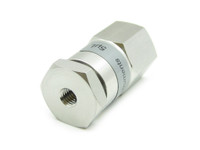
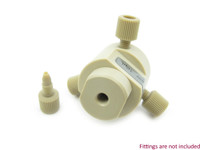
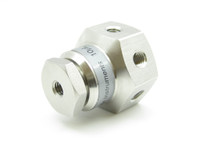
ASI Static Mixers
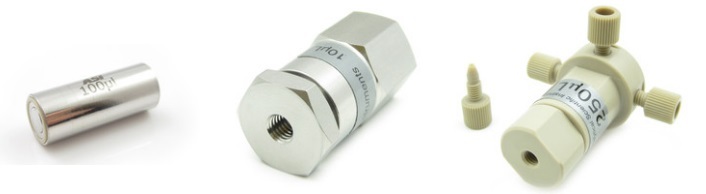
- Interchangeable mixer cartridges for flexible volume selection
- Optimized mixing efficiency to improve gradient performance
- Available in in-line, binary, and ternary configurations
- Offered in stainless steel or PEEK constructions
- Enhanced reaction efficiency for post-column derivatization
ASI Static Mixers are engineered to address the most demanding high-pressure mixing challenges encountered in modern chromatography. Featuring advanced internal geometries, ASI mixers deliver consistent, reproducible solvent blending across a wide range of flow rates, making them ideal for UHPLC, analytical HPLC, and reaction-based workflows.
ASI’s proprietary HyperShear™ mixing technology employs a highly efficient cross-flow shearing mechanism that generates vortex-based mixing rather than relying on conventional packed beds or tortuous flow paths. This design typically provides 25% to 200% greater mixing efficiency compared to traditional static mixers, resulting in smoother gradients and improved chromatographic fidelity.
Within each mixer flow series, interchangeable mixer cartridges allow users to fine-tune mixing volume without replacing the entire assembly. This modular approach simplifies optimization while reducing cost and downtime. In contrast, UHPLC mixers are factory-tested and pressure-rated as complete assemblies, ensuring reliable performance at pressures up to 18,000 PSI.
Selecting the appropriate static mixer involves balancing delay volume, mixing noise, gradient accuracy, and overall chromatographic performance. ASI Static Mixers provide the flexibility and performance needed to achieve optimal results across a broad range of applications.
| INLINE | BINARY TEE | TERNARY TEE | MIXER CARTRIDGE VOLUME (µL) |
RECOMMENDED FLOW RATES (µL/min) |
REPLACEMENT CARTRIDGE |
|---|---|---|---|---|---|
| SS MICRO FLOW SERIES – COMPLETE ASSEMBLIES (CARTRIDGE & HOUSINGS) | |||||
| 401-0005 | 402-0005 | 403-0005 | 5 | 0 – 5 | 400-0005 |
| 401-0010 | 402-0010 | 403-0010 | 10 | 5 – 10 | 400-0010 |
| 401-0025 | 402-0025 | 403-0025 | 25 | 10 – 20 | 400-0025 |
| PEEK MICRO FLOW SERIES – COMPLETE ASSEMBLIES (CARTRIDGE & HOUSINGS) | |||||
| 401-0005B | 402-0005B | 403-0005B | 5 | 0 – 5 | 400-0005B |
| 401-0010B | 402-0010B | 403-0010B | 10 | 5 – 10 | 400-0010B |
| 401-0025B | 402-0025B | 403-0025B | 25 | 10 – 20 | 400-0025B |
| SS LOW FLOW SERIES – COMPLETE ASSEMBLIES (CARTRIDGE & HOUSINGS) | |||||
| 411-0050 | 412-0050 | 413-0050 | 50 | 20 – 150 | 410-0050 |
| — | ★ 412-0100 | — | 100 | 100 – 250 | 410-0100 |
| 411-0150 | 412-0150 | 413-0150 | 150 | 150 – 500 | 410-0150 |
| 411-0250 | 412-0250 | 413-0250 | 250 | 500+ | 410-0250 |
| PEEK LOW FLOW SERIES – COMPLETE ASSEMBLIES (CARTRIDGE & HOUSINGS) | |||||
| 411-0050B | 412-0050B | 413-0050B | 50 | 20 – 150 | 410-0050B |
| — | ★ 412-0100B | — | 100 | 100 – 250 | 410-0100B |
| 411-0150B | 412-0150B | 413-0150B | 150 | 150 – 500 | 410-0150B |
| 411-0250B | 412-0250B | 413-0250B | 250 | 500+ | 410-0250B |
| SS UHPLC SERIES – COMPLETE ASSEMBLIES (SOLD AS COMPLETE ASSEMBLY ONLY) | |||||
| 401-0005HP | 402-0005HP | 403-0005HP | 5 | 0 – 5 | — |
| 401-0010HP | 402-0010HP | 403-0010HP | 10 | 5 – 10 | — |
| 401-0025HP | 402-0025HP | 403-0025HP | 25 | 10 – 20 | — |
| 411-0050HP | 412-0050HP | 413-0050HP | 50 | 20 – 150 | — |
| 411-0150HP | 412-0150HP | 413-0150HP | 150 | 150 – 500 | — |
| 411-0250HP | 412-0250HP | 413-0250HP | 250 | 500+ | — |
★ Top Seller | Other configurations are available. Please contact Chrom Tech for more information.
- ➜ For any given flow rate, the more the mixing volume the better the mixing, and the lower the baseline noise.
- ➜ The smaller the mixing volume, the better the definition and sharpness of linear gradients.
- ➜ Multi-pump high pressure gradient systems typically require far less mixing volume than low pressure single pump systems when running linear gradients.
- ➜ An ASI 150 µL in-line static mixer can be added in addition to the standard onboard mixer to further reduce mixing noise.