
AdvanceBio Glycan Mapping
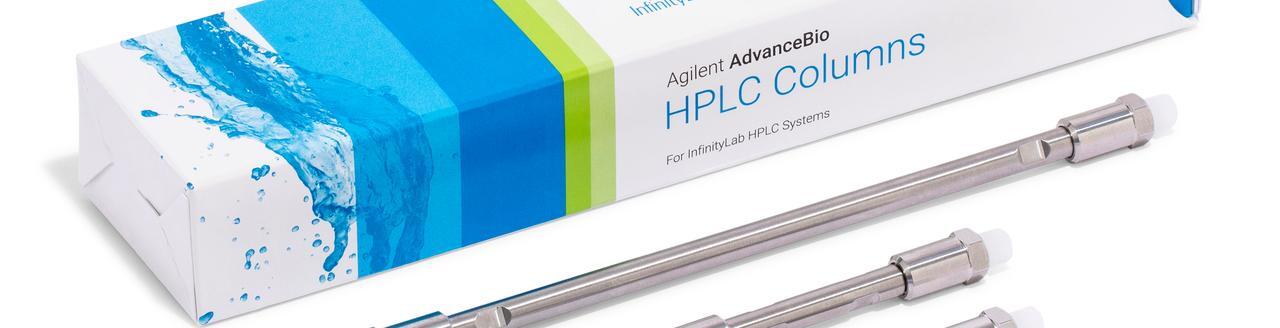
Agilent AdvanceBio Glycan Mapping
The Agilent AdvanceBio Glycan Mapping column family is engineered specifically for fast, high-resolution profiling of released glycans in biopharmaceutical development and quality control. Built on advanced particle technologies, these columns deliver exceptional efficiency, sharp peak shape, and highly reproducible migration patterns—allowing analysts to confidently monitor glycosylation changes that directly impact drug safety, efficacy, and stability.
- Ultra-fast analysis — Generate detailed glycan maps in under 10 minutes to accelerate characterization and lot-release workflows.
- High-resolution structural insight — Precisely resolve both labeled and unlabeled glycans to detect subtle shifts caused by culture conditions, purification steps, or formulation changes.
- Flexible particle technologies — 2.7 µm superficially porous particles (SPP) provide high resolution with lower backpressure, ensuring compatibility with virtually all LC systems. 1.8 µm fully porous particles (FPP) deliver maximum resolving power for UHPLC workflows requiring the highest separation efficiency.
- Lot-to-lot reproducibility — Each column is QA-tested using a 2-AB–labeled IgG N-linked glycan sample to ensure consistent retention, selectivity, and glycan pattern fidelity.
Optimized for biopharma, biosimilars, vaccine development, and glycoprotein characterization, the AdvanceBio Glycan Mapping portfolio enables confident, quantitative profiling across development and QC environments.
For help selecting the ideal particle format or method setup, contact Chrom Tech’s technical support team.
AdvanceBio Glycan Mapping Amide HILIC is specifically engineered for high-resolution separation of released and labeled glycans. The amide stationary phase supports hydrophilic interaction chromatography (HILIC), providing strong retention and excellent resolution of structurally similar N-linked and O-linked glycans.
When to Choose This Phase
- 2-AB, 2-AA, RFMS, or other fluorescently labeled glycan analysis
- High-resolution N-glycan profiling
- Glycoform characterization of monoclonal antibodies
- Biosimilar comparison and batch-to-batch QC testing
How It Works
In HILIC mode, glycans are retained based on hydrophilicity and hydrogen-bonding interactions. The amide functionality provides consistent retention and selectivity, enabling reliable separation of high-mannose, complex, hybrid, and sialylated glycan structures.
Key Specifications
| Separation Mode | Hydrophilic Interaction Chromatography (HILIC) |
| Bonded Phase | Amide |
| Application Focus | Released & labeled glycan mapping |
| Compatibility | FLD, MS, and LC/MS workflows |
| Typical Use | Biotherapeutic glycan profiling & QC |
Product List
| SKU | Name | LC Column Phase | Particle Size | Inner Diameter (ID) | Length |
|---|---|---|---|---|---|
SKU
858700-913
|
Name
858700-913 - AdvanceBio Glycan Map 2.1x100, 1.8um
|
LC Column Phase
Amide HILIC
|
Particle Size
1.8 um
|
Inner Diameter (ID)
2.1 mm
|
Length
100 mm
|
SKU
859700-913
|
Name
859700-913 - AdvanceBio Glycan Map 2.1x150, 1.8um
|
LC Column Phase
Amide HILIC
|
Particle Size
1.8 um
|
Inner Diameter (ID)
2.1 mm
|
Length
150 mm
|
SKU
821725-906
|
Name
821725-906 - AdvanceBio Glycan Map 2.1mm, 2.7um fast guard
|
LC Column Phase
Amide HILIC
|
Particle Size
2.7 um
|
Inner Diameter (ID)
2.1 mm
|
Length
5 mm
|
SKU
821725-905
|
Name
821725-905 - AdvanceBio Glycan Map 2.1mm, 1.8um fast guard
|
LC Column Phase
Amide HILIC
|
Particle Size
1.8 um
|
Inner Diameter (ID)
2.1 mm
|
Length
5 mm
|
SKU
683775-913
|
Name
683775-913 - AdvanceBio Glycan Map 2.1x150, 2.7um
|
LC Column Phase
Amide HILIC
|
Particle Size
2.7 um
|
Inner Diameter (ID)
2.1 mm
|
Length
150 mm
|
SKU
680975-913
|
Name
680975-913 - AdvanceBio Glycan Map 4.6x250, 2.7um
|
LC Column Phase
Amide HILIC
|
Particle Size
2.7 um
|
Inner Diameter (ID)
4.6 mm
|
Length
250 mm
|
SKU
685975-913
|
Name
685975-913 - AdvanceBio Glycan Map 4.6x100, 2.7um
|
LC Column Phase
Amide HILIC
|
Particle Size
2.7 um
|
Inner Diameter (ID)
4.6 mm
|
Length
100 mm
|
SKU
685775-913
|
Name
685775-913 - AdvanceBio Glycan Map 2.1x100, 2.7um
|
LC Column Phase
Amide HILIC
|
Particle Size
2.7 um
|
Inner Diameter (ID)
2.1 mm
|
Length
100 mm
|
SKU
683975-913
|
Name
683975-913 - AdvanceBio Glycan Map4.6x150, 2.7um
|
LC Column Phase
Amide HILIC
|
Particle Size
2.7 um
|
Inner Diameter (ID)
4.6 mm
|
Length
150 mm
|
SKU
651750-913
|
Name
651750-913 - AdvanceBio Glycan Map 2.1x250, 2.7um
|
LC Column Phase
Amide HILIC
|
Particle Size
2.7 um
|
Inner Diameter (ID)
2.1 mm
|
Length
250 mm
|