
ZORBAX 80Å StableBond
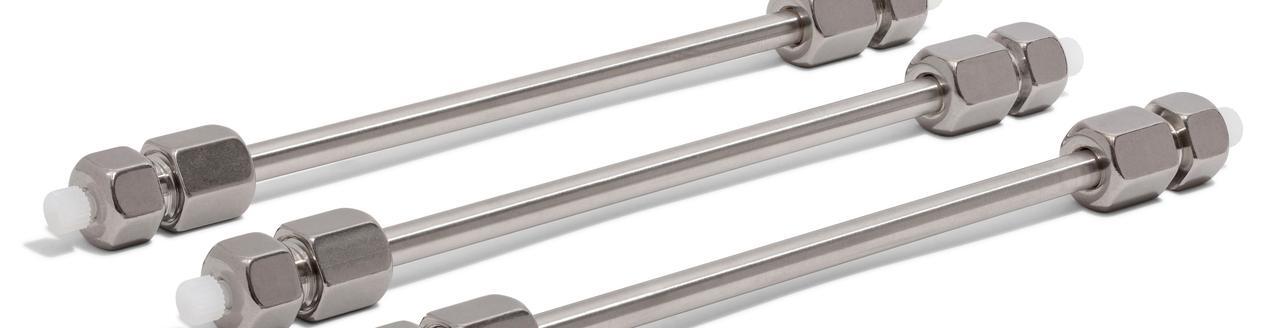
Agilent ZORBAX 80Å StableBond HPLC Columns
- Industry-leading stability at low pH — engineered for long, reliable lifetimes in acidic mobile phases down to pH 1.
- Patented sterically protected siloxane bond delivers rugged performance under high temperature and harsh acidic conditions.
- Six bonded phases (SB-C18, SB-C8, SB-CN, SB-Phenyl, SB-C3, SB-Aq) provide broad selectivity for method development.
- High-purity Type B silica ensures sharp peaks, low bleed, and excellent reproducibility.
Agilent ZORBAX 80Å StableBond (SB) columns are the gold standard for low-pH reversed-phase separations. Built with patented nonfunctional silanes featuring bulky di-isobutyl or di-isopropyl side groups, the SB family sterically protects the critical siloxane bond from hydrolysis—ensuring unmatched stability where conventional silica columns rapidly degrade.
Because StableBond phases are not endcapped, they maintain maximum low-pH robustness and deliver highly reproducible retention for acids, bases, and neutrals. This makes the SB series ideal for pharmaceutical assays, stability-indicating methods, impurity profiling, and any workflow requiring extended operation at pH 1–2.
With six selectivity options and reliable performance across a wide range of temperatures and mobile phases, ZORBAX StableBond columns provide a dependable platform for accelerated method development and long-term routine analyses.
For guidance on choosing the best StableBond phase or exploring Chrom Tech’s full LC column portfolio, contact our technical specialists.
ZORBAX 300SB-C3 is a StableBond C3 phase with a 300 Å pore size engineered for large molecules (peptides/proteins) where standard 80 Å pores can restrict mass transfer. The shorter C3 ligand provides reduced hydrophobic retention versus C8/C18, which can improve recovery and peak shape for strongly retained biomolecules.
- Peptides/proteins that show broad peaks or poor recovery on 80 Å phases
- Large analytes where 300 Å pores improve mass transfer and efficiency
- Methods where C18 retention is excessive (need gentler hydrophobic interaction)
Compared to 80 Å SB-C18, 300SB-C3 typically improves performance for larger molecules and can reduce irreversible adsorption. If the target is peptides/proteins (not small molecules), 300 Å is often the correct starting point.
| Separation Mode | Reversed phase (biomolecule-focused) |
| Bonded Phase | C3 (short-chain alkyl), StableBond |
| Pore Size | 300 Å |
| Recommended Analytes | Peptides, proteins, larger biomolecules |
| Typical Particle Sizes | Format dependent (varies by catalog offering) |
| pH / Temperature Guidance | Follow phase- and format-specific limits; StableBond is commonly selected for robust acidic conditions |
Practical tip: for LC-MS peptide mapping, confirm recovery and carryover using a reference digest and a strong wash protocol.
ZORBAX Rx-C8 is a reversed-phase C8 option used when you want reduced retention and faster gradients compared to C18 while maintaining a conventional RP workflow. It is commonly evaluated alongside SB-C8/SB-C18 when optimizing run time and retention without changing separation mode.
- C18 run times are long due to strongly retained hydrophobics
- You need shorter gradients while preserving RP method simplicity
- You want a C8 baseline for screening before switching selectivity (CN/Phenyl)
| Separation Mode | Reversed phase |
| Bonded Phase | C8 (octylsilane) |
| Pore Size | 80 Å |
| Typical Particle Sizes | Format dependent |
| pH / Temperature Guidance | Follow product-specific limits |
Decision rule: if your goal is “shorter run time with minimal selectivity change,” moving from C18 to C8 is typically the first step.
ZORBAX SB-Aq is designed for reversed-phase methods that operate at very high aqueous mobile phases. It is commonly selected to improve retention of polar and early-eluting compounds and to support methods that begin at (or remain at) high water content.
- Polar analytes elute near the void on standard C18/C8
- Methods require high aqueous starting conditions (isocratic or gradient)
- You want more polar retention without switching to HILIC
Compared to SB-C18, SB-Aq is typically the better choice when your method is “too weak” at high water (early elution, compressed polar peaks). If high aqueous content is fundamental to the method, SB-Aq is often the first SB chemistry to evaluate.
| Separation Mode | Reversed phase (aqueous-compatible) |
| Bonded Phase | SB-Aq aqueous-friendly RP ligand |
| Pore Size | 80 Å |
| Typical Use | High-aqueous methods, polar analytes, early-elution control |
| Typical Particle Sizes | Format dependent |
| pH / Temperature Guidance | Follow product-specific limits |
Method tip: keep pH/buffer consistent and allow adequate re-equilibration after gradients—polar retention can be sensitive to small changes in aqueous fraction and ionic strength.
ZORBAX SB-C3 provides a conventional RP workflow with lower hydrophobic retention than SB-C8 or SB-C18. It’s a practical choice when C18 retains too strongly or when you want a gentler alkyl phase while staying in reversed-phase mode.
- Need reduced retention vs C18/C8 to shorten gradients
- Strongly retained hydrophobics require a gentler alkyl phase
- Want simpler adjustment than changing solvents, pH, or buffer system
| Separation Mode | Reversed phase |
| Bonded Phase | C3 (short-chain alkyl), StableBond |
| Pore Size | 80 Å |
| Typical Particle Sizes | Format dependent |
| pH / Temperature Guidance | Follow product-specific limits; SB phases are commonly selected for robust acidic conditions |
ZORBAX SB-C8 is the StableBond C8 option used when you want moderate hydrophobic retention and faster gradients than C18, with predictable RP behavior. It’s a common “middle step” between SB-C3 and SB-C18 during method development.
- SB-C18 retention is too strong; need shorter cycle times
- Want minimal workflow disruption while tuning retention
- Need a practical C8 baseline before switching selectivity (CN/Phenyl)
| Separation Mode | Reversed phase |
| Bonded Phase | C8 (octylsilane), StableBond |
| Pore Size | 80 Å |
| Typical Particle Sizes | Format dependent |
| pH / Temperature Guidance | Follow product-specific limits |
Method tip: speeding a validated C18 method often starts with C8 before changing solvents or buffer chemistry.
ZORBAX SB-C18 is a general-purpose StableBond C18 phase widely used for small-molecule separations. It provides a familiar C18 retention profile and is commonly selected for methods operating in acidic mobile phases where consistent performance and method robustness are required.
- Default RP starting point when strong, broad C18 retention is desired
- QC and impurity profiling methods needing predictable performance
- Method transfer workflows using the same chemistry family
Compared to SB-C8, SB-C18 increases retention for hydrophobic analytes and expands gradient flexibility. If you need an orthogonal selectivity shift (not just more/less retention), consider SB-CN or SB-Phenyl.
| Separation Mode | Reversed phase |
| Bonded Phase | C18 (octadecylsilane), StableBond |
| Pore Size | 80 Å |
| Typical Use | Small molecules, broad RP applicability |
| Typical Particle Sizes | Format dependent |
| pH / Temperature Guidance | Follow product-specific limits; SB phases are commonly selected for robust acidic conditions |
ZORBAX SB-CN is a polar CN phase used to introduce a meaningful selectivity shift from C18/C8. In reversed-phase methods it can improve resolution for polar and mid-polar compounds; it can also be used in normal-phase style conditions during screening when you want a different retention mechanism without moving to HILIC.
- C18/C8 cannot resolve critical pairs and you need different interactions
- Polar/mid-polar analytes need moderate retention and altered selectivity in RP
- Dual-mode flexibility (RP/NP) is useful for method development screening
| Separation Mode | Reversed phase / Normal phase (method dependent) |
| Bonded Phase | Cyanopropyl (CN), StableBond |
| Pore Size | 80 Å |
| Typical Particle Sizes | Format dependent |
| pH / Temperature Guidance | Follow product-specific limits |
Screening tip: CN is often a fast path to orthogonal selectivity while staying compatible with RP-friendly solvents.
ZORBAX SB-Phenyl is selected when aromatic selectivity matters. Phenyl phases provide π–π interactions that can change elution order and improve resolution for aromatics, conjugated systems, and structural isomers—often fixing coelutions seen on C18/C8.
- Aromatic compounds coelute on SB-C18/SB-C8
- Need improved isomer separation or impurity resolution for aromatics
- Want an RP-compatible selectivity shift without changing mode
| Separation Mode | Reversed phase (aromatic selectivity) |
| Bonded Phase | Phenyl, StableBond |
| Pore Size | 80 Å |
| Typical Particle Sizes | Format dependent |
| pH / Temperature Guidance | Follow product-specific limits |
Method tip: if aromatic critical pairs coelute on C18, try Phenyl before altering buffer chemistry—selectivity often improves immediately with minimal method disruption.
Quick selection guide: SB-C18 (default RP) • SB-C8 (faster vs C18) • SB-Aq (high-aqueous/polar retention) • SB-CN (polar selectivity shift) • SB-Phenyl (aromatic selectivity) • SB-C3 (reduced retention) • 300SB-C3 (300 Å for peptides/proteins).
Product List
| SKU | Name | LC Column Phase | Particle Size | Inner Diameter (ID) | Length |
|---|---|---|---|---|---|
SKU
883975-314
|
Name
883975-314 - SB-Aq 3.0 x 150mm 5u
|
LC Column Phase
SB-Aq
|
Particle Size
5 um
|
Inner Diameter (ID)
3 mm
|
Length
150 mm
|
SKU
880975-902
|
Name
880975-902 - SB-C18 Analytical HPLC Column 4.6x250
|
LC Column Phase
SB-C18
|
Particle Size
5 um
|
Inner Diameter (ID)
4.6 mm
|
Length
250 mm
|
SKU
883975-312
|
Name
883975-312 - SB-Phenyl Solvent Saver HPLC Col 3.0x150
|
LC Column Phase
SB-Phenyl
|
Particle Size
5 um
|
Inner Diameter (ID)
3 mm
|
Length
150 mm
|
SKU
880975-314
|
Name
880975-314 - SB-Aq 3.0x250mm 5u
|
LC Column Phase
SB-Aq
|
Particle Size
5 um
|
Inner Diameter (ID)
3 mm
|
Length
250 mm
|
SKU
883975-309
|
Name
883975-309 - SB-C3 Solvent Saver HPLC Col 3.0x150
|
LC Column Phase
SB-C3
|
Particle Size
5 um
|
Inner Diameter (ID)
3 mm
|
Length
150 mm
|
SKU
880975-312
|
Name
880975-312 - SB-Phenyl Solvent Saver HPLC Col 3.0x250
|
LC Column Phase
SB-Phenyl
|
Particle Size
5 um
|
Inner Diameter (ID)
3 mm
|
Length
250 mm
|
SKU
883975-306
|
Name
883975-306 - Rx/SB-C8 Solvent Saver HPLC Col 3.0x150
|
LC Column Phase
Rx-C8
|
Particle Size
5 um
|
Inner Diameter (ID)
3 mm
|
Length
150 mm
|
SKU
880975-309
|
Name
880975-309 - SB-C3 Solvent Saver HPLC Col 3.0 x 250
|
LC Column Phase
SB-C3
|
Particle Size
5 um
|
Inner Diameter (ID)
3 mm
|
Length
250 mm
|
SKU
883975-305
|
Name
883975-305 - SB-CN Solvent Saver HPLC Col 3.0 x 150
|
LC Column Phase
SB-CN
|
Particle Size
5 um
|
Inner Diameter (ID)
3 mm
|
Length
150 mm
|
SKU
880975-306
|
Name
880975-306 - Rx/SB-C8 Solvent Saver HPLC Col 3.0x250
|
LC Column Phase
Rx-C8
|
Particle Size
5 um
|
Inner Diameter (ID)
3 mm
|
Length
250 mm
|
SKU
883975-302
|
Name
883975-302 - SB-C18 Solvent Saver HPLC Col 3.0 x 150
|
LC Column Phase
SB-C18
|
Particle Size
5 um
|
Inner Diameter (ID)
3 mm
|
Length
150 mm
|
SKU
880975-305
|
Name
880975-305 - SB-CN Solvent Saver HPLC Col 3.0 x 250
|
LC Column Phase
SB-CN
|
Particle Size
5 um
|
Inner Diameter (ID)
3 mm
|
Length
250 mm
|