Thermo Scientific

Thermo Fisher Scientific HPLC and UHPLC Columns

Thermo Fisher Scientific offers a focused portfolio of HPLC and UHPLC columns engineered to match real-world separation challenges—from routine method scouting to high-resolution, high-throughput analysis. At a high level, the lineup centers on three core families:

  • Accucore: A solid-core platform built for high-resolution separations with excellent speed and productivity, delivering strong sensitivity while maintaining compatibility with standard HPLC systems.
  • Hypersil GOLD: A fully porous, broadly applicable workhorse family built on decades of innovation—often the go-to choice for fast method development, general analysis, and method scouting across common chemistries.
  • Acclaim: Designed for complicated samples and tougher separations, offering a wider range of chemistries (from classic C18 to mixed-mode) to provide added selectivity and resolving power for complex mixtures.

Together, these families make it easy to choose the right column based on your priority—speed and efficiency (Accucore), method development and general use (Hypersil GOLD), or maximum selectivity for challenging samples (Acclaim).

Quick Guide to Choosing a Phase
C18 Polar Phases Aromatic HILIC
Low to moderate
complexity sample
Fully porous Hypersil GOLD columns Hypersil GOLD aQ columns Hypersil GOLD PFP columns Hypersil GOLD HILIC columns
Solid core Accucore RP-MS columns Accucore aQ columns Accucore Phenyl-Hexyl columns Accucore HILIC columns
Moderate to high
complexity sample
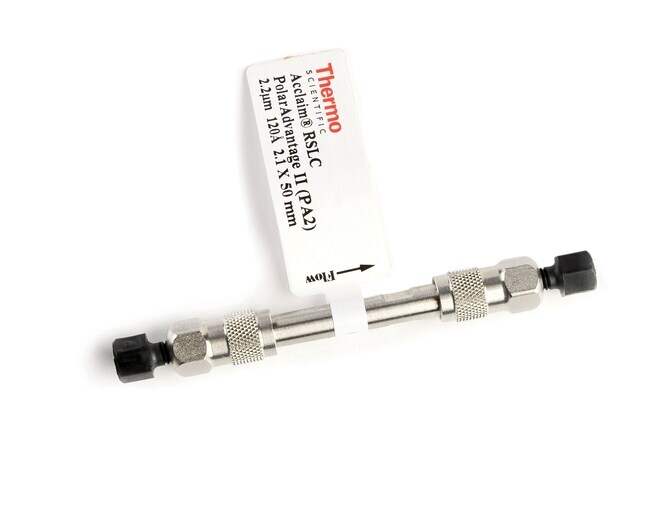
Fully porous Acclaim 120 C18 columns Acclaim Polar Advantage II columns Acclaim Phenyl-1 columns Acclaim HILIC-10 columns
Solid core Accucore C18 columns Accucore Polar Premium columns Accucore Biphenyl columns Accucore Amide-HILIC columns
Columns Overview
Reversed-Phase HILIC / Normal Phase Ion-Exchange Specialty Phases
Accucore
U(HPLC) columns
C18, C18+, C8, C4, aQ, Polar Premium, RP-MS, Biphenyl, Phenyl-Hexyl, Phenyl-X, PFP, C30, XL C18, XL C8 HILIC, Urea HILIC, Amide HILIC
Hypersil GOLD
U(HPLC) columns
C18, C8, C4, aQ, PFP, Phenyl, Peptide Cyano (CN), Amino, Silica, HILIC AX, SAX
Acclaim
U(HPLC) columns
C18, C8, PA, PA2, Phenyl-1, C30 HILIC-10, Mixed-Mode HILIC-1 Trinity P1, Trinity P2, Mixed-Mode WAX-1, Mixed-Mode WCX-1 SEC, AmG C18, Organic Acids, Surfactant, Surfactant Plus, Explosives E2, Trinity Q1, Carbamate, Carbonyl C18

Thermo Scientific HPLC & UHPLC Column Families

Thermo Scientific HPLC and UHPLC columns are organized into three core families, allowing fast selection based on performance requirements, method development needs, and sample complexity.


Key Definitions
Solid-Core (Core-Shell) Particles
Chromatography particles consisting of a solid, nonporous core surrounded by a thin porous shell. This design improves efficiency and sensitivity while reducing backpressure compared to fully porous particles.
Fully Porous Particles
Traditional chromatography particles with pores throughout the entire particle structure. Fully porous columns are widely used for method development, routine analysis, and regulated applications.
Reversed-Phase Chromatography
A separation mode that uses a nonpolar stationary phase (such as C18 or C8) with a polar mobile phase. Reversed-phase chromatography is the most common technique for small-molecule, pharmaceutical, and LC-MS analyses.
HILIC (Hydrophilic Interaction Liquid Chromatography)
A chromatographic mode designed for polar and highly hydrophilic compounds, using a polar stationary phase and a high-organic mobile phase. HILIC is commonly used for metabolites, carbohydrates, and polar pharmaceuticals.
Mixed-Mode Chromatography
A separation technique that combines multiple interaction mechanisms—such as reversed-phase and ion exchange— within a single stationary phase to improve selectivity for complex or challenging samples.
UHPLC Compatibility
The ability of a column to operate at higher pressures and with smaller particle sizes, enabling faster run times, improved resolution, and higher throughput compared to traditional HPLC methods.
Frequently Asked Questions
Which Thermo column family should I start with?
For most reversed-phase methods, start with Hypersil GOLD for broad applicability and fast method development. Choose Accucore when you need higher efficiency and faster runs (solid-core performance), and choose Acclaim when you need added selectivity for complex samples, challenging matrices, or mixed-mode separations.
What is the difference between solid-core and fully porous particles?
Solid-core (core-shell) particles reduce diffusion distances, often improving efficiency and sensitivity while keeping backpressure manageable—ideal for fast, high-resolution separations. Fully porous particles are a widely used standard for routine and regulated methods and are available across a broad range of chemistries and dimensions.
When should I choose C18 vs. a polar-embedded or aromatic phase?
C18 is the default starting point for most reversed-phase methods. Use polar-embedded or aqueous-compatible phases (aQ / Polar Advantage style) for more polar analytes or high-water mobile phases. Choose aromatic phases (phenyl/phenyl-hexyl/biphenyl) for compounds with aromatic rings or when you need alternative selectivity versus C18.
What is HILIC, and when is it a better choice than reversed-phase?
HILIC is designed for very polar compounds that show little retention in reversed-phase. It uses a polar stationary phase and high-organic mobile phases to improve retention and separation of polar analytes such as metabolites, carbohydrates, and highly hydrophilic pharmaceuticals.
How do I choose column dimensions (ID and length)?
Smaller IDs (e.g., 2.1 mm) are common for UHPLC and LC/MS to reduce solvent use and improve sensitivity. Longer columns generally increase resolution, while shorter columns increase speed. A practical starting point is 2.1 × 100 mm for balanced performance, or 2.1 × 50 mm for faster screening.
Can I move a method from HPLC to UHPLC without changing selectivity?
Often, yes—keep the same stationary phase chemistry (e.g., C18 to C18) and scale dimensions and particle size appropriately. Selectivity is primarily driven by phase chemistry, while UHPLC formats improve speed and efficiency. Verify pressure limits, dwell volume effects, and system dispersion when transferring methods.
Explore HPLC Columns
Shop HPLC Columns
Explore all column families, modes, applications, and resources in the full pillar guide.