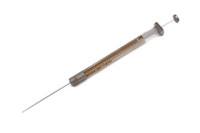
Syringes for Shimadzu
Hamilton Syringes for Shimadzu GC Autosamplers
Platform-specific GC syringe options for 43 mm and 51 mm Shimadzu autosampler requirements, repeatable injections, and dependable performance

Hamilton syringes for Shimadzu GC autosamplers are designed for accurate, repeatable sample introduction across Shimadzu gas chromatography platforms with different autosampler needle-length requirements. Chrom Tech supplies Hamilton syringes as an authorized distributor, helping laboratories select the correct syringe configuration for Shimadzu systems that require either 43 mm needle lengths or standard 51 mm needle lengths. These syringes are built for dependable fit, consistent injection performance, and long service life in GC workflows where the syringe must match the autosampler geometry precisely.
Shimadzu GC syringe selection depends on more than volume alone. Needle length is one of the most important platform-specific requirements in this category, because an incorrect length can affect autosampler movement, injector access, and overall injection consistency. Hamilton offers a wide variety of Shimadzu-compatible syringes designed specifically around these mechanical requirements, making it easier for laboratories to choose a syringe that matches the actual Shimadzu autosampler setup rather than adapting a general-purpose GC syringe.
Why Hamilton Syringes for Shimadzu GC Autosamplers Are Used
In gas chromatography, syringe fit and injection repeatability directly affect data quality and daily instrument reliability. A properly matched GC autosampler syringe helps the system aspirate, transport, and inject sample with minimal variation from run to run. Hamilton syringes for Shimadzu GC autosamplers are used because they are designed around the dimensional and operational requirements of Shimadzu autosampler platforms, helping support reliable mechanical alignment and more consistent chromatographic performance.
This matters especially in the Shimadzu category because autosampler configurations may require different needle lengths depending on the instrument design. Some Shimadzu autosamplers require 43 mm needle lengths, while others use the more common 51 mm format. By separating these configurations within the Shimadzu category, Hamilton makes syringe selection more practical and helps laboratories avoid mismatched syringe geometry that could reduce performance or service life.
Built for 43 mm and 51 mm Shimadzu Needle-Length Requirements
Hamilton’s Shimadzu GC autosampler syringe offering is centered on compatibility with autosamplers that require either 43 mm needle lengths or standard 51 mm needle lengths. This distinction is one of the defining features of the category and is critical when matching the syringe to the autosampler. A correctly sized needle helps the syringe reach the injector properly, align with the autosampler motion, and perform more consistently over repeated cycles.
Because these dimensional requirements are platform-specific, the correct Shimadzu syringe should be selected based on the actual autosampler design rather than by syringe volume alone. Hamilton’s Shimadzu-compatible syringe range helps laboratories align syringe choice with both the instrument mechanics and the intended GC method, supporting smoother operation and more dependable day-to-day use.
Designed for Repeatability, Durability, and GC Workflow Fit
For chromatography laboratories, the correct GC autosampler syringe must support more than simple sample transfer. It must deliver repeatable injections, maintain compatibility with the autosampler mechanism, and provide the durability needed for repeated cycling. Hamilton syringes for Shimadzu GC autosamplers are designed to support these demands, helping laboratories maintain accurate sample introduction across routine analytical work, quality control testing, and other GC methods.
Because Shimadzu GC workflows can differ by autosampler design and injection setup, syringe selection is most effective when it is tied directly to the instrument platform. A properly matched Hamilton syringe helps reduce avoidable downtime, supports consistent injection repeatability, and gives laboratories greater confidence in routine Shimadzu GC operation. For users running compatible Shimadzu autosamplers, these syringes provide a practical, platform-specific solution for reliable gas chromatography sample introduction.