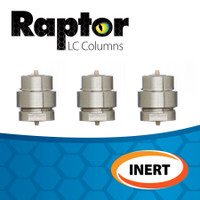
Raptor LC Columns

Restek Raptor LC Columns

Restek Raptor LC Columns utilize advanced core-shell (superficially porous particle) technology to deliver fast, high-efficiency separations with reduced backpressure. Designed for modern UHPLC and HPLC systems, Raptor columns provide sharp peak shapes, improved sensitivity, and rugged durability across diverse analytical workflows.

Advanced Core-Shell Performance

The superficially porous particle design minimizes band broadening and enhances mass transfer kinetics, producing superior peak capacity and consistent performance—even under demanding gradient conditions. Many laboratories achieve UHPLC-level efficiency on conventional HPLC systems.

Wide Phase Selectivity

The Raptor family includes multiple bonded phases tailored for reversed-phase, polar analyte, pharmaceutical, food safety, environmental, and clinical applications—supporting flexible method development and reproducible results.

Durable & Reproducible

Built with high-quality silica and robust bonding chemistry, Raptor LC columns offer extended column lifetime and dependable lot-to-lot consistency, maintaining stable retention and resolution across challenging sample matrices.

Chrom Tech supplies Restek Raptor LC Columns in a broad range of dimensions and particle sizes to support analytical and high-throughput laboratories. Our team can assist with phase selection and method optimization to ensure optimal chromatographic performance.

Raptor LC Phases — Expand/Collapse All

Key Definitions
Superficially Porous Particles (SPP / Core-Shell)
LC particle technology featuring a solid core with a porous outer shell. This design reduces band broadening, improves efficiency, and allows faster separations with lower backpressure compared to fully porous particles.
USP Phase Classification (L1, L11, L43)
United States Pharmacopeia (USP) designations that categorize stationary phase chemistry. L1 typically refers to C18 (octadecylsilane), L11 to phenyl phases, and L43 to pentafluorophenyl (PFP) phases.
Core-Shell Efficiency
The enhanced chromatographic performance achieved through improved mass transfer and reduced eddy diffusion in core-shell particles, resulting in sharper peaks and higher resolution.
Orthogonal Selectivity
A different retention mechanism or interaction profile compared to a standard C18 column, often used to improve separation of challenging analytes during method development.
HILIC (Hydrophilic Interaction Liquid Chromatography)
A chromatographic mode used to retain and separate highly polar compounds. HILIC typically uses high organic mobile phase content and provides complementary selectivity to reversed-phase chromatography.
LC-MS Compatibility
Column chemistry and mobile phase conditions optimized to minimize ion suppression, improve analyte response, and maintain stable performance when coupled with mass spectrometry detection.
Frequently Asked Questions
What advantages do Raptor core-shell particles provide?
Raptor LC columns use superficially porous (core-shell) particles that improve mass transfer efficiency and reduce band broadening. This produces sharper peaks, higher resolution, and faster separations compared to traditional fully porous particles.
Which Raptor phase should I choose for LC-MS/MS applications?
ARC-18 is optimized for low-pH LC-MS methods, Biphenyl enhances retention of aromatic and conjugated analytes, FluoroPhenyl offers orthogonal selectivity and improved retention of basic compounds, Polar X targets highly polar analytes, and EtG/EtS is purpose-built for toxicology workflows.
Are Raptor LC columns compatible with both HPLC and UHPLC systems?
Yes. Raptor columns are available in 1.8 µm, 2.7 µm, and 5 µm particle sizes. The 2.7 µm core-shell format often delivers UHPLC-like performance at pressures compatible with many conventional HPLC systems.
What pH range can Raptor LC columns tolerate?
Most Raptor LC columns operate within a pH range of 2.0–8.0. ARC-18 extends down to pH 1.0 for highly acidic mobile phases. Always confirm operating limits for the specific phase and particle size.
When should I use HILIC-based Raptor phases instead of reversed-phase columns?
Choose HILIC-Si or Polar X when highly polar or small hydrophilic compounds exhibit poor retention on reversed-phase columns. These phases increase retention without relying on ion-pairing reagents and are well suited for LC-MS detection.