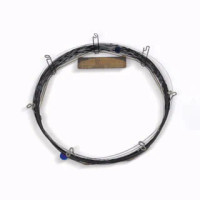
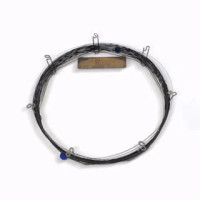
PLOT Columns

Agilent PLOT GC Columns
Agilent Porous Layer Open Tubular (PLOT) GC columns deliver highly efficient solid-gas separations for
light hydrocarbons, permanent gases, and other small volatile molecules. Engineered for applications
requiring strong retention and sharp peak shapes for low-molecular-weight analytes, PLOT columns provide
excellent resolution, stability, and performance across a wide range of industrial, petrochemical,
environmental, and refinery workflows.
Unlike conventional GC columns, PLOT columns use a porous adsorbent layer bonded to the column wall, enabling selective interactions ideal for fixed gases, C1–C5 hydrocarbons, solvents, and trace-level impurities. Agilent J&W PLOT columns incorporate advanced particle-trapping technology that prevents stationary-phase particle shedding—a common issue that can lead to detector contamination, flow restriction, leaks, and instrument downtime.
This integrated PLOT particle-trap design protects the GC system without the need for external traps, reducing maintenance, extending column lifetime, and improving overall system reliability. With rugged construction, tight manufacturing tolerances, and industry-leading inertness, Agilent PLOT GC columns deliver reproducible performance and high-quality separations for both routine and demanding gas-phase analyses.
Unlike conventional GC columns, PLOT columns use a porous adsorbent layer bonded to the column wall, enabling selective interactions ideal for fixed gases, C1–C5 hydrocarbons, solvents, and trace-level impurities. Agilent J&W PLOT columns incorporate advanced particle-trapping technology that prevents stationary-phase particle shedding—a common issue that can lead to detector contamination, flow restriction, leaks, and instrument downtime.
This integrated PLOT particle-trap design protects the GC system without the need for external traps, reducing maintenance, extending column lifetime, and improving overall system reliability. With rugged construction, tight manufacturing tolerances, and industry-leading inertness, Agilent PLOT GC columns deliver reproducible performance and high-quality separations for both routine and demanding gas-phase analyses.