

Understanding the Labeling Difference
If you’ve ever shopped for autosampler vials, you’ve probably noticed both 1.5 mL and 2.0 mL options that look almost identical. The difference is often misunderstood—even among experienced chromatographers. In practice, these vials share the same external dimensions: a 12 x 32 mm autosampler vial. The distinction lies in how manufacturers define volume.
A 1.5 mL vial typically refers to the working fill volume—the realistic amount you’d fill during sample preparation. A 2.0 mL vial reflects the total physical capacity of that same vial. In other words, it’s not about size—it’s about labeling convention.
The Industry Reality
Both vial types follow the standard 12 × 32 mm vial format used in most HPLC and GC autosamplers. The true difference lies in volume definition:
- 1.5 mL vial – represents the recommended working fill, typically around 1.5 mL.
- 2.0 mL vial – represents the total fill capacity, which should not be reached in practice.
Because chromatographers rarely fill a vial completely (to maintain headspace and prevent carryover), the usable fill remains about 1.5 mL for both types.
Quick Comparison
| Feature | 1.5 mL Vial (Labeled) | 2.0 mL Vial (Labeled) |
|---|---|---|
| Typical Dimensions | 12 × 32 mm | 12 × 32 mm |
| Total Capacity | ≈ 2.0 mL | ≈ 2.0 mL |
| Usable Fill Volume | ≈ 1.5 mL | ≈ 1.5 mL |
| Manufacturer Definition | Working volume | Total capacity |
| Common Use | HPLC, UHPLC, GC | HPLC, UHPLC, GC |
Both vials share identical dimensions—the label simply reflects different volume definitions.
Why the Two Labels Exist
The naming difference stems from historical manufacturer preferences. Early suppliers referenced usable volume (1.5 mL), while later ones emphasized total capacity (2.0 mL). Both standards persist, but functionally, the vials are identical and interchangeable.
Limited-Volume Vials
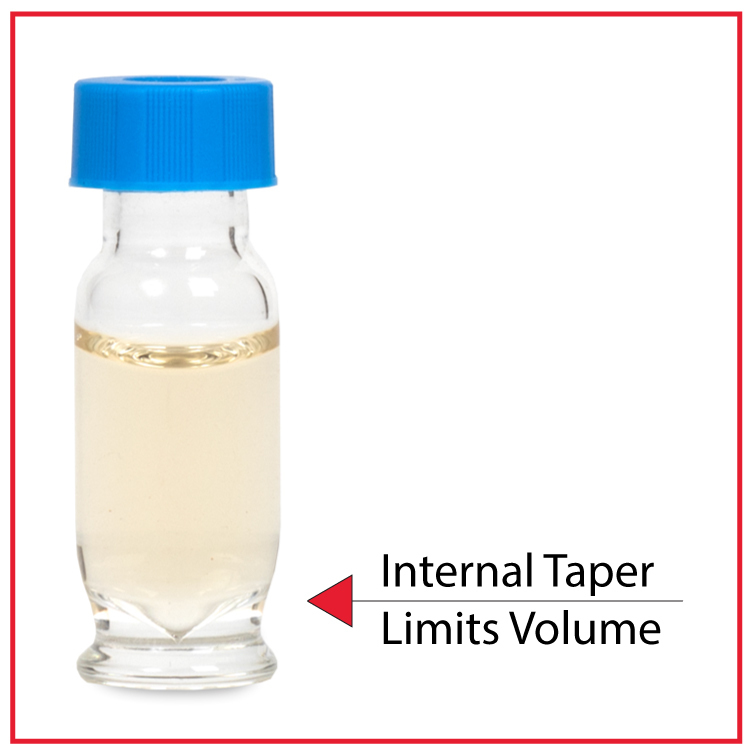
Limited-volume or micro-volume vials are the true exceptions, featuring smaller internal capacities (0.3–1.2 mL) or fitted glass inserts for sample recovery. For trace analysis or small sample sizes, vial inserts are recommended to minimize sample loss and maximize recovery.
Filling Best Practices
Even though a 2.0 mL vial can hold its full capacity, you should typically fill only 1.2–1.5 mL. This prevents overflow, septa compression, and sample carryover. A small headspace also allows pressure equalization and supports cleaner injections.
- Do not fill to the brim. Use ~1.2–1.5 mL fill to preserve headspace.
- Headspace reduces risk of overflow, septa compression, and carryover.
Closure and Material Options
| Closure Type | Description | Best Use |
|---|---|---|
| Screw Thread (9 mm / 10-425) | Reusable, convenient | Routine HPLC & UHPLC |
| Crimp Top (11 mm) | Provides tightest seal | GC & volatile samples |
| Snap Top | Quick, tool-free closure | High-throughput analysis |
Both 1.5 mL and 2.0 mL vials are available in clear or amber borosilicate glass. Clear glass aids visibility, while amber glass protects light-sensitive samples. All are compatible with standard autosampler racks.
Using Vial Inserts
For small-volume applications, glass inserts improve sample recovery and needle access. Choose conical inserts for maximum recovery or flat-bottom inserts for economical use. Always verify insert dimensions to maintain autosampler alignment. For detailed guidance, visit our Vial Insert Selection Guide.
Practical Summary
| Same Outer Size | Both labeled 1.5 mL and 2.0 mL vials are 12 × 32 mm and autosampler-compatible. |
| Label Difference | 1.5 mL = working volume; 2.0 mL = total capacity. |
| Fill Guideline | Fill to ≈ 1.5 mL to allow headspace and avoid overflow. |
| Limited-Volume Vials | Truly smaller capacity vials (0.3–1.2 mL) for low-volume samples. |
| Material Options | Clear or amber borosilicate glass with screw, crimp, or snap closures. |
Bottom Line
Whether labeled 1.5 mL or 2.0 mL, these autosampler vials are the same standard size. The difference reflects manufacturer terminology—not physical design. Both are intended for a working volume of roughly 1.5 mL to support accurate, contamination-free sampling.
Chrom Tech supplies a full range of HPLC, GC, and headspace vials built to exacting specifications for reliable performance and instrument compatibility. Explore our complete selection to find the right fit for your chromatography workflow.
Ready to explore all vial types? Visit our Chromatography Vials Resource Center to compare HPLC, GC, and headspace options in one place.