
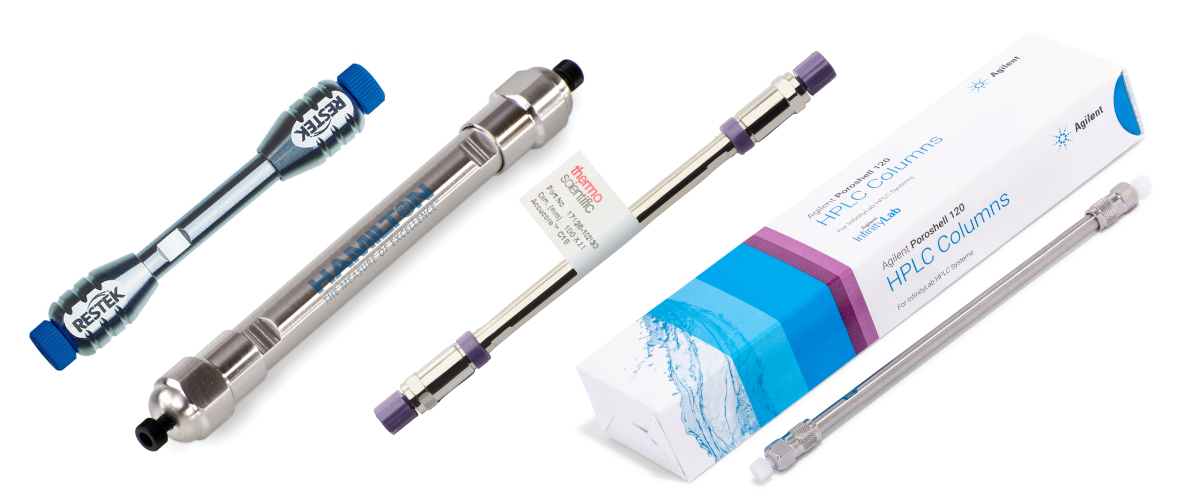
Superficially porous particle (SPP) HPLC columns are one of the most effective ways to achieve high chromatographic efficiency without generating the high backpressure normally associated with sub-2-µm fully porous columns. This makes SPP technology especially useful for analysts who want faster separations, sharper peaks, and improved throughput while still working within the pressure limits of conventional HPLC systems.
Poroshell vs. ZORBAX Columns
Agilent’s ZORBAX columns have long been used in chromatography laboratories because of their consistent performance and broad chemistry range. Building on that foundation, Agilent introduced the Poroshell family, which uses superficially porous particle technology while aligning with many established ZORBAX chemistries.
When chromatographers compare Poroshell 120 EC-C18 to ZORBAX Eclipse Plus C18 RRHT, they often observe very similar separations but with substantially lower operating pressure on the Poroshell column. This makes method transfer attractive because existing methods can often be moved over with little disruption while also reducing system wear on pumps and seals.
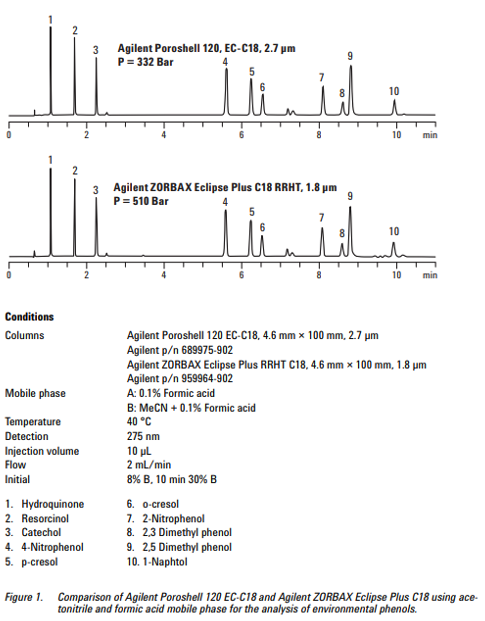
Because the bonding chemistries between the two product lines are similar, method transfer from sub-2-µm fully porous columns to SPP Poroshell columns frequently requires minimal or no changes. Retention behavior, selectivity, and resolution can often be preserved while operating at lower pressure.
Why Switch Columns If the Chemistry Is So Similar?
Even when the bonded phase chemistry is closely aligned, Poroshell columns offer important performance advantages because of their particle structure. Lower operating pressure gives laboratories more flexibility to optimize methods without exceeding instrument limits.
With lower backpressure, analysts may be able to:
- Increase flow rates to improve sample throughput
- Use longer columns to gain higher resolution without exceeding pressure limits
- Reduce long-term mechanical stress on HPLC pumps and seals
For laboratories working on legacy HPLC systems or seeking better productivity without moving to a dedicated UHPLC platform, these advantages make Poroshell columns an appealing upgrade path.
A Closer Look at the Inlet Frit Design
Another important feature of Agilent Poroshell columns is the inlet frit design. Many sub-2-µm columns use inlet frits in the 0.2–0.5 µm range, which can be more prone to clogging, especially when samples contain complex matrices.
Poroshell columns instead use a 2 µm frit, which allows improved flow and lowers the risk of blockage. This contributes to better durability, fewer maintenance interruptions, and a longer useful column lifetime in demanding routine workflows.
Why Poroshell Columns Support Easier Method Transfer
Poroshell columns combine chemistry continuity with lower pressure operation, which is why method transfer is often so practical. Laboratories can frequently move established methods from ZORBAX platforms to Poroshell with only minor optimization of conditions such as flow rate, temperature, or gradient slope.
This approach helps maintain familiar selectivity while improving speed, pressure tolerance, and overall robustness.
Conclusion
As HPLC continues to move toward smaller particles and higher-efficiency separations, Agilent Poroshell 120 columns offer a strong balance of performance, speed, and system compatibility. They deliver high resolution similar to sub-2-µm columns without requiring extreme operating pressure.
For many laboratories, transitioning from fully porous columns to superficially porous Poroshell columns is straightforward and can often be done with minimal method modification. This makes Poroshell columns a practical option for improving throughput, reducing maintenance burden, and extending the useful life of existing HPLC instrumentation.
To learn more about ZORBAX HPLC columns, Poroshell columns, or to connect with a chromatography specialist, visit Chrom Tech.
Source: Agilent White Paper – Transfer of Methods between Poroshell 120 EC-C18 and ZORBAX Eclipse Plus C18 Columns (5990-6588EN)