
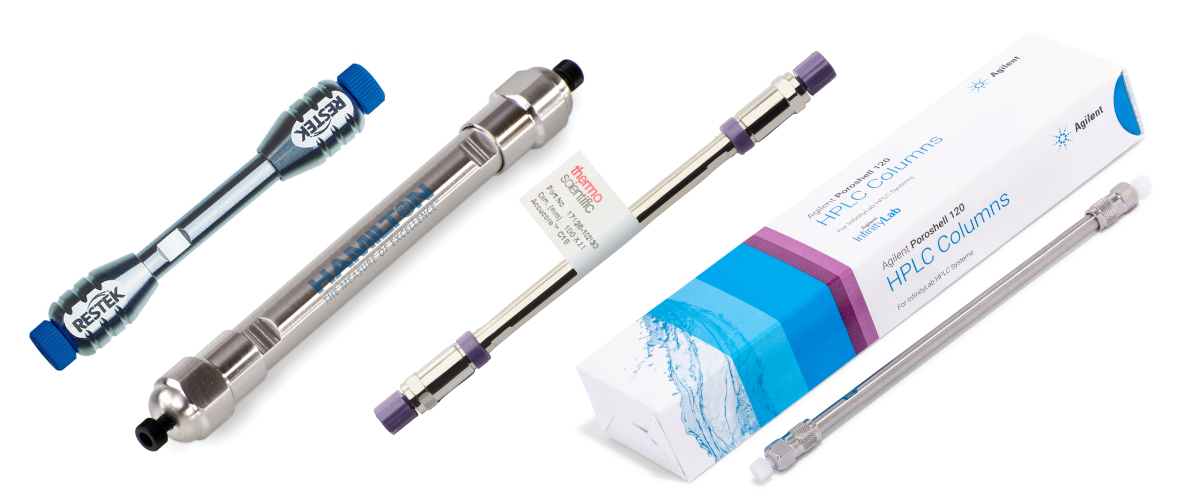
Protecting Your HPLC Columns: The Role of Filters and Guard Columns
In high-performance liquid chromatography (HPLC), protective devices such as inline filters, pre-column filters, and guard columns help prevent column damage and extend column life. Over time, column performance can decline because of irreversibly bound compounds or particulate buildup on the inlet frit. These contaminants may come from mobile phase buffers, pump seal wear, or sample particulates, and they can eventually cause higher backpressure or even complete blockage.
Using the right filtration components helps protect both the instrument and the analytical column by removing contaminants before they can interfere with chromatographic performance.
Inline Filters vs Guard Columns in HPLC
Inline Solvent Filters
Inline solvent filters are designed to trap particles in the mobile phase before those particles can move farther into the system. They are usually installed between the pump and the injector and serve two main purposes:
- Prevent particulate contamination in the mobile phase
- Protect pump rotor seals from wear-related debris
Because inline filters are installed in the lower-pressure section of the HPLC system, void volume is generally less critical than it is closer to the analytical column. These filters act as an early line of defense and help keep the solvent path cleaner while reducing premature wear on pump components.
Pre-Column Filters
Pre-column filters are installed between the injector and the analytical column. Their main role is to protect the column from particulates and debris introduced with the injected sample. By trapping this material before it reaches the analytical column inlet frit, pre-column filters help reduce clogging and extend column life.
These filters are typically constructed as union-style fittings with replaceable frits of defined porosity. Because they are positioned immediately before the analytical column, their internal swept volume should be kept as low as possible to reduce the risk of peak broadening. High-quality pre-column filters are designed for ultra-high-pressure compatibility and can offer frit porosities down to 0.2 µm while maintaining very low internal volume.
Guard Columns
A guard column is a short, replaceable cartridge installed directly before the analytical column. Unlike a simple frit-based filter, a guard column uses stationary phase chemistry that matches or closely resembles the main analytical column.
This allows the guard column to provide two kinds of protection:
- Trapping particulate matter at the inlet before it clogs the analytical column frit
- Capturing strongly retained or irreversibly bound compounds before they foul the analytical stationary phase
Although guard columns are more expensive than inline or pre-column filters, they offer broader protection because they protect not only the frit but also the column chemistry itself. This makes them especially valuable for methods involving dirty samples, complex matrices, or long analytical runs.
Choosing the Right Column Protection Solution
Each protective component in an HPLC system serves a different purpose:
- Inline filters protect the pump and solvent path
- Pre-column filters protect the analytical column from sample particulates immediately after injection
- Guard columns protect both the column frit and the stationary phase from fouling and irreversible adsorption
For the highest level of protection, these solutions are often used together. Inline filtration helps protect the system itself, pre-column filters reduce particulate loading at the column inlet, and guard columns provide additional chemical protection for the main stationary phase.
Using the proper combination of filtration components can improve reproducibility, extend analytical column life, and reduce unplanned downtime in HPLC workflows.
Explore Chrom Tech’s full range of chromatography supplies, including inline filters, pre-column filters, and guard columns designed for a wide range of system configurations.