
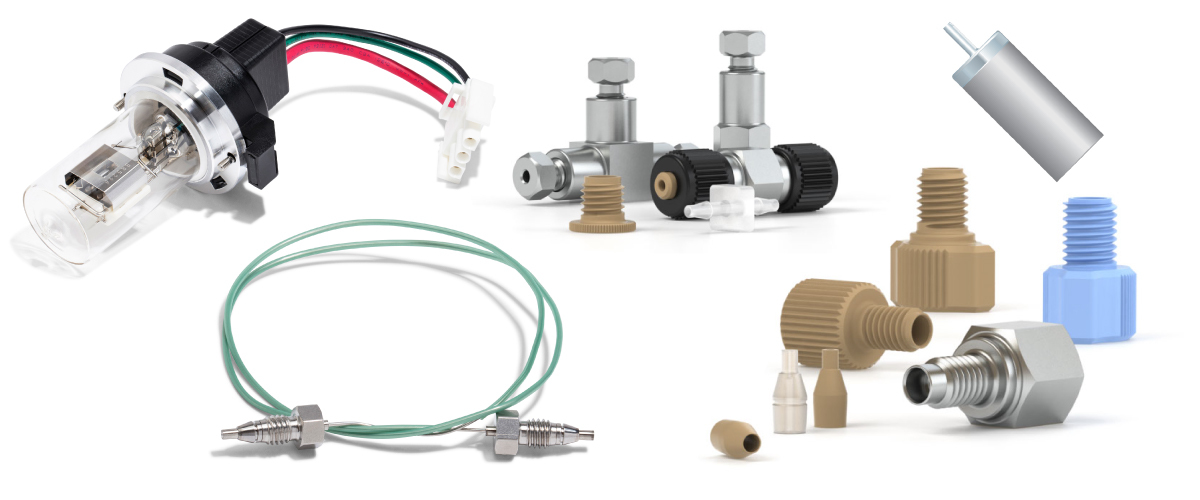
Chromatography systems rely on precise control of fluid movement. Every step in a separation, from delivering the mobile phase to introducing the sample and directing flow through the column, depends on reliable flow control. One of the most important components that makes this possible is the valve.
In HPLC and UHPLC systems, valves regulate where fluids travel, when samples are introduced, and how solvents move through the instrument. Without them, it would be difficult to maintain reproducible separations or support complex analytical workflows. Modern chromatography systems use several specialized valve types, each designed for a specific role within the flow path.
Understanding the different types of chromatography valves and how they function can help laboratories maintain system performance, troubleshoot issues, and choose the right accessories for their instrumentation.
Why Valves Are Essential in Chromatography
Chromatography requires highly controlled movement of liquids through narrow tubing and packed columns. The system must deliver solvent at precise flow rates, inject exact sample volumes, and direct the mobile phase through specific flow paths. Valves provide the mechanical switching needed to perform these tasks.
In addition to directing flow, valves help maintain system pressure, prevent contamination, and support automation. Many modern HPLC systems depend on automated valve switching for functions such as gradient solvent selection, column switching, and sample handling.
Because HPLC systems often operate at pressures of several thousand psi, and UHPLC systems may exceed 15,000 psi, chromatography valves must be engineered to withstand high mechanical stress while maintaining tight sealing and accurate alignment.
Injection Valves
Injection valves are among the most recognizable valves in chromatography systems. Their main function is to introduce a sample into the mobile phase without disrupting system pressure or flow rate.
One of the most common designs is the six-port, two-position injection valve, which operates in two modes: load and inject.
In the load position, the sample enters a sample loop while the mobile phase bypasses the loop and flows directly to the column. This allows the sample loop to fill without interrupting the chromatographic run.
In the inject position, the mobile phase flows through the sample loop and carries the sample into the column. Because the loop volume is fixed, this design supports highly reproducible injection volumes.
Injection valves are widely used in both manual injectors and automated autosampler systems and are essential for consistent sample introduction.
Check Valves
Check valves are one-way valves used in chromatography pumps. Their role is to allow fluid to flow in only one direction and prevent backflow during pump operation.
Inside an HPLC pump, check valves help ensure that solvent moves forward through the system during each pump stroke. If solvent were allowed to flow backward, pump efficiency would decrease and flow delivery would become inconsistent.
Check valves open and close based on pressure differences. Forward pressure opens the valve to allow solvent flow, while pressure reversal closes the valve to stop backflow.
Over time, contaminants or particulate matter can interfere with check valve operation. When this happens, the pump may show unstable flow rates or fluctuating pressure. Clean mobile phases and routine maintenance help reduce these issues.
Switching Valves
Switching valves are used to redirect fluid flow within a chromatography system. These valves allow the mobile phase or sample to move between different pathways depending on method requirements.
For example, a switching valve may allow a system to alternate between two columns, route solvent through a cleanup column, or direct effluent toward different detectors. In advanced methods, switching valves also support multidimensional chromatography and column regeneration workflows.
In automated systems, switching valves are typically controlled electronically so timing and coordination can be tightly managed during complex analytical methods.
Purge Valves
Purge valves help remove air bubbles and contaminants from the system. These unwanted elements can interfere with chromatography performance by causing unstable baselines or inconsistent flow.
Usually located near the pump, purge valves allow the mobile phase to flow temporarily out of the system. This flushing action removes trapped air, residual solvents, or contaminants that may have accumulated in the pump or tubing.
Opening a purge valve during solvent changes or system startup helps maintain a cleaner, bubble-free flow path and can improve pump performance while reducing pressure fluctuations.
Back Pressure Regulators
Back pressure regulators (BPRs) are often grouped with chromatography valves because they influence pressure and flow behavior within the system. While technically a pressure-control device rather than a traditional switching valve, a BPR performs a similar control role in the flow path.
A BPR is typically installed downstream of the detector. Its purpose is to maintain constant pressure in the system, helping prevent solvent outgassing and bubble formation. This is especially important when working with volatile solvents or detectors that are sensitive to bubbles.
Stable backpressure can improve baseline stability and support more consistent chromatographic performance.
Solvent Selection Valves
Solvent selection valves allow chromatography systems to switch between multiple solvent reservoirs. These valves direct the pump to draw mobile phase from different sources as required by the method.
They are especially important in gradient elution methods, where solvent composition changes during the run. Automated solvent selection supports precise mobile phase mixing based on the programmed gradient.
These valves are also useful during system cleaning, equilibration, and method changes when multiple mobile phases must be selected efficiently.
Column Switching Valves
Column switching valves route the mobile phase through different columns within the same chromatography system. This is useful for laboratories running multiple analytical methods on one instrument.
A column switching valve may be used to alternate between columns with different stationary phases or dimensions. It can also support guard column integration, sample cleanup steps, or column regeneration.
In multidimensional chromatography, column switching valves play a central role by directing fractions from one column to another for additional separation.
Degassing Valves
Degassing valves work with vacuum degassing systems to remove dissolved gases from the mobile phase before it enters the pump. Dissolved gases can create bubbles when pressure changes occur, which can disrupt flow and interfere with detectors.
By removing gases early in the flow path, degassing valves help the system operate more smoothly and reduce problems such as baseline noise or pump cavitation.
Consistent degassing supports stable pressure and more reliable chromatographic results.
Relief Valves
Relief valves are safety devices designed to protect chromatography systems from excessive pressure. If system pressure rises above a defined limit, the relief valve opens and releases solvent to help prevent damage to the pump, column, or tubing.
This is especially important in high-pressure systems such as UHPLC instruments, where blockages or failures could otherwise cause serious component damage.
Relief valves help protect expensive instrumentation and reduce the risk of system downtime.
Sample Selection Valves
Sample selection valves allow an instrument to choose which sample enters the mobile phase. These valves are commonly used in automated systems and sample preparation workflows.
By selecting samples from multiple reservoirs or containers, the system can perform sequential analysis without manual intervention. This improves throughput and reduces the chance of operator error.
Sample selection valves are especially useful in high-volume analytical laboratories where automation is important for efficiency.
Key Design Features of Chromatography Valves
Chromatography valves must meet several demanding performance requirements. One of the most important is high pressure tolerance. HPLC valves are designed to operate under several thousand psi, while UHPLC systems may exceed 15,000 psi.
Material compatibility is also critical. Valves must resist corrosion and chemical degradation across a wide range of solvents. Stainless steel and PEEK are commonly used because they provide both durability and chemical resistance.
Precision engineering is equally important. Valves must switch accurately and maintain leak-free connections. Even small alignment errors can affect flow paths, injection volumes, or system pressure.
Conclusion
Although they are relatively small components within a larger instrument, valves play a central role in chromatography system operation. From sample injection to solvent selection and pressure control, they make sure fluids move where and when they are needed.
Properly functioning valves support accurate sample introduction, stable flow rates, and consistent chromatographic performance. Regular inspection and maintenance help laboratories avoid flow disruptions, pressure fluctuations, and analytical errors. Understanding valve types and applications makes it easier to maintain reliable operation and choose the right components for HPLC and UHPLC systems.