
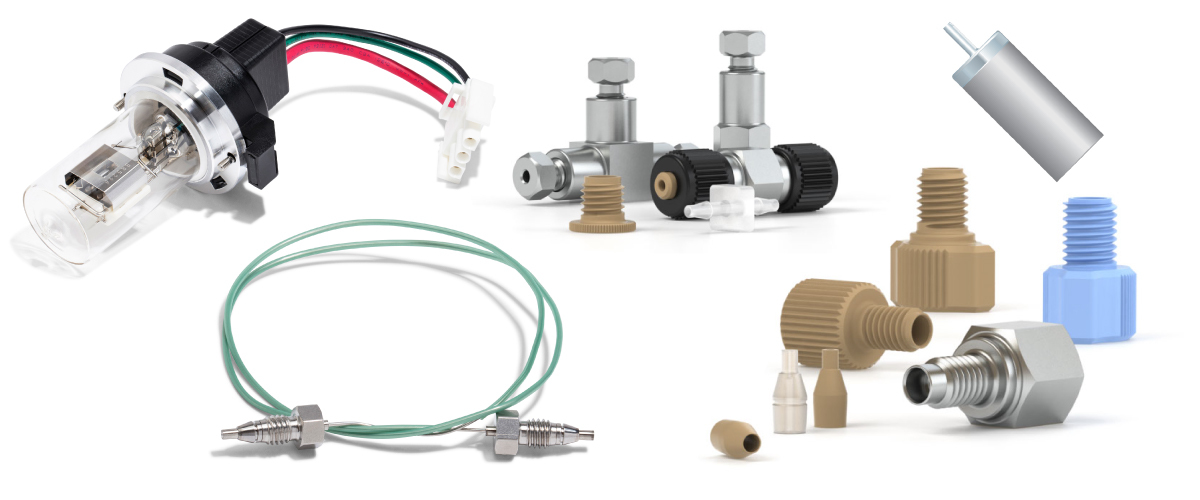
In high-performance liquid chromatography (HPLC), tight and leak-free connections are essential for system accuracy and reproducibility. Two of the most common connection components are unions and adapters. Although they may appear similar, each serves a different function within the flow path. Knowing when to use a union and when to use an adapter helps reduce leaks, minimize unnecessary volume, and improve chromatography performance.
Unions vs. Adapters in HPLC
Unions are used to connect two components that share the same thread style or port geometry on both sides. Common examples include 1/4-28 to 1/4-28 or 10-32 to 10-32 connections. Because the geometry is already matched, unions are generally more economical and easier to install than adapters.
Adapters are used when the two sides of the connection are not the same. This may include transitions such as a male 1/4-28 connection to a female 10-32 port, or a barbed fitting to a threaded fitting. Adapters are especially useful when connecting dissimilar components, instruments, or tubing systems.
Chrom Tech offers a wide range of HPLC accessories, including unions, adapters, barbed connectors, Y-connectors, T-connectors, and male-to-female fittings for both low- and high-pressure applications.
How to Choose the Right Union or Adapter
The first consideration when choosing a union or adapter should be the pressure requirement of the connection.
1. Determine Pressure Type
If two pieces of tubing are being joined, the pressure limit of the overall connection is defined by the softer or lower-pressure-rated tubing. For example, if 1/16" OD PEEK tubing is connected to 1/8" OD FEP tubing, the connection is limited by the FEP side, which is substantially softer and less pressure tolerant.
2. Match the Thread Geometry
For low-pressure connections, one of the most common solutions is a 1/4-28 flat-bottom union, which can be used with both 1/8" and 1/16" OD tubing. Even when tubing diameters differ, if both ends share a 1/4-28 thread style, a union is often the simplest and lowest-cost solution.
If the port styles do not match, an adapter may be required. In general, unions should be considered first whenever the geometry already matches, because they reduce complexity and often help minimize unswept internal volume.
3. Consider Dead Volume
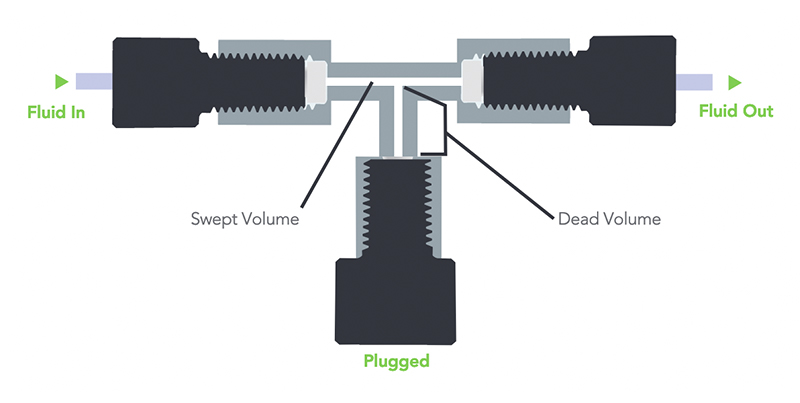
When selecting a fitting, union, or adapter, it is important to consider the internal connection volume. In practice, users often refer to all unwanted internal space as “dead volume,” but the more precise concern is the unswept volume that contributes to sample mixing, dispersion, or stagnation.
Dead Volume vs. Swept Volume vs. Void Volume
Void Volume refers to the total internal volume inside the fitting or connection. This total can be divided into two parts:
- Swept Volume: The portion directly in the active flow path
- Dead Volume: The portion outside the main flow path where fluid can stagnate
VOID VOLUME = SWEPT VOLUME + DEAD VOLUME
Excess dead volume can cause several unwanted chromatographic problems:
- Peak broadening
- Reduced resolution
- Sample carryover
- Split or distorted peaks
To minimize these issues, Chrom Tech recommends using Zero Dead Volume (ZDV) unions whenever possible. Matching the tubing internal diameter to the fitting through-hole can also help reduce turbulence and preserve clean flow characteristics.
Summary
In general, unions are the preferred choice when both sides of the connection use the same port geometry, because they are simpler, less expensive, and often better for controlling internal volume. Adapters are necessary when thread types, tubing sizes, or connection styles differ.
Choosing the right union or adapter improves connection integrity, reduces leak risk, and helps preserve chromatographic performance. For help identifying the correct fitting, union, or adapter for a specific HPLC setup, contact Chrom Tech for technical guidance.