
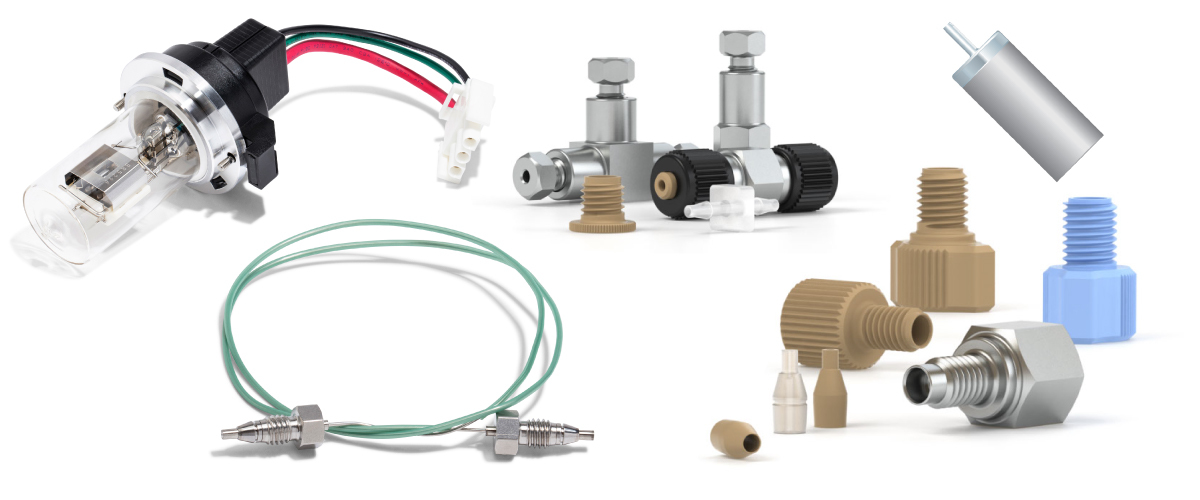
Selecting the right HPLC tubing is a foundational step in building an efficient, reliable chromatography fluid path. Tubing moves mobile phases and samples between critical components, so its material, pressure tolerance, chemical compatibility, and physical properties directly affect system performance. The right tubing choice helps control backpressure, reduce dead volume, improve reproducibility, and support consistent chromatographic results.
Whether you are plumbing a new system, replacing worn lines, or troubleshooting poor performance, understanding where each tubing material belongs can help you maintain a cleaner, lower-dead-volume flow path. In practical HPLC use, tubing selection is not just a hardware choice. It also influences peak shape, retention time stability, baseline quality, and overall maintenance frequency.
Why Tubing Matters in HPLC
Tubing determines how solvent and sample move through the instrument. If the wrong tubing is installed in the wrong part of the system, performance problems can develop quickly. Common issues include unnecessary backpressure increases, poor sealing at fittings, chemical incompatibility, contamination, and unwanted chromatographic distortion such as peak broadening or retention time shifts.
A well-matched tubing setup supports sharp peaks, reliable quantitation, and a consistent, low-dead-volume fluid path. This is especially important in modern HPLC and UHPLC systems, where small internal volumes and tight tolerances play a major role in overall efficiency.
Tubing Materials and Their Strengths
Stainless Steel Tubing
Stainless steel tubing is the standard choice for high-pressure chromatography lines. It delivers excellent mechanical strength and broad solvent compatibility, which makes it especially well suited for demanding HPLC and UHPLC zones. In many systems, 316 stainless steel tubing is used because it provides strong corrosion resistance and consistent dimensional control.
Key benefits of stainless steel tubing include:
- Very high pressure capability, often up to approximately 20,000 psi or more depending on wall thickness and fittings
- Compatibility with a wide range of HPLC solvents, including aggressive chemistries
- Strong, durable construction that helps minimize corrosion risk
Best uses: pump outlet to injector, injector to column, column inlet and outlet lines, UHPLC applications, and preparative HPLC connections.
Important consideration: stainless steel is more difficult to cut cleanly in the lab. Poor cutting technique can create burrs, cracks, curled ends, or angled faces that interfere with sealing and increase dead volume. For many applications, pre-cut stainless steel tubing is the best choice because it helps ensure square, polished ends and more reliable leak-free connections.
PEEK Tubing
PEEK tubing is a high-performance polymer option that combines good pressure tolerance with excellent ease of handling. It is commonly used in moderate-pressure HPLC systems and is especially valuable in workflows that benefit from a bioinert and metal-free fluid path.
Advantages of PEEK tubing include:
- Bioinert and metal free, making it useful for proteins, peptides, and other biomolecule separations
- Smooth internal surface that supports reproducible flow and low analyte adsorption
- Easier in-house cutting with a dedicated PEEK tubing cutter
- Resistance to many common HPLC solvents with low extractables
When not to use PEEK tubing: although PEEK is robust, it is not universal. It can swell or degrade in certain aggressive solvents such as dichloromethane (DCM), tetrahydrofuran (THF), dimethyl sulfoxide (DMSO), and strong acids. In these conditions, stainless steel is typically preferred. PEEK also has a lower pressure ceiling than stainless steel, which generally makes it better suited for low- to moderate-pressure lines.
Best uses: autosampler connections, sample loop plumbing, low- to moderate-pressure flow paths, and bioinert applications.
Fluoropolymer Tubing
Fluoropolymer tubing includes materials such as PFA, FEP, PTFE, and ETFE. These materials are valued for their outstanding chemical resistance and, in many cases, their translucent or transparent appearance, which allows visual confirmation of solvent movement.
Strengths of fluoropolymer tubing include:
- Excellent chemical inertness across a broad solvent range
- Strong suitability for low-pressure lines
- Visual flow monitoring in translucent tubing types
Best uses: solvent reservoir to pump inlet lines, detector to waste lines, and general low-pressure plumbing.
Limitation: fluoropolymer tubing is generally not appropriate for high-pressure pump-to-column connections in HPLC or UHPLC unless it is part of a specialized supported assembly.
Hybrid and Specialty Tubing
Specialized applications may require tubing designed for very small internal diameters or highly controlled flow characteristics. In these cases, hybrid constructions can provide advantages beyond traditional metal or polymer tubing alone.
PEEKsil Tubing
PEEKsil tubing combines a precision fused silica core with a PEEK outer jacket. This design provides a very smooth internal surface, strong chemical compatibility, and improved mechanical durability compared with bare fused silica alone.
Best uses: nano LC, micro flow LC, capillary electrophoresis, and LC/MS interfaces where tight internal diameter control and minimal band broadening are important.
Important handling note: PEEKsil tubing should not be cut in the lab. Damaging the fused silica core can permanently alter flow behavior and compromise performance.
IDEX Polymeric Tubing
| Tubing | PEEK | Capillary PEEK | ETFE | DuPont® FEP | DuPont PFA | DuPont High Purity PFA |
|---|---|---|---|---|---|---|
| Description |
Biocompatible and chemically inert to most commonly used solvents. Flexible with a smooth internal surface and easy length cutting.
|
Delivers the benefits of larger PEEK tubing in capillary dimensions as an alternative to fused silica and stainless steel capillary tubing.
|
Chemically inert and better suited for higher-pressure aqueous applications than PTFE, FEP, and PFA. Greater rigidity helps resist ID collapse.
|
A strong alternative to PTFE tubing, chemically inert to most solvents, easy to cut, and translucent for easy fluid monitoring.
|
Excellent chemical compatibility with a smooth inner surface and greater translucence than PTFE tubing.
|
Premium-grade PFA tubing designed for very low contamination applications.
|
| Specifications | PEEK | Capillary PEEK | ETFE | DuPont® FEP | DuPont PFA | DuPont High Purity PFA |
|---|---|---|---|---|---|---|
| OD (outside diameter) | 1/16" (1.55 mm), 1/8" (3.5 mm) | 0.0145" (360 µm), 1/32" (785 µm) | 1/16" (1.55 mm), 1/8" (3.2 mm) | 0.040" (1.0 mm), 1/16" (1.55 mm), 0.080" (2.0 mm), 0.118" (3.0 mm), 1/8" (3.2 mm) | 1/16" (1.55 mm), 1/8" (3.2 mm) | 0.0145" (360 µm), 1/16" (1.55 mm), 1/8" (3.2 mm), 3/16" (4.8 mm), 1/4" (6.35 mm) |
| ID (inside diameter) | 0.025" (65 mm) - 0.080" (2.0 mm) | 0.001" (25 µm) - 0.020" (0.50 mm) | 0.010" (0.25 mm) - 0.093" (2.40 mm) | 0.020" (0.50 mm) - 0.080" (2.0 mm) | 0.020" (0.50 mm) - 0.062" (1.55 mm) | 0.020" (0.50 mm) - 0.188" (4.80 mm) 0.002" (50 µm) - 0.006" (150 µm) for 360 µm tubing |
| Operating temp | -51 to 100 °C | -51 to 100 °C | -51 to 80 °C | -51 to 100 °C | -51 to 80 °C | -51 to 80 °C |
| Pressure rating | 3000 - 10,000 PSI (207 - 690 bar) | 2,000 - 5,000 PSI (138 - 345 bar) | 500 - 4,000 PSI (34 - 276 bar) | 2,500 - 4,000 PSI (172 - 276 bar) | 500 - 2,000 PSI (34 - 138 bar) | 250 - 2,000 PSI (17 - 138 bar) 1,750 - 3,500 PSI (121 - 241 bar) for 360 µm tubing |
| Typical tolerances | ± 0.001" (25 µm) for 1/16" OD tubing, ±0.003" (75 µm) for 1/8" OD tubing | ± 0.0005" (12.5 µm) | ± 0.001" (25 µm) for 1/16" OD tubing, ±0.003" (75 µm) for 1/8" OD tubing | ± 0.001" (25 µm) for 1/16" OD tubing, ±0.003" (75 µm) for 1/8" OD tubing | ± 0.001" (25 µm) for 1/16" OD tubing, ±0.003" (75 µm) for 1/8" OD tubing | ± 0.001" (25 µm) for 1/16" OD tubing, ± 0.0005" (12.5 µm) for 360 µm tubing |
| Refractive index (clarity) | Opaque | Opaque | 1.4 | 1.338 | 1.34 | 1.34 |
| pH range | 0 - 14 | 0 - 14 | 0 - 14 | 0 - 14 | 0 - 14 | 0 - 14 |
| Sterilization techniques | Gamma irradiation; ethylene oxide; thermal | Gamma irradiation; ethylene oxide; thermal | Ethylene oxide | Ethylene oxide; thermal | Ethylene oxide; thermal | Gamma irradiation; ethylene oxide; thermal |
| Autoclavable? | Y | Y | Y | Y | Y | Y |
Choosing the Right Tubing by Flow Path Zone
One of the simplest ways to select HPLC tubing is to match material choice to the pressure and function of each section of the flow path. Dividing the system into zones makes tubing decisions more practical and more performance-focused.
High-Pressure Zones
- Pump outlet to injector
- Injector to column
- Column inlet and outlet
Recommended tubing: stainless steel, PEEK, or PEEKsil depending on pressure demands, solvent chemistry, and application requirements.
Medium-Pressure or Moderate-Pressure Zones
- Sample loop lines
- Autosampler connections
Recommended tubing: PEEK or stainless steel, selected according to solvent compatibility and whether a bioinert flow path is preferred.
Low-Pressure Zones
- Solvent reservoir to pump inlet
- Detector to waste
- General plumbing below approximately 2,000 psi
Recommended tubing: fluoropolymers such as PFA, FEP, PTFE, and ETFE.
Cutting Tubing: Why End Quality Matters
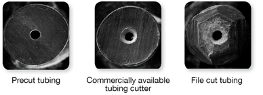
Proper tubing preparation is critical to achieving leak-free connections and minimizing dead volume. Tubing ends should be square, clean, and burr free. Poorly prepared ends can create sealing problems, disturb flow, and contribute to inconsistent chromatographic results.
- Stainless steel tubing: best purchased pre-cut from the manufacturer whenever possible, since improvised cutting methods often create angled or deformed ends
- PEEK tubing: can usually be cut cleanly in house with a dedicated PEEK tubing cutter, making it easier for routine lab adjustments
- Fluoropolymer tubing: can be cut with sharp blades or tubing cutters, but extra care is needed to avoid deforming the bore
Whenever possible, using professionally prepared tubing lengths or appropriate cutting tools helps reduce imperfections that can lead to dead volume, leaks, and retention time inconsistency.
Tubing and Chromatographic Performance
Tubing affects more than pressure handling. Internal diameter, surface smoothness, and connection quality all influence how sample bands move through the system. These variables can impact:
- Peak shape and symmetry
- Retention time reproducibility
- Baseline noise
- Overall system backpressure
Minimizing dead volume is especially important in high-pressure zones and in applications where preserving resolution is critical. High-quality tubing with controlled dimensions and precision fittings supports a smoother fluid path and helps maintain chromatographic efficiency.
Conclusion
Choosing the right HPLC tubing means balancing pressure requirements, chemical compatibility, ease of use, and application-specific needs. Stainless steel remains the preferred option for high-pressure and chemically aggressive conditions. PEEK provides an easy-to-handle, bioinert alternative for many moderate-pressure applications. Fluoropolymers are well suited to low-pressure plumbing, while PEEKsil supports advanced micro flow and nano flow workflows.
By matching tubing type to each flow path zone and avoiding common cutting mistakes, laboratories can improve reproducibility, protect chromatographic performance, and reduce maintenance issues. When selecting tubing for an HPLC or UHPLC system, focusing on fit-for-zone performance is one of the most practical ways to build a more reliable fluid path.