

- Use at least 50 PSI of back pressure, and ideally 1,000 PSI for pumps with a pulse dampener.
- To reduce cavitation, keep solvent bottles above the pump and replace the inlet filter element during routine maintenance.
- Filter HPLC solvents so particulates do not build up inside the pump.
- Use the self-flush mechanism, especially when pumping buffers, acids/bases, near-saturated inorganic solutions, or harsh solvents like THF.
Routine care and preventative maintenance are essential for reliable performance from Chrom Tech continuous process pumps. A well-maintained pump supports stable pressure, consistent flow, and longer service life for pistons, seals, check valves, and fittings.
When pump problems do appear, they are often tied to a few common causes such as air in the solvent path, contamination in the check valves, worn seals, or incorrect solvent handling practices. A structured troubleshooting approach can help laboratories restore normal operation while reducing unnecessary downtime.
Common HPLC Pump Problems
Several recurring symptoms usually indicate that an HPLC pump needs attention. Common support topics include:
- Erratic or inconsistent flow rates
- No flow from the outlet check valve
- Pressure fluctuation or drift
- Visible leakage or fluid seepage
These symptoms are commonly associated with air bubbles, contaminated check valves, worn piston seals, scratched pistons, poorly degassed solvents, plugged inlet filters, or improper tubing and fitting setup.
Preventing Bubbles in the HPLC Pump
Bubbles in the solvent path can cause unstable pressure and baseline noise. Preventing them starts with proper solvent preparation and correct pump setup before operation.
Solvent Out-Gassing and Helium Sparging
Dissolved gases such as oxygen and nitrogen can come out of solution during pumping. Sparging with helium for 10 to 15 minutes before use helps remove these gases. Maintaining a 2 to 3 psi helium blanket during operation can further improve stability.
Mixed solvents such as water with acetonitrile or methanol benefit from active sparging for best performance. A back-pressure regulator installed after the detector flow cell can also help prevent out-gassing bubbles and related baseline noise.
Cavitation and Reservoir Placement
Cavitation happens when vapor bubbles form during the inlet stroke. This can interrupt solvent delivery and lead to unstable pump performance. Several common causes:
- Crimped or restricted inlet tubing
- Plugged inlet filters
- Tubing longer than 48 in (120 cm) or less than 0.085 in (2 mm) ID
- Solvent reservoirs placed below pump level
Reservoirs should be kept at or slightly above pump height to support smooth solvent delivery and reduce cavitation risk.
Viscosity and Filtration
High-viscosity solvents may require added inlet pressure. Raising reservoir height or sparging with helium is recommended to improve flow. Solvents should also be filtered through a 0.5 µm filter to help protect pump seals and check valves.
For buffers or salts, frequent filtration and sealed, particle-free storage help reduce contamination and wear.
Solvents to Avoid in HPLC Pumps
Chrom Tech pump wetted components such as stainless steel, ceramic, sapphire, ruby, and fluoropolymer are durable, some chemicals should be avoided. These include:
- Strong acids such as hydrochloric acid
- Halogenated solvents such as chloroform and carbon tetrachloride
- Ammonium hydroxide and other aggressive bases
Where chemical resistance is important and compatibility allows, PEEK pump heads may be considered.
Reservoir Placement and Self-Flush Systems
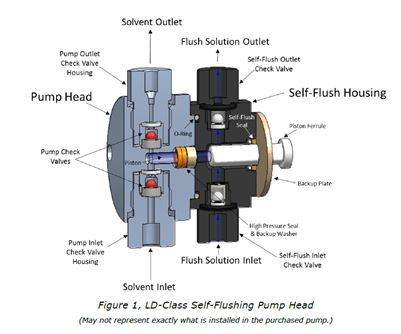
Reservoirs should be kept near pump height and connected with short inlet lines to minimize backpressure. For pumps equipped with self-flush heads, the piston should be continuously washed with flush solvent to help prevent salt buildup and abrasive wear.
- Use 100% IPA
- Use 100% methanol
- Use 20% IPA or methanol in water
- Avoid using water alone
Regular flushing is especially important when pumping buffers, acids, or volatile solvents such as THF or acetone.
Routine HPLC Pump Maintenance Procedures
1. Inlet Filter Replacement
Inspect inlet filters periodically and replace them when clogged to help prevent cavitation. When pumping 100% aqueous solutions, using 10 to 20% organic solvent or a mild biocide is recommended to help reduce microbial growth.
2. Piston Seal Replacement
Low pressure, leaks, or pressure drift often indicate worn piston seals. Replacement approximately every 1,000 hours, depending on solvent type and application conditions is recommended.
3. Piston Cleaning
Pistons should be cleaned gently along their length using a folded scouring pad, then wiped with an alcohol-dampened lint-free cloth. Avoid applying perpendicular pressure that could scratch the piston surface.
4. Check Valve Cleaning
- Remove the pump head and immerse it in an ultrasonic cleaner for about 30 minutes
- Rinse thoroughly with distilled water
- Reinstall the pump head
- Run distilled water at 1 mL/min for 15 minutes to waste
If problems continue after cleaning, the check valves may need replacement.
5. Flushing Procedure
Flush sequence for pump cleaning:
- Prepare 100% IPA, 100% distilled H₂O, and 20% HNO₃/H₂O for stainless steel flow paths
- Connect the outlet to waste and set the pump to maximum flow or PRIME
- Flush sequentially: 100% IPA for 3 minutes, 100% H₂O for 3 minutes, 20% HNO₃ for 3 minutes if using stainless steel, H₂O for 3 minutes, then IPA for 3 minutes
Support Longer Pump Life with Preventative Care
Most pump performance issues can be traced to piston seals, check valves, fittings, or solvent handling practices. Routine maintenance such as filter changes, solvent degassing, flushing, and seal replacement helps support stable operation and longer pump life.
Chrom Tech also supplies HPLC accessories and replacement pump parts, including fittings, PEEK tubing, and 316 SS components. Chrom Tech is an authorized Agilent distributor providing certified Agilent parts for HPLC and GC systems.
For easier replacement-part identification, you can also use Chrom Tech’s pump part lookup tool.