
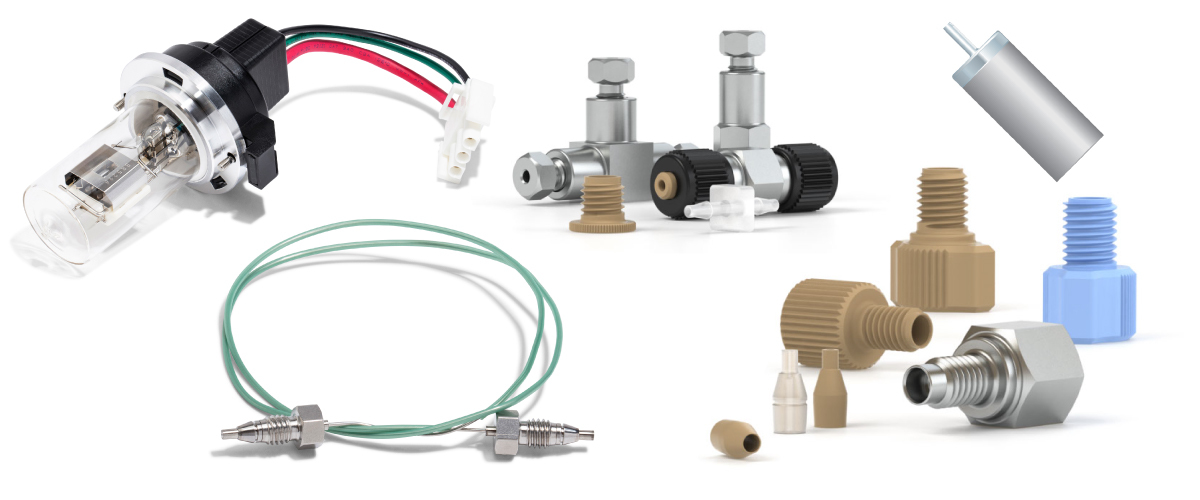
High-Performance Liquid Chromatography (HPLC) is a core analytical technique used to separate, identify, and quantify components in complex mixtures. At the center of every HPLC method is the flow path, which is the route the mobile phase and sample follow as they move through the system during analysis.
Understanding the HPLC flow path is important for optimizing performance, troubleshooting issues, and maintaining accurate, reproducible results. Each component in the flow path plays a distinct role, and even a minor problem in one part of the system can affect the quality of the chromatographic separation.
What Is the HPLC Flow Path?
The HPLC flow path is the sequence of components the mobile phase and sample pass through during an analysis. In a simplified system, the flow path can be summarized as:
Solvent Reservoir → Pump → Injection Valve → Sample Loop → Column → Detector → Recorder → Waste Reservoir
This path represents the movement of solvent from storage, through sample introduction and separation, to detection and final waste collection. Each section of the flow path contributes to the stability, accuracy, and efficiency of the analysis.
Solvent Reservoir
The solvent reservoir holds the mobile phase used to transport the sample through the HPLC system. Depending on the method, the mobile phase may be a single solvent for isocratic separations or a changing solvent mixture for gradient elution.
Mobile phase selection directly affects analyte retention and separation efficiency. Reservoir filters are often used to remove particulate matter before the solvent enters the system. Keeping the reservoir clean helps reduce contamination and lowers the risk of pressure spikes caused by blockages.
Pump
The pump is one of the most important components in the HPLC system. It draws solvent from the reservoir and delivers it through the system at a controlled flow rate. Most modern HPLC systems use dual-piston pumps that provide stable flow even under high pressure.
Consistent flow is essential because changes in flow rate can alter retention times and peak shape. Traditional HPLC systems may operate up to about 6,000 psi, while UHPLC systems may reach up to about 15,000 psi. The pump must overcome resistance from tubing, valves, the column, and other accessories while maintaining reproducible solvent delivery.
Degasser
A degasser is an optional but important component that removes dissolved gases from the mobile phase before the solvent enters the high-pressure portion of the system. Dissolved gases can form bubbles under changing pressure conditions, which may disrupt flow and create noisy detector signals.
Vacuum degassers are commonly used to improve flow stability and detector performance, especially with sensitive detectors such as UV-Vis and fluorescence.
Injection Valve
Once the mobile phase is moving through the system, the injection valve introduces the sample. A common design is the six-port, two-position valve, which uses load and inject positions.
In the load position, the sample fills the sample loop while the mobile phase bypasses the loop. In the inject position, the mobile phase flows through the loop and carries the sample into the column.
This design allows accurate, reproducible sample introduction without disturbing system pressure or flow rate, making the injection valve critical for quantitative HPLC work.
Sample Loop
The sample loop is a fixed-volume tube that temporarily holds the sample before injection. The size of the loop determines the injection volume and plays a direct role in reproducibility.
Larger sample loops allow higher injection volumes but may add extra-column volume, which can contribute to peak broadening. Smaller loops reduce sample load but can help maintain sharper peak shapes. Selecting the proper loop size depends on the analytical method and the required injection volume.
Column
The column is where chromatographic separation takes place. It contains stationary phase particles that interact differently with each analyte based on chemical characteristics such as polarity, size, or charge.
As the mobile phase carries the sample through the packed bed, compounds partition between the mobile and stationary phases and separate over time. Column properties such as stationary phase chemistry, length, internal diameter, and particle size all affect resolution, retention, and backpressure.
Smaller particles and longer columns often improve separation but increase system pressure. Columns are selected to match the application, sample type, and desired analytical performance.
Detector
After leaving the column, separated analytes pass through the detector. The detector measures the analytes and generates a signal that can be processed into a chromatogram.
Common HPLC detectors include UV-Vis, mass spectrometry (MS), evaporative light scattering (ELSD), refractive index (RI), and fluorescence detectors. Accurate detection depends on stable flow and a clean, bubble-free flow path. Air bubbles or flow disruptions can create noisy baselines or inconsistent peak responses.
Data System
The data system, often chromatography software on a computer, receives the detector signal and produces a chromatogram. This software is used to identify and quantify analytes based on retention time and peak area.
Modern chromatography software also helps with baseline correction, peak integration, reporting, and method documentation. Although it does not physically contact the flow path, it is a critical part of turning detector output into usable analytical data.
Waste Reservoir
At the end of the process, the mobile phase and sample components are collected in the waste reservoir. Proper waste handling is important for laboratory safety and environmental compliance.
In most analytical HPLC methods, waste is collected for disposal. Some preparative systems may recover or recycle solvents, but routine analytical methods typically direct the effluent to waste.
Pressure Zones in the HPLC Flow Path
The HPLC flow path can be divided into three main pressure zones. Understanding these zones makes troubleshooting easier because problems in each zone often behave differently.
Low-Pressure Zone Before the Pump
The first low-pressure zone runs from the solvent reservoir to the pump inlet. This area typically operates under low or even slightly negative pressure as the pump draws solvent into the system.
High-Pressure Zone
The high-pressure zone begins at the pump outlet and extends through the injection valve, sample loop, and column. Here, the system forces the mobile phase through narrow tubing and packed stationary phase under high pressure.
Low-Pressure Zone After the Column
The second low-pressure zone starts at the column outlet and continues to the waste reservoir. Pressure drops significantly after the column because the flow is no longer restricted by the packed bed.
Leaks or air bubbles in the low-pressure zone may affect solvent delivery differently than clogs or restrictions in the high-pressure zone. Recognizing where a problem occurs in the flow path can make troubleshooting much more effective.
Why Understanding the HPLC Flow Path Matters
A clear understanding of the HPLC flow path helps analysts optimize method performance, maintain reproducibility, and troubleshoot more efficiently. Stable solvent delivery, accurate sample introduction, proper separation, and consistent detection all depend on each flow path component working correctly.
By visualizing the full route from the solvent reservoir to the waste reservoir, laboratories can better prevent common issues such as bubble formation, pressure spikes, blocked filters, poor sample injection, and unstable baselines. This understanding supports both routine analysis and method development and helps ensure that HPLC systems perform reliably from run to run.