
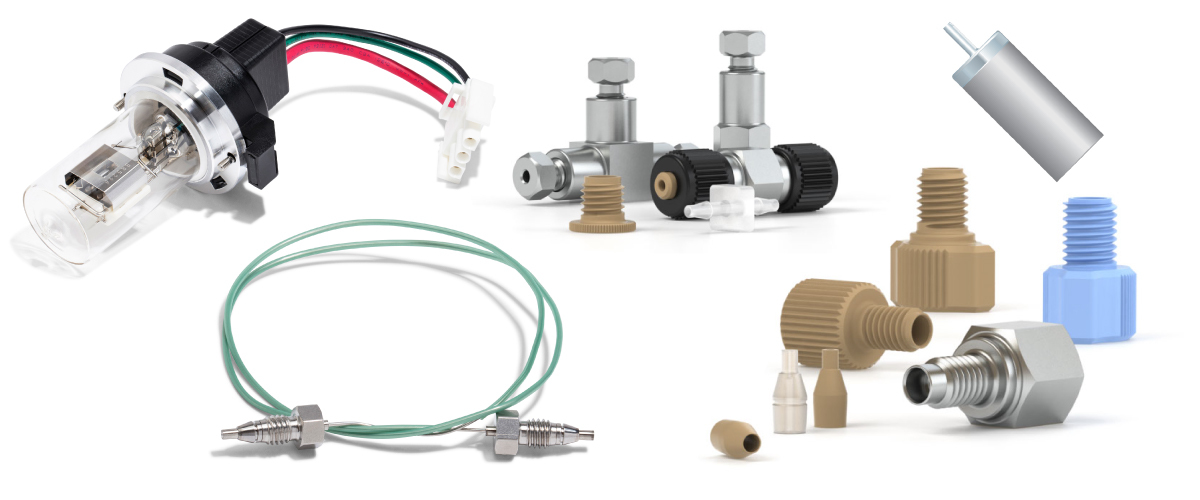
An Introduction to HPLC Fittings
HPLC fittings are critical components in chromatography systems because they connect tubing, adapters, and instrument modules while helping maintain leak-free, stable operation. Reliable fittings are essential for preserving system pressure, minimizing dead volume, and achieving reproducible chromatographic results.
"Creating good connections with fittings is extremely important for successful chromatography."
In most analytical systems, a fitting consists of two main parts: a nut and a ferrule. The nut supplies the compression force, while the ferrule forms the seal between the tubing and the receiving port. When selecting fittings, chromatographers should consider thread type, fitting geometry, tubing size, material of construction, and expected pressure range.
For more detail on fitting styles, see also: What Types of Fittings Are Used in HPLC?
Fittings for Low-Pressure Sections
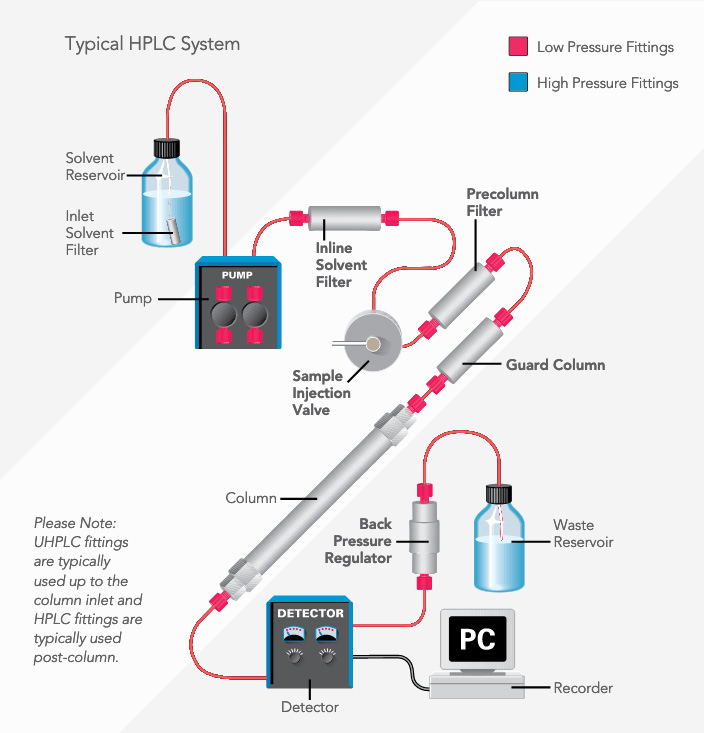
Although HPLC stands for high-performance liquid chromatography, not every part of the system operates at high pressure. Low-pressure areas typically include:
- Tubing between solvent reservoirs and the pump inlet
- Waste lines following the HPLC column
In these areas, fittings are commonly 1/4-28 flat-bottom designs used with 1/8" OD tubing. Polymeric fittings, including PEEK, are often preferred because they are easy to handle, chemically resistant, and typically do not require tools for installation.
Fittings for High-Pressure Sections
High-pressure sections are usually located between the pump outlet and the analytical column. These connections must tolerate the full operating pressure of the system, which may exceed 6,000 psi in UHPLC methods.
The most common fitting type in these sections is the 10-32 coned fitting used with 1/16" OD tubing. For standard HPLC conditions, polymeric fittings may sometimes be acceptable. However, for UHPLC and other ultra-high-pressure applications, stainless steel nuts and ferrules are often preferred because of their improved mechanical strength and pressure tolerance.
Typical HPLC System Overview
The diagram below illustrates where low- and high-pressure fittings are commonly used in a typical HPLC system. Low-pressure fittings are generally located near solvent reservoirs and waste lines, while high-pressure fittings are most often found between the pump and the analytical column.
Other Common Fitting Types
In addition to 1/4-28 and 10-32 fittings, several other fitting styles are commonly used in chromatography systems:
- Barbed fittings: Often used for waste lines and other non-pressurized tubing connections
- Luer fittings: Common for syringe-to-tubing connections and low-pressure fluid handling
- Large-bore fittings: Used in specialized applications requiring larger tubing diameters or higher flow rates
Because chromatography systems can include several different pressure zones and connection geometries, it is important to match the fitting type to the application rather than assuming one fitting style works everywhere.
Other Chromatography Consumables to Keep on Hand
Reliable chromatography performance depends on more than fittings alone. To reduce downtime and keep systems operating smoothly, labs should also keep essential consumables readily available, including:
- Chromatography vials and closures
- Sample preparation consumables such as syringe filters and SPE cartridges
- Tubing and fittings
- HPLC columns
- Syringes and sample loops
- Instrument-specific replacement parts
- HPLC solvents and reagents
Choosing the correct fittings helps reduce leaks, control dead volume, and protect chromatographic performance. Matching the right fitting style, tubing size, and material to each part of the system is one of the simplest ways to improve HPLC reliability.
Chrom Tech offers fittings, tubing, consumables, and replacement parts for a wide range of HPLC configurations. For help identifying the correct fitting type for a specific instrument or flow path, contact Chrom Tech technical support.