
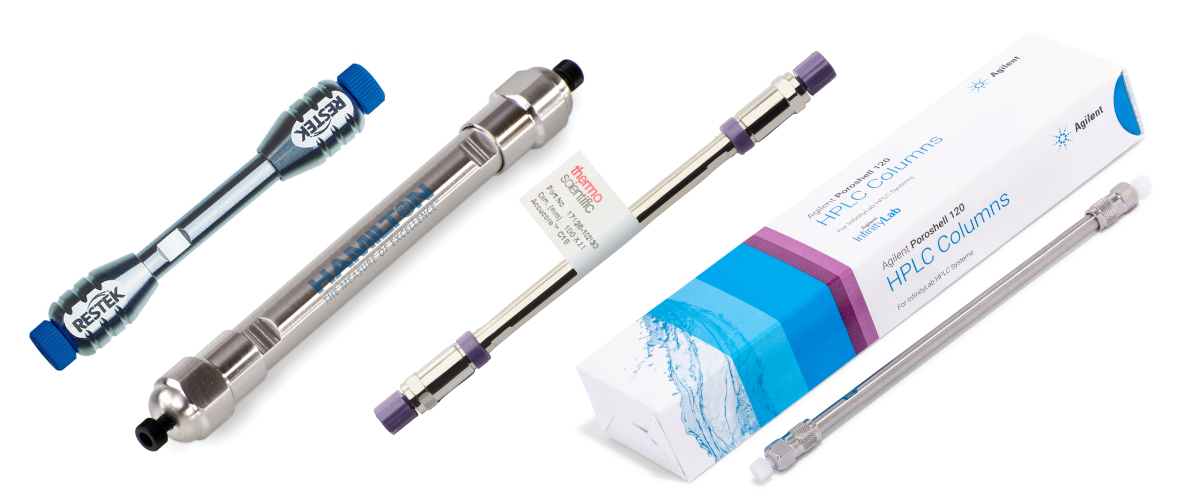
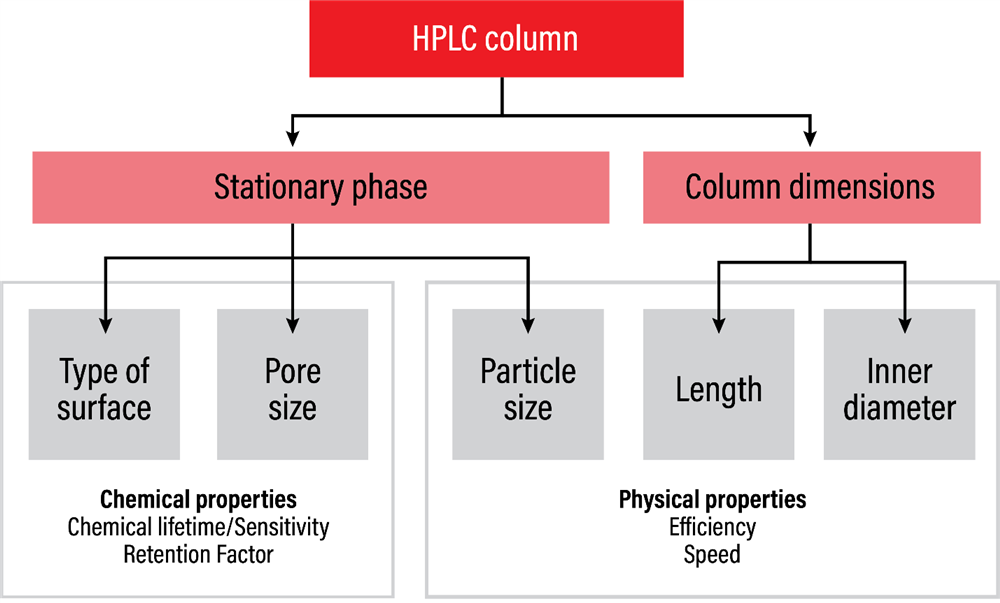
Selecting the right HPLC column is essential for achieving precise and reproducible chromatographic results. Chemical factors such as stationary phase type and pore size influence selectivity and retention, while physical parameters such as particle size, column length, and inner diameter affect efficiency, backpressure, and analysis speed.
Understanding Pore Size
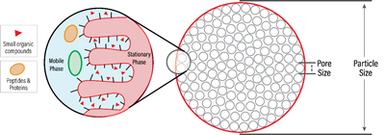
Pore size describes the average size of the pores within the stationary phase particles and is typically measured in angstroms (Å). Pore size directly affects whether analytes can access the internal surface area of the stationary phase. Choosing the correct pore size is important because it determines how efficiently analytes of different molecular weights diffuse into the packing material and interact with the phase.
| Analyte Type | Typical MW | Recommended Pore Size (Å) |
|---|---|---|
| Small molecules | ≤ 2,000 | 80–120 |
| Peptides / Proteins | 2,000–100,000 | 200–450 |
| Large proteins / Vaccines | >100,000 | 1,000–4,000 |
For GPC or SEC separations, pore size should always be matched to the molecular weight distribution of the sample for the best resolution. Explore InfinityLab Poroshell 120 Columns for reliable performance.

Understanding Particle Size
Particle size refers to the diameter of the stationary phase particles packed inside the column. A narrower particle size distribution supports better reproducibility, higher efficiency, and improved peak symmetry.
Common Particle Sizes and Applications
- 5 µm: Traditional analytical HPLC applications
- 3.5 µm: Method development and routine QC analysis
- Sub-2 µm: High-speed, high-resolution UHPLC separations
Performance Relationships
- Halving particle size approximately doubles theoretical plates
- Halving particle size increases backpressure by roughly fourfold
- Superficially porous particles (SPP) provide sub-2 µm performance with lower backpressure, which makes them attractive for conventional HPLC systems
Column Length Considerations
- Doubling column length approximately doubles plate count and analysis time
- Backpressure rises proportionally with column length
For example, a 2.1 × 100 mm column packed with 3.5 µm particles may produce roughly 13,000 plates. Switching to 1.8 µm particles can increase efficiency substantially, but pressure also rises sharply. Reducing column length can shorten run time while maintaining strong efficiency at the cost of higher operating pressure.
Selecting Column Inner Diameter (ID)
The inner diameter of the column affects sensitivity, solvent consumption, and detector compatibility. Narrower columns generally use less solvent and can improve sensitivity, which makes them particularly useful in LC-MS workflows.
| Column ID | Recommended Use | Benefits |
|---|---|---|
| 2.1 mm | Mass spectrometry & low-flow analysis | High sensitivity, reduced solvent cost |
| 3.0–4.6 mm | Standard analytical HPLC | Balanced throughput and robustness |
| > 4.6 mm | Preparative chromatography | High loading capacity, faster flow |
Quick Reference: Column Selection Guidelines
| Goal | Recommended Setup |
|---|---|
| High Throughput | Short columns with sub-2 µm particles |
| Complex Separations | Longer columns, small particles, high pressure |
| LC-MS Sensitivity | 2.1 mm ID columns, reduced flow rates |
| Preparative Scale | Larger ID (≥ 10 mm), 5–10 µm particles |
Choosing the Right Balance of Pore Size and Particle Size
Selecting an HPLC column requires balancing pore size, particle size, column length, and inner diameter to match the analytical goal. Pore size should be chosen based on analyte molecular size, while particle size should be selected based on the desired balance of efficiency, pressure, and speed.
Whether the priority is throughput, resolution, or sensitivity, understanding these column parameters helps support reliable and reproducible chromatographic performance. For personalized guidance or to source authentic Agilent and Chrom Tech columns, visit our HPLC Accessories page.