
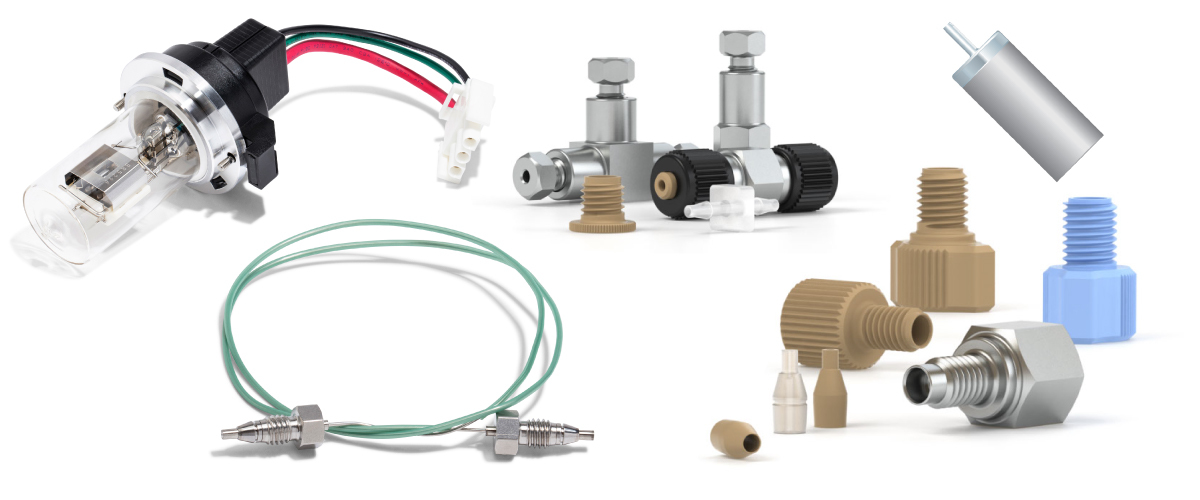
Backpressure is a fundamental characteristic of high-performance liquid chromatography (HPLC) systems. Every chromatographic separation depends on controlled pressure to move the mobile phase through the column and the rest of the flow path. Although the column is often viewed as the main source of system pressure, accessories throughout the flow path also play an important role in determining total HPLC backpressure.
Components such as tubing, fittings, filters, frits, and valves all introduce resistance to solvent movement. When these accessories are properly selected and maintained, pressure remains more stable and predictable. When they are poorly matched, improperly installed, or partially clogged, they can significantly increase backpressure and negatively affect chromatographic performance.
Understanding how accessories contribute to system pressure helps laboratories diagnose pressure problems more effectively, extend column life, and maintain reliable separations.
Tubing Dimensions and Flow Resistance
One of the most important accessory-related contributors to backpressure is tubing. The internal diameter (ID) and length of the tubing strongly influence how easily the mobile phase can travel through the system.
Narrow inner diameter tubing creates greater resistance to flow. In many HPLC and UHPLC systems, this can be beneficial because it reduces extra-column volume and helps support better peak shape. However, the trade-off is increased pressure. As tubing ID decreases, backpressure rises quickly, especially at higher flow rates.
Tubing length also matters. Longer tubing runs increase the distance the solvent must travel, which raises the pressure required to maintain flow. Even a small amount of extra tubing can produce measurable pressure increases in high-pressure systems.
For better system performance, tubing should be kept as short as practical and selected to match the pressure requirements of both the system and the column.
Fluid Viscosity and Mobile Phase Composition
The viscosity of the mobile phase is another major factor that affects HPLC pressure. More viscous liquids resist flow more strongly, which means the system must generate more pressure to move them through the column and accessories.
In gradient methods, mobile phase composition often changes during the run. Water-rich mixtures are generally more viscous than many organic solvents, so pressure may be higher at the start of the gradient and lower later in the run as the organic content increases.
Temperature also affects viscosity. Cooler solvents are more viscous and tend to generate higher system pressure, while warmer solvents flow more easily and reduce backpressure. Laboratories with temperature-controlled environments often see more stable pressure profiles because solvent viscosity stays more consistent.
Flow Rate and Pressure Relationships
Flow rate has a direct relationship with backpressure. Increasing flow rate forces more solvent through the column and accessories in the same amount of time, which increases resistance and raises pressure.
This becomes especially important when methods are transferred between instruments or when smaller-particle columns are used. UHPLC methods often operate at higher pressures because they combine smaller particle columns with reduced internal diameters in system tubing.
If system pressure rises sharply after a flow-rate adjustment, it may indicate that accessories such as tubing or filters are creating more resistance than expected.
Filters, Frits, and Protective Components
Inline filters and frits are used to protect the column and system from particulate contamination. Although they are important for system cleanliness, they also add resistance to the flow path.
Over time, these components can collect particles from mobile phases, samples, or degraded column packing material. As contaminants build up, the flow path becomes more restricted and backpressure gradually increases.
Replacing clogged filters is one of the simplest and most effective ways to restore normal system pressure. Many laboratories use routine filter replacement schedules to reduce the risk of unexpected pressure spikes.
Dead Volume and Fitting Design
Dead volume refers to spaces in the flow path where solvent can collect or mix before continuing through the system. These areas often occur at poorly fitted connections or mismatched fittings.
Dead volume is usually discussed in relation to peak broadening and reduced chromatographic resolution, but it can also contribute to increased pressure. Poorly designed or improperly tightened fittings can create turbulent flow and additional resistance.
Using properly matched fittings and minimizing unnecessary connectors helps support smoother laminar flow and reduce pressure fluctuations.
Check Valves in the Pump
Check valves help maintain one-directional flow within the HPLC pump. They ensure that solvent moves forward rather than backward during pump cycles.
If a check valve becomes contaminated, worn, or stuck, solvent delivery can become irregular. In some cases, this leads to unstable pressure readings or increased backpressure. Periodic pump maintenance, including cleaning or replacing check valves, helps support more consistent performance.
Back Pressure Regulators
Back pressure regulators (BPRs) are used in applications such as post-column reactions or systems that require stable downstream pressure conditions. These devices are designed to maintain a constant pressure in the downstream flow path.
Although BPRs are used to regulate pressure, incorrect settings or a malfunctioning regulator can create excessive backpressure. If pressure becomes unusually high after installing a BPR, checking its pressure rating and settings is an important troubleshooting step.
Clogs and Blockages in the Flow Path
Particles, precipitated buffer salts, or sample residues can accumulate anywhere in the HPLC flow path. When these materials collect inside tubing, filters, frits, or connectors, they restrict solvent movement and cause pressure to rise.
Some clogs develop gradually, leading to slowly increasing pressure over multiple runs. In more severe cases, pressure may spike suddenly when a blockage forms.
Preventive practices such as filtering samples, preparing clean mobile phases, and regularly flushing the system can help reduce the risk of blockages.
Column Resistance and System Pressure
Although accessories contribute meaningfully to total system pressure, the column itself usually generates the majority of resistance in an HPLC system. Column packing material, particle size, and column dimensions all affect pressure.
Smaller particle sizes and longer columns provide higher chromatographic efficiency, but they also create greater resistance to solvent flow. This is one reason UHPLC columns often run at much higher pressures than traditional HPLC columns.
Accessories must be compatible with these operating pressures. Tubing, fittings, and filters designed for lower-pressure systems may fail or add unnecessary resistance in high-pressure methods.
Temperature Effects on Backpressure
Temperature changes can influence both solvent viscosity and the physical behavior of system components. As temperature increases, solvents usually become less viscous and pressure decreases.
Column ovens help stabilize pressure by maintaining a consistent temperature during the run. In contrast, fluctuations in laboratory temperature can cause slight changes in system pressure throughout the day.
Maintaining stable environmental conditions and consistent column temperatures supports more reproducible pressure profiles and more reliable chromatographic results.
Managing Backpressure Through Accessory Selection
Proper accessory selection and routine maintenance are important for controlling HPLC backpressure. Choosing tubing with an appropriate internal diameter, minimizing tubing length, and replacing filters on a regular basis can significantly reduce unnecessary pressure buildup.
Routine inspection of fittings, valves, and other system components also helps identify restrictions before they become serious problems. Looking at the HPLC system as a complete flow path, rather than focusing only on the column, makes it easier to diagnose pressure issues accurately.
Understanding how accessories affect backpressure helps chromatographers build more reliable systems, extend column life, and maintain consistent analytical performance.