

Priming your HPLC pump is one of the simplest and most important steps in maintaining reliable system performance. Whether you are starting up a new system, switching solvents, or bringing a pump back online after storage, proper priming helps ensure the pump head and solvent lines are completely filled with mobile phase and free of trapped air.
Air bubbles in the solvent path can cause pressure fluctuations, inaccurate flow rates, inconsistent baselines, and retention time variation. Over time, trapped air can also contribute to seal wear. Priming also helps confirm that only the intended solvent is moving through the system, reducing the chance of contamination from a previous mobile phase.
Why Priming an HPLC Pump Matters
Priming is important because it removes air from the pump and solvent path before normal operation begins. A properly primed system is better able to maintain stable pressure and consistent solvent delivery throughout the chromatography workflow.
This is especially important after maintenance, after storage, and whenever solvents are changed. In each of these situations, air can enter the pump or lines and interfere with normal pump performance.
How to Prime an HPLC Pump with a Prime/Purge Valve
If the pump is equipped with a prime/purge valve, priming is direct and easy. Before beginning, make sure all connections downstream of the valve are closed.
- Confirm that all connections downstream of the prime/purge valve are closed.
- Attach a syringe to the prime/purge valve port.
- Open the prime/purge valve. On Chrom Tech pumps, this is done by turning the knob counterclockwise one to two turns.
- Draw the syringe back to pull about 20 mL of solvent through the system.
- Press the Prime button, or set the pump to maximum flow, and continue drawing until no bubbles appear in the solvent line.
- Close the prime/purge valve.
- Stop the prime function and remove the syringe.
What does the prime/purge valve do? The valve vents solvent flow to atmosphere so air can be removed more efficiently. When the valve is closed, pressure is directed through the outlet port for normal system operation. When the valve is opened, pressure is vented and solvent exits the drain port, which makes it easier to pull solvent through the pump with a luer syringe and purge trapped bubbles.
How to Prime an HPLC Pump Without a Prime/Purge Valve
If the pump does not have a built-in prime/purge valve, it can still be primed manually using standard HPLC fittings. Remove the 10-32 fitting on the outlet check valve, which is the standard outlet port size on most HPLC pumps, insert a P-642 female luer adapter, attach a luer syringe, and draw solvent through the pump head until the air is fully removed.
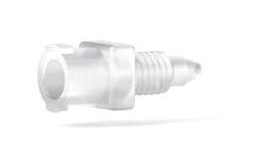
P-642 female luer adapter shown above
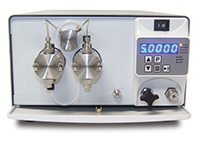
Chrom Tech Pumps and Easy Pump Maintenance
Chrom Tech HPLC pumps are designed for accessible maintenance. The inlet check valve is positioned at the bottom of the pump head, and the outlet check valve is positioned at the top, allowing access without disassembling the chassis. This simplifies routine service tasks such as priming and valve inspection.
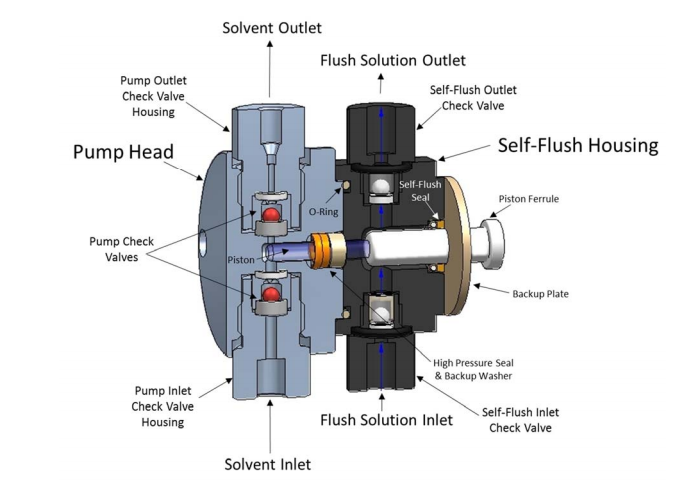
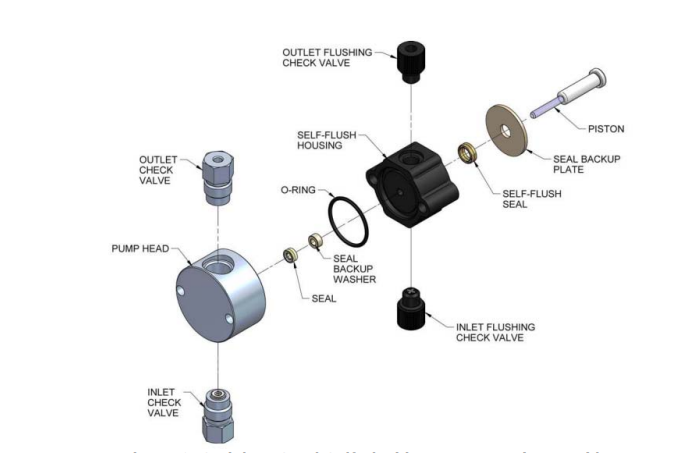
Every Chrom Tech pump includes a Self-Flush system that continuously wets the piston to help prevent salt buildup and buffer crystallization. This design helps extend seal life and maintain long-term performance by reducing the chance of scratches on the piston surface and leaks caused by seal wear.
For more guidance on pump maintenance, see the related Chrom Tech resource: HPLC Pump Care and Troubleshooting.
Chrom Tech Pumps in Production Environments
Chrom Tech HPLC pumps are used not only in analytical laboratories but also in long-running production environments. One long-time customer, Cody Bullis, Equipment Maintenance Technician Supervisor at Cantel Medical, shared the following feedback:
“We can trust that the Chrom Tech pumps are consistent every time. That’s why we chose Chrom Tech when we needed to expand our diluent lines. The products are reliable, but it’s the support that stands out—Chrom Tech always responds quickly and helps us find a solution. We have 75 Chrom Tech pumps in operation and continue to choose Chrom Tech because of the quality, service, and relationship we’ve built.”
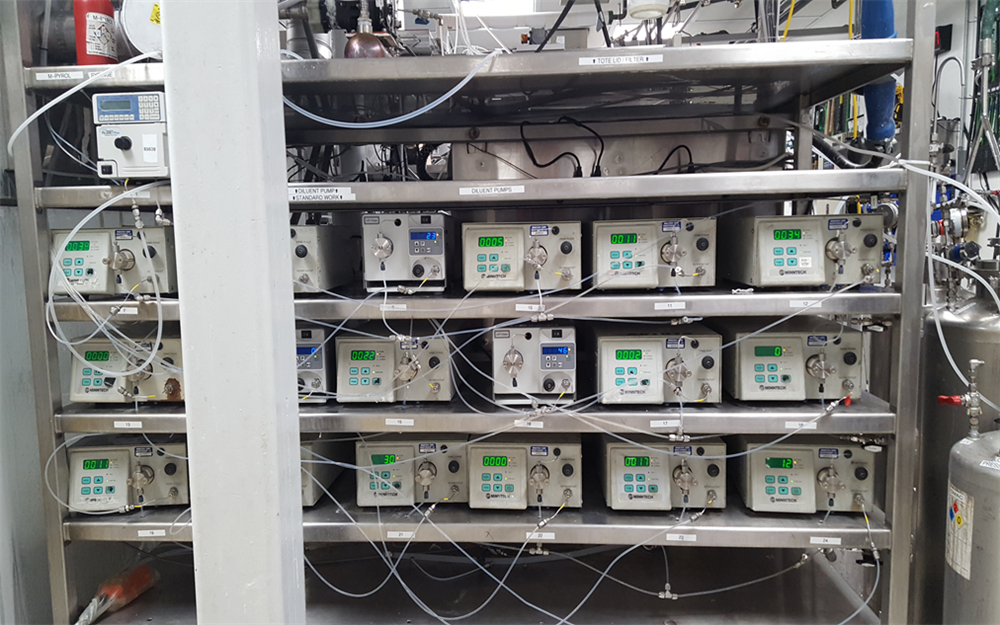
Chrom Tech HPLC pumps have been trusted in production facilities for decades, offering consistent performance, accessible maintenance, and responsive technical support.