
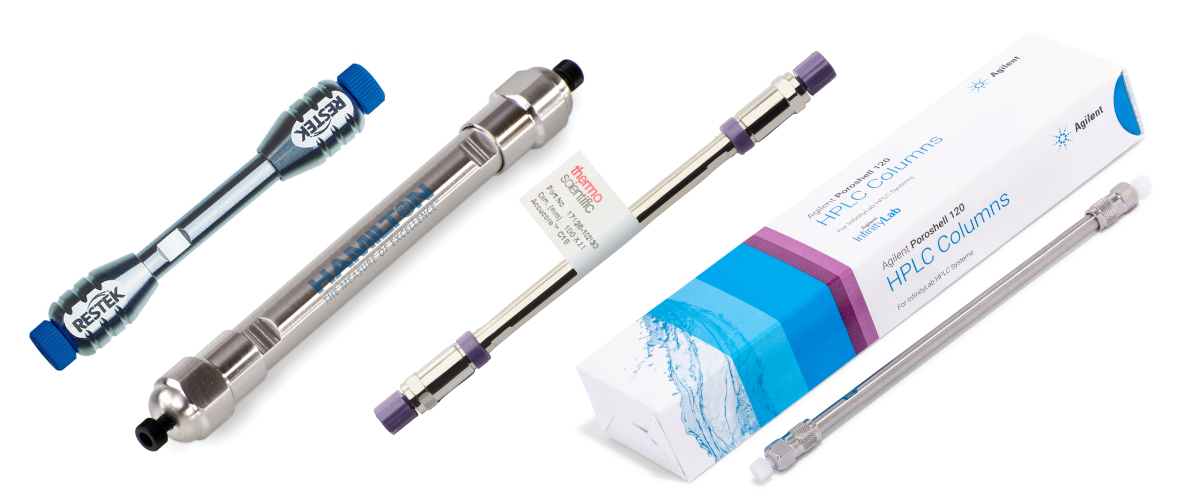
All HPLC columns undergo gradual wear over time. Repeated sample injections, residual proteins, lipids, particulates, and contaminants from the mobile phase or LC system can accumulate inside the column and eventually lead to increased backpressure, reduced efficiency, and declining chromatographic performance. With proper maintenance and good sample preparation practices, however, laboratories can significantly extend column life and maintain more consistent results.
Sample Preparation and Clean-Up
Proper sample preparation is one of the most important factors in extending HPLC column lifetime. Clean-up steps help remove particulates, salts, and matrix components that could foul the stationary phase or block the inlet frit.
Common preparation techniques include:
- Solid-Phase Extraction (SPE): Uses a sorbent cartridge to remove contaminants before analysis and provide cleaner injections
- Liquid-Liquid Extraction (LLE): Separates analytes into an immiscible phase for selective isolation of compounds of interest
- Syringe Filtration: Uses Chrom Tech syringe filters to remove particulates before injection and protect the column from clogging
For simplified sample prep, Chrom Tech also offers filter vials, which combine filtration and vial loading in a single step, and filter plates for scalable 96-well workflows.
Solvent and Buffer Procedures
Using clean, freshly prepared solvents and properly filtered buffers is essential for maximizing column longevity. Old or contaminated mobile phases may contain particulates, precipitated salts, or microbial growth, all of which can damage the column bed or alter chromatographic performance.
Always filter freshly prepared buffers before use and maintain the manufacturer-recommended pH range for the column. Extremely low pH conditions can hydrolyze bonded phases, while excessively high pH can dissolve silica and shorten column life.
Using Filters and Guard Columns
Multiple filtration points in the HPLC system help prevent debris from reaching the analytical column:
- Inline Solvent Filters: Installed between the pump and injector to capture debris before it enters the flow path
- Pre-Column Filters: Positioned immediately before the column to trap remaining particulates in the sample stream
- Guard Columns: Short columns packed with matching stationary phase to capture contaminants before they reach the analytical column
Chrom Tech guard columns are a practical way to extend analytical column life because the guard can be replaced when contaminated, protecting the more expensive main column.
Follow Operating Conditions
Staying within the column manufacturer’s specified operating conditions is essential for long-term performance. Each HPLC column has defined limits for pH, temperature, and pressure, and operating outside these limits can shorten column life and compromise reproducibility.
For example, silica-based reversed-phase packings are often stable near room temperature across a pH range of approximately 2 to 8. Hybrid-silica materials may tolerate a broader range, such as pH 1 to 12. However, operating near either limit at elevated temperature can accelerate degradation.
Always review the column documentation for guidance on solvent compatibility, sample loading, storage solvent, and maximum operating conditions.
How to Extend Column Life in Daily Practice
In daily laboratory use, the most effective strategies for extending HPLC column lifetime include:
- Performing proper sample clean-up before injection
- Filtering all samples, buffers, and mobile phases
- Using syringe filters, filter vials, or filter plates as appropriate
- Installing inline filters and guard columns
- Preparing fresh solvents and replacing aqueous buffers regularly
- Operating within the recommended pH, temperature, and pressure limits
Combining these practices helps maintain column efficiency, reduce pressure buildup, and protect chromatographic performance over a greater number of injections.