
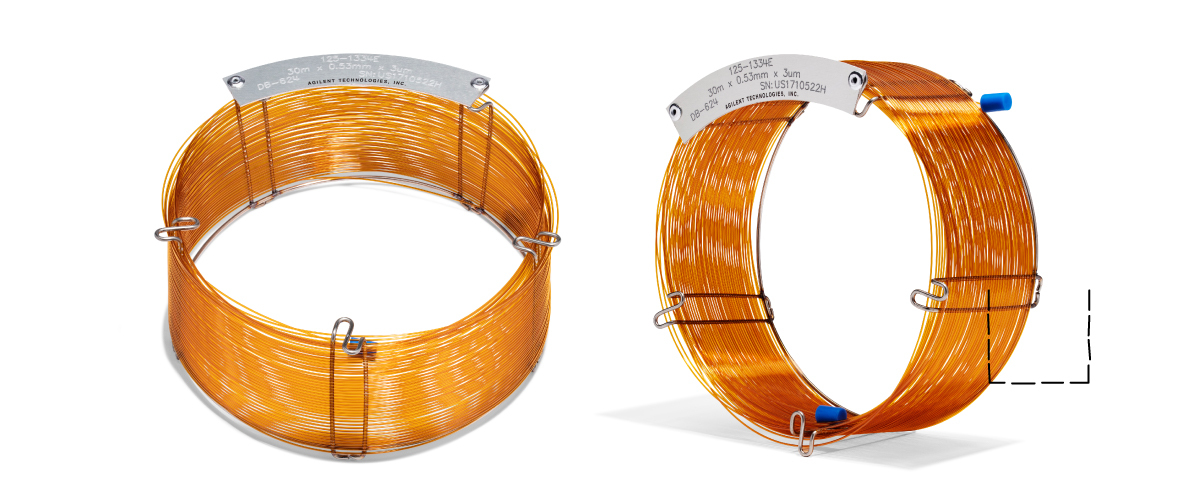
Choosing the right GC column has a direct impact on separation quality, run time, sensitivity, and method robustness. For most laboratories, the best approach is to begin with a few key variables that control chromatography performance: stationary phase, column length, inner diameter, and film thickness.
Chrom Tech supports GC laboratories with column selection guidance built around practical decision points. When selecting a GC column for a new method or refining an existing one, it helps to first identify the chemistry of the analytes, then align the column dimensions with the required resolution, speed, and sensitivity.
Start with Stationary Phase
Stationary phase is the first and most important GC column selection variable because it determines how strongly analytes interact with the column. A good starting point is to match the column phase to the chemical character of the compounds being analyzed.
- Non-polar columns are typically used for hydrocarbons and general-purpose applications.
- Polar columns are better suited to alcohols, acids, amines, and other polar compounds.
- Mid-polar columns are a practical starting point for mixed or unknown sample types.
For many routine GC methods, beginning with the correct phase family simplifies the rest of the selection process and reduces trial-and-error method development.
Use Column Length to Balance Resolution and Speed
Column length plays a major role in separation efficiency and total run time. In general, longer columns improve resolution, while shorter columns reduce analysis time.
- 30–60 m columns are better when maximum resolution is the main priority.
- 15–30 m columns are often preferred when faster run times are more important.
When method speed matters, a shorter column can improve productivity. When closely eluting compounds need better separation, a longer column is often the better choice.
Use Inner Diameter to Adjust Sensitivity
Column inner diameter affects sample capacity, efficiency, and sensitivity. In general, smaller inner diameters provide higher sensitivity, making them useful for low-concentration or trace-level analysis.
Common selection logic includes:
- 0.18–0.25 mm ID columns for higher sensitivity and lower concentration samples
- 0.25–0.53 mm ID columns when application needs, method robustness, or sample loading requirements call for larger dimensions
For many standard methods, 0.25 mm ID remains a strong general-purpose choice because it balances performance and usability.
Match Film Thickness to Analyte Volatility
Film thickness is especially important when analytes vary in volatility. A thicker film increases retention for very volatile compounds, while a thinner film is often better for high-boiling compounds.
- Thicker films such as 0.5 µm or greater are useful for highly volatile analytes.
- Standard films around 0.25 µm are a practical choice for many routine applications.
- Thinner films at 0.25 µm or less are often preferred for high-boiling compounds.
Film thickness can also be used strategically to support either faster analysis or stronger retention, depending on the sample profile.
A Practical GC Column Decision Path
A practical decision tree for GC column selection can be summarized in four steps:
- Identify the analyte type and choose a non-polar, polar, or mid-polar stationary phase.
- Define the main goal, such as maximum resolution, faster run time, or higher sensitivity.
- Evaluate analyte volatility to guide film thickness selection.
- Decide whether speed or robustness matters more and adjust column dimensions accordingly.
If faster run times are the priority, a shorter column with a thinner film may be the better fit. If reproducibility and general robustness are more important, standard dimensions are usually the safer starting point.
A Reliable Starting Point for Many GC Methods
For many routine GC applications, a 30 m × 0.25 mm × 0.25 µm column with a non-polar stationary phase is a reliable starting point. This configuration balances resolution, speed, and sensitivity and works well as a general-purpose baseline for method development or troubleshooting.
Chrom Tech helps laboratories choose GC columns based on application needs, analyte chemistry, and practical performance goals. Starting with the right phase and dimensions can reduce method development time and improve the chances of achieving a stable, useful separation more quickly.