
In high-performance liquid chromatography (HPLC), stable solvent delivery is important for accurate and reproducible analysis. Even small changes in pressure or flow can create detector noise and baseline instability, which can affect quantitation and sensitivity. This is why many HPLC systems use a pulse dampener to smooth the flow produced by reciprocating piston pumps.
Pulse dampeners are especially useful in applications where solvent delivery stability directly affects chromatographic performance. By reducing pump pulsation, they help create a more consistent flow profile through the system and column.
Why Pulse Dampeners Are Used in HPLC Pumps
Chrom Tech’s positive-displacement piston pumps are designed for precise solvent delivery across analytical, clinical, preparative, and metering applications. Even with accurate pump design, reciprocating piston movement naturally creates some pulsation during the refill cycle, when flow briefly decreases and pressure can fluctuate.
These fluctuations may appear as baseline noise in the detector and can negatively affect the limit of detection (LOD) and quantitative precision in sensitive methods. To help minimize these effects, Chrom Tech recommends using a pulse dampener to absorb pressure spikes and stabilize solvent flow.
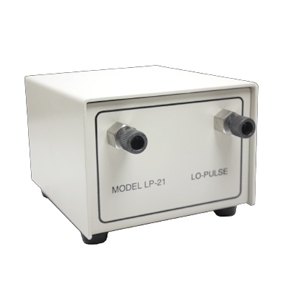
The LO-Pulse Pulse Dampener is designed to reduce pump pulsations in flow-sensitive HPLC applications. It can be factory-installed inside an HPLC pump or added externally to an existing system.
How a Pulse Dampener Works
The LO-Pulse Pulse Dampener works through a fluid-compression design that helps balance the pulsation created by reciprocating piston pumps. Inside the device is an internal cavity divided by a flexible, chemically inert diaphragm. The lower chamber contains a damping fluid that compresses and expands in response to pressure changes in the mobile phase stream.
When system pressure rises during the pump’s forward stroke, the damping fluid compresses slightly and absorbs excess energy. When the piston retracts and pressure briefly drops, the fluid expands again to help maintain more consistent pressure and flow through the column.
This compensation helps reduce the flow irregularities that can otherwise contribute to baseline drift or detector noise.
Operating Conditions for Effective Pulse Dampening
The LO-Pulse performs best at operating pressures of 500 psi or higher, with ideal performance above 1,000 psi. Its internal volume of about 0.9 mL provides a completely swept flow path, which helps minimize solvent memory effects when changing mobile phases.
For additional dampening efficiency, a short length of small-bore tubing can be added at the outlet to create slight flow restriction.
Benefits of the LO-Pulse Pulse Dampener
- Reduces baseline noise and signal fluctuation in sensitive analyses
- Improves quantitative precision by helping maintain a steadier flow rate
- Minimizes detector noise associated with pump piston cycles
- Enhances system stability in gradient and isocratic separations
- Compatible with single- and dual-piston pumps
- Operates automatically without manual adjustments or controls
Improving HPLC Flow Stability
A pulse dampener is a simple but effective addition to HPLC systems that use reciprocating piston pumps. By smoothing solvent flow and reducing short pressure fluctuations, it helps support better baseline stability, more consistent solvent delivery, and improved analytical performance.
Chrom Tech’s LO-Pulse Pulse Dampener is designed for demanding chromatography workflows and can be used in new systems or retrofitted to existing setups. For help selecting the right configuration, contact Chrom Tech’s technical team at support@chromtech.com.