
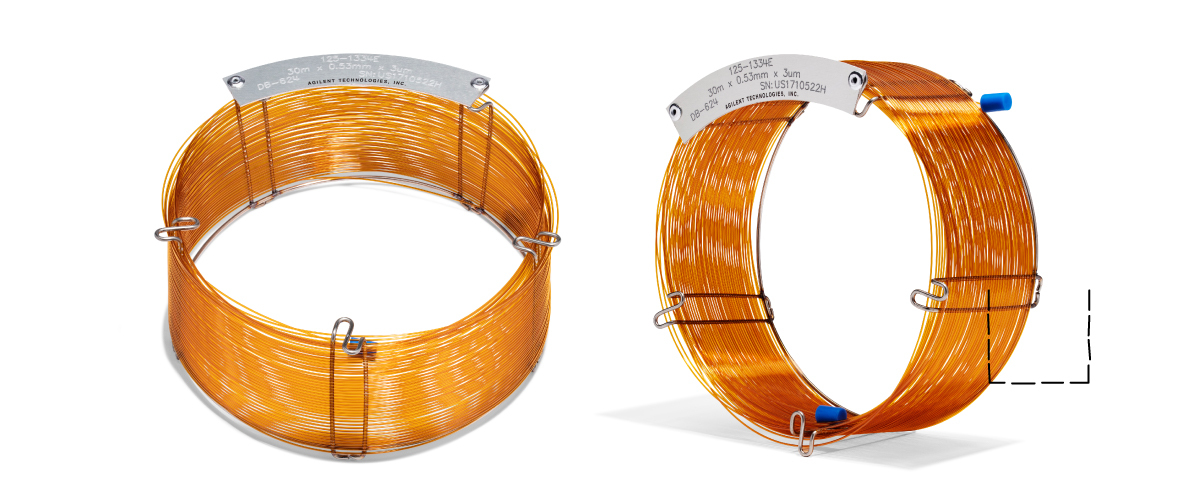
The stationary phase is the most important factor in GC column selection because it determines how compounds interact with the column and how well they separate. A good phase choice improves resolution, supports more accurate identification, and helps produce reproducible results across a wide range of applications.
Chrom Tech helps laboratories simplify GC column selection by focusing first on the chemistry of the sample. When choosing a stationary phase, the most useful starting point is to match phase polarity and selectivity to the analytes being measured and to the type of separation the method requires.
What the GC Stationary Phase Does
The stationary phase is the liquid coating bonded to the inside of the GC column. As analytes pass through the column, they interact with that phase, and those interactions determine retention and separation behavior.
Different stationary phases change GC performance by affecting:
- Polarity-based interactions
- Intermolecular interactions
- Boiling point behavior
Because the stationary phase drives selectivity, it often has a greater impact on separation quality than simply changing column dimensions alone.
Non-Polar GC Stationary Phases
Non-polar phases such as 100% dimethylpolysiloxane are commonly used when analytes are non-polar and separation is driven mainly by boiling point differences.
Characteristics of Non-Polar Phases
- Low polarity
- Separation based mainly on boiling point
- Strong fit for non-polar analytes
Best Uses for Non-Polar Phases
- Hydrocarbons
- Petrochemicals
- Environmental samples
- Alkanes and aromatics
For hydrocarbon-focused work and general non-polar separations, non-polar phases are often the best fit.
Mid-Polar GC Stationary Phases
Mid-polar phases such as 5% phenyl / 95% dimethylpolysiloxane provide more balanced selectivity and are often the most practical option when the sample contains mixed chemistries or when the analyte profile is not fully known.
Characteristics of Mid-Polar Phases
- Moderate polarity
- Balanced selectivity
- Useful across broad method types
Best Uses for Mid-Polar Phases
- General-purpose analysis
- Unknown samples
- Mixed compound classes
- Many pharmaceutical methods
For many laboratories, a mid-polar phase is the most useful starting point because it offers broad compatibility and dependable performance across mixed sample types.
Polar GC Stationary Phases
Polar phases such as polyethylene glycol (PEG) are best when analytes are polar and stronger dipole or hydrogen-bonding interactions are needed to achieve useful selectivity.
Characteristics of Polar Phases
- High polarity
- Stronger interaction with polar compounds
- Useful when selectivity depends on dipole and hydrogen bonding interactions
Best Uses for Polar Phases
- Alcohols
- Acids
- Esters
- Flavor and fragrance compounds
When the target compounds are clearly polar, a polar stationary phase is often the best route to stronger selectivity and better peak separation.
How to Choose the Right GC Stationary Phase
A practical phase-selection workflow can be broken into three main steps:
- Identify compound polarity. Non-polar analytes generally fit non-polar phases, polar analytes fit polar phases, and unknown mixtures often start with mid-polar phases.
- Consider the separation goal. If compounds have similar boiling points, phase selectivity becomes especially important. If the boiling range is wide, a non-polar phase may already provide adequate separation.
- Match the phase to the application. Environmental testing often uses non-polar phases, pharmaceutical analysis often benefits from mid-polar phases, and flavor or fragrance work often uses polar phases.
The Key Rule: Like Dissolves Like
A useful principle in GC stationary phase selection is that compounds interact most strongly with phases that have similar polarity. In practice, this often leads to better separation, improved peak shape, and more reliable results.
This is why phase polarity should be evaluated first, before making fine adjustments to dimensions or other method variables.
Common Stationary Phase Selection Mistakes
One common mistake is using a non-polar column for strongly polar compounds, which can lead to poor separation and co-elution. Another is overcomplicating the decision too early when a mid-polar phase may already perform well. It is also important not to ignore phase selectivity differences, because phase choice can matter more than column length in many methods.
A Practical Starting Point for Many Methods
For many general-purpose GC methods, a mid-polar phase such as 5% phenyl is a strong starting point. It provides balanced selectivity, works well with mixed samples, and supports reliable performance across a broad range of analytical conditions.
Chrom Tech helps laboratories choose GC columns by focusing on analyte chemistry, application fit, and practical selectivity. Starting with the right stationary phase can reduce method development time and improve the chances of achieving useful separation more quickly.