
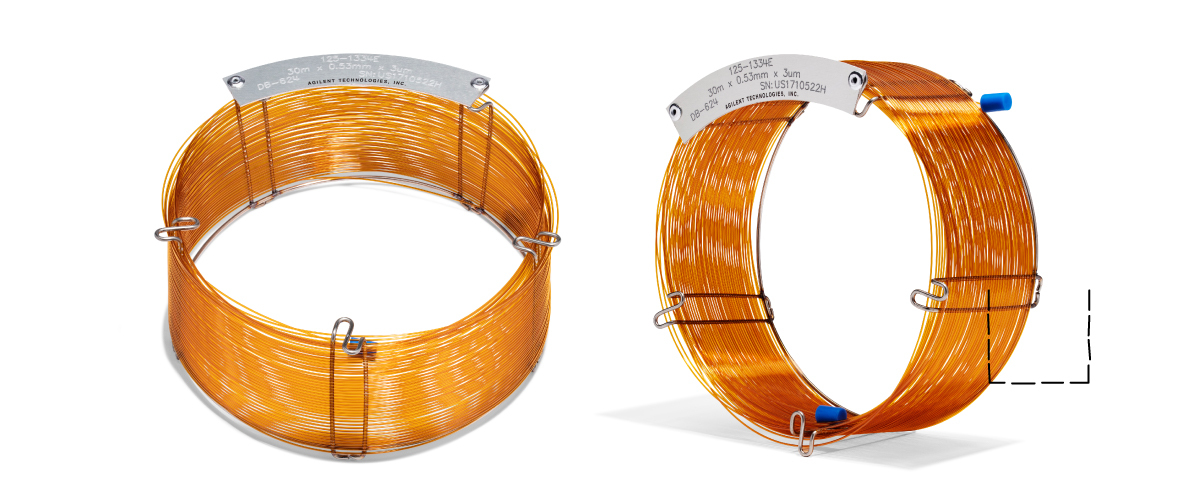
GC column dimensions are one of the most important variables in method performance because they directly influence separation quality, sensitivity, sample capacity, and run time. The three main dimensions to evaluate are length, inner diameter (ID), and film thickness. Understanding how these three variables work together helps laboratories choose a column that fits both the sample and the performance goal.
Chrom Tech supports GC laboratories with practical selection guidance that makes column choice easier to understand. Rather than treating dimensions as isolated specifications, it is more useful to view them as connected parameters that shape chromatographic behavior as a system.
GC Column Length Explained
Column length determines how much time analytes have to separate as they move through the GC system. In general, longer columns increase resolution, while shorter columns reduce analysis time.
What Longer Columns Do
- Higher resolution
- Better separation of complex mixtures
- Longer run times
Longer columns in the 30–60 m range are useful when working with closely related compounds, complex samples, or method development where better separation is the main priority.
What Shorter Columns Do
- Faster analysis
- Lower resolution
- Better fit for routine or high-throughput methods
Shorter columns in the 15–30 m range are often chosen for fast screening, simple mixtures, and laboratories focused on productivity.
GC Column Inner Diameter Explained
Inner diameter affects sensitivity, efficiency, and sample capacity. Smaller and larger IDs each have clear tradeoffs, so the right choice depends on sample cleanliness, concentration, and how much sample loading flexibility is needed.
Smaller ID Columns
Smaller ID columns, typically in the 0.18–0.25 mm range, are associated with:
- Higher sensitivity
- Narrower peaks
- Lower sample capacity
These are often preferred for trace analysis, sensitive detection, and cleaner samples where higher performance is needed.
Larger ID Columns
Larger ID columns, typically in the 0.32–0.53 mm range, are associated with:
- Higher sample capacity
- Lower sensitivity
- More robustness for dirtier samples
Larger IDs are often better for routine industrial analysis, more complex matrices, and methods where the sample load is higher and peak sharpness is less critical.
Smaller IDs require tighter flow control, while larger IDs are more forgiving but less efficient. This tradeoff is central to column selection.
GC Film Thickness Explained
Film thickness influences how strongly analytes are retained and how the column handles compounds with different volatility. It also affects peak shape and method speed.
Thicker Films
Thicker films, generally 0.5 µm or greater, are useful for:
- Better retention of volatile compounds
- Reduced analyte loss
- Longer retention times
These are often selected for volatile analytes, gas samples, and early-eluting compounds that need stronger retention.
Standard and Thin Films
Standard films around 0.25 µm provide balanced performance for many methods. Thinner films, generally in the 0.1–0.25 µm range, are better when the goal is:
- Faster elution
- Better performance with high-boiling compounds
- Sharper peaks in suitable applications
When volatile analytes are retaining too weakly, increasing film thickness is often the right correction. When high-boiling compounds retain too long, a thinner film may be a better fit.
How Length, ID, and Film Thickness Work Together
GC column dimensions are interdependent, and the overall result depends on the combination rather than a single number alone.
For example:
- Long column + small ID + thick film supports maximum resolution but usually gives the slowest run time.
- Short column + large ID + thin film favors faster analysis but gives lower resolution.
A balanced configuration for many methods is 30 m × 0.25 mm × 0.25 µm, which provides a practical middle ground between speed, sensitivity, and separation performance.
Common GC Column Dimension Mistakes
Some of the most common dimension-related mistakes include choosing a column that is longer than necessary, selecting an ID that is too large for the sensitivity required, or using a film thickness that does not match analyte volatility.
- A column that is too long can create unnecessarily long run times without improving separation enough to justify it.
- An ID that is too large can reduce sensitivity and broaden peaks.
- The wrong film thickness can make volatile compounds elute too quickly or cause high-boiling compounds to retain too long.
A Practical Starting Point for Many Methods
For many general GC applications, starting with a 30 m × 0.25 mm × 0.25 µm column provides a flexible baseline. This configuration balances resolution, speed, and sensitivity well enough to support a wide variety of routine separations.
Chrom Tech helps laboratories choose GC columns by focusing on analyte behavior, method goals, and practical operating tradeoffs. When column dimensions are selected thoughtfully, method development becomes faster and performance is easier to optimize.