
Key Highlights
- Gas chromatography vials help protect sample integrity and support analytical accuracy in GC testing.
- Understanding vial types such as clear and amber helps reduce degradation risk and preserve sample purity.
- Proper vial selection depends on sample volume, material, and autosampler compatibility.
- Vial design, sealing method, and material choice can directly affect chromatographic performance.
- Correct handling and storage practices help reduce contamination risk and preserve analytical precision.
Introduction
Gas chromatography vials are important to maintaining sample integrity and achieving accurate analytical results. These vials are commonly made from borosilicate glass and are designed to support secure storage, reliable autosampler handling, and consistent injection performance. Whether the sample contains volatile compounds or more complex mixtures, the right vial helps reduce evaporation, limit contamination, and support better chromatographic consistency.
For GC laboratories, vial selection is more than a packaging decision. The vial, closure, and septum all influence how well the sample is protected before injection and how consistently the autosampler can perform.
Understanding Gas Chromatography Vials
Explore Chrom Tech’s Full Range of GC Vials and Closures
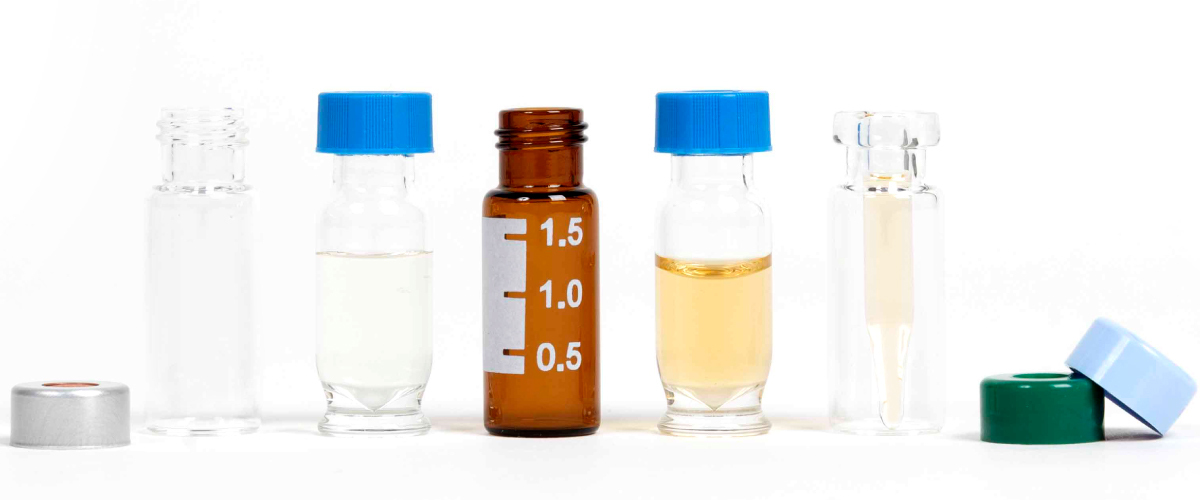
Gas chromatography vials act as secure sample containers before analysis. They are available in both clear and amber formats, with each option supporting different sample needs. Clear glass vials are useful when visual inspection is important, while amber vials help protect photosensitive compounds from light exposure that may cause degradation.
The correct choice depends on sample stability, storage conditions, and the specific analytical requirements of the application.
The Role of Vials in Gas Chromatography
GC vials help maintain sample purity, reduce evaporation, and limit cross-contamination. Their flat-bottom designs help provide stability during handling and autosampler use, while properly matched caps and silicone/PTFE septa help create airtight seals. Reliable vial performance supports chromatographic efficiency and helps preserve peak integrity from sample preparation through injection.
Clear vs. Amber Vials
Clear vials are commonly used for routine applications where visual sample inspection is helpful. Amber vials are better suited to light-sensitive compounds because they help shield the sample from UV and visible light exposure. Both clear and amber vials can support good autosampler compatibility when dimensions are controlled correctly, so the key difference is usually sample sensitivity rather than instrument fit.
Selecting the Right Vial for Your Application
Comprehensive Guide to Choosing the Right Chromatography Vial
Choosing the right GC vial means aligning the vial design with the sample and the instrument. Important variables include material composition, sample volume, closure type, and autosampler compatibility. For volatile samples, tight-sealing caps with PTFE-lined septa are especially important because they help reduce evaporation and preserve analyte integrity.
Borosilicate glass is a common choice when chemical resistance, visibility, and inertness are priorities. Polypropylene can be considered in applications where disposability, breakage reduction, or convenience are more important.
Factors That Influence GC Vial Selection
- Sample Volume: Vial capacity affects concentration handling and detection sensitivity. Smaller vials can help minimize sample loss in trace analysis, while larger vials may suit higher-volume testing.
- Material Composition: Borosilicate glass offers chemical resistance and durability, while plastic vials may reduce breakage risk in higher-throughput environments.
- Closure Type: Silicone/PTFE septa help provide tight seals and good chemical resistance, supporting sample purity during storage and injection.
- Autosampler Fit: Consistent vial dimensions help prevent leaks, misalignment, and handling issues inside automated systems.
Autosampler Compatibility
Vials must fit correctly in the autosampler tray and align properly with the injection system to avoid leaks, poor positioning, or interrupted sequences. Chrom Tech’s GC vials are described as being designed for broad compatibility across autosamplers from major brands including Agilent, Shimadzu, and Thermo Fisher. Proper vial-to-sampler fit helps improve injection precision and reduces avoidable downtime.
Proper Handling and Storage
Correct handling helps protect sample quality before the vial ever reaches the instrument. GC vials should be handled with clean gloves, and users should avoid touching vial rims or septa surfaces directly. This helps reduce contamination risk at critical sealing and injection surfaces.
Store vials upright in a controlled environment away from direct light and contaminants. Vials should also be inspected periodically for chips, cracks, residue, or other visible issues before use. These simple practices help improve reliability and support more consistent chromatographic performance.
Conclusion
Learn More About GC Headspace Vials and Their Applications
Gas chromatography vials play a foundational role in achieving accurate, contamination-controlled results. Choosing the right material, color, closure, and size helps protect sample integrity and improve chromatographic performance. Whether the method calls for clear vials in routine analysis or amber vials for light-sensitive samples, the best vial choice is the one that preserves the sample and works smoothly with the autosampler.
Chrom Tech offers GC vials and closures designed to support dependable performance across a wide range of analytical applications.