
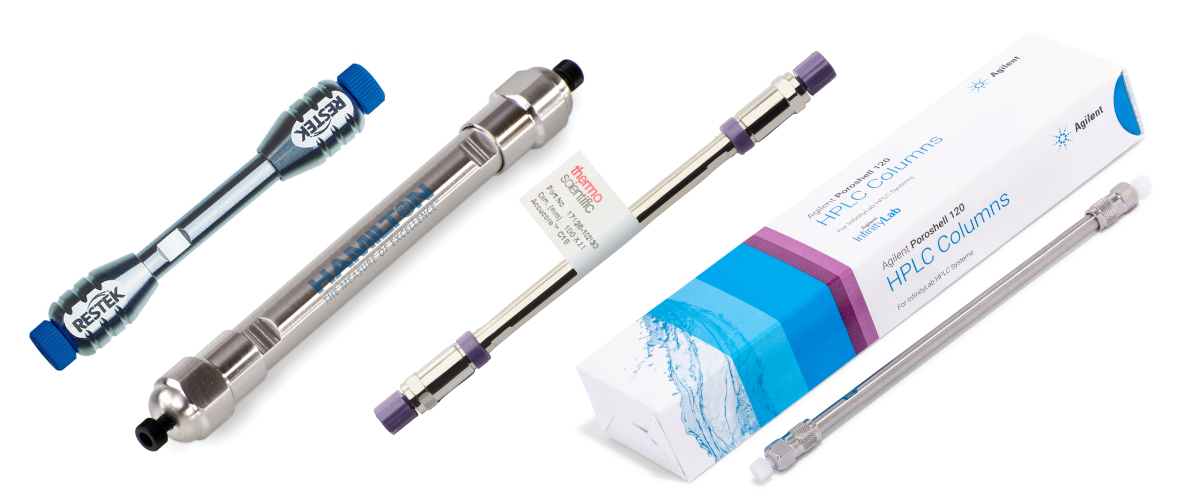
Proper regeneration and cleaning are important for extending the life of HPLC columns and maintaining consistent chromatographic performance. Routine maintenance helps remove accumulated particulates, salts, and strongly retained analytes that can contribute to rising pressure, poor peak shape, or reduced efficiency.
Standard Regeneration Procedure for Reversed-Phase Columns
For reversed-phase columns that can be backflushed—typically those packed with particles larger than 1.8 µm—cleaning is usually performed using progressively stronger solvents. Waste should always be directed into a collection vessel, and system pressure limits must never be exceeded.
- Disconnect the column from the detector and divert flow to waste.
- Flush with 10–20 column volumes of mobile phase without buffer salts, such as a water/organic mixture.
- Rinse with 100% organic solvent such as methanol or acetonitrile.
- Check the system pressure. If it returns to normal, regeneration may be complete.
- If pressure remains high, use a stronger solvent mixture such as 75% acetonitrile / 25% isopropanol.
- If contamination persists, flush with 100% isopropanol, methylene chloride, or hexane.
Important: If methylene chloride or hexane is used, flush with isopropanol before returning the column to a reversed-phase aqueous/organic mobile phase.
Important: Columns packed with sub-2 µm particles should not be backflushed. Backflushing these columns may disrupt the packed bed and cause irreversible damage. In those cases, replacement is generally recommended rather than reverse flushing.
Column Regeneration Quick Reference
| Column Particle Size | Backflush Allowed? | Initial Solvent | Intermediate Solvent | Strong Solvent (if needed) | Notes |
|---|---|---|---|---|---|
| > 1.8 µm | Yes | Mobile phase (no buffer) | 100% Methanol or ACN | 75% ACN / 25% IPA → 100% IPA / Methylene Chloride / Hexane | Flush with isopropanol before switching back to aqueous mobile phase |
| < 1.8 µm | No | Replace column – backflushing not recommended | |||
Storage Recommendations for Reversed-Phase Columns
After regeneration, proper storage helps protect column integrity and improve reproducibility in future analyses. For silica-based bonded-phase columns, storage in a pure organic solvent such as acetonitrile is typically recommended.
- Purge the column with 20–30 column volumes of a 50:50 methanol/water mixture to remove buffer salts.
- Follow with 20–30 column volumes of 100% organic solvent.
- Seal both ends tightly using end plugs to prevent the column from drying out.
Residual buffer salts should also be removed from the instrument and flow path before storage. Flushing with a non-buffered mobile phase, such as 60:40 acetonitrile/water instead of 60:40 acetonitrile/phosphate buffer, helps reduce corrosion risk and shortens equilibration time before the next use.
Use a Standalone HPLC Pump for Regeneration
Column regeneration can be performed without occupying the main analytical system by using a standalone HPLC pump. This approach allows flushing and regeneration to take place independently, preserving analytical uptime and making overnight cleaning workflows easier to manage.
Chrom Tech offers HPLC pumps, HPLC accessories, and stainless-steel tubing assemblies that support column cleaning and regeneration workflows.