
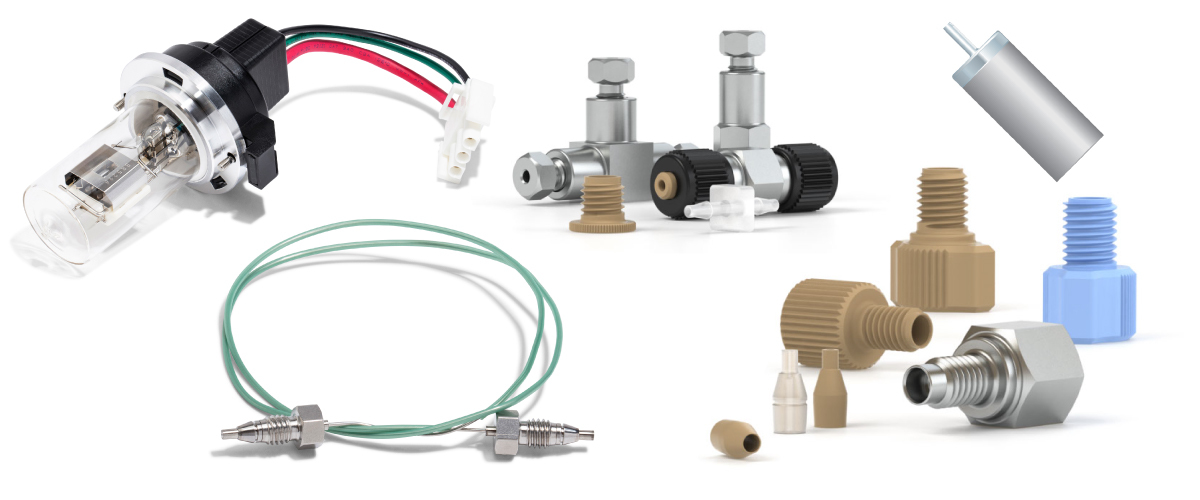
Replacing capillary tubing connections in an HPLC system can seem complicated, but selecting the correct tubing dimensions and fittings is one of the most important ways to preserve consistent chromatographic performance. Choosing the proper capillary length, inner diameter, and connection type helps minimize extra-system dispersion and supports accurate, reproducible separations.
This guide summarizes practical considerations for selecting Agilent HPLC replacement capillaries and related fittings for reliable system performance.
Selecting the Correct Tubing Length
Each capillary segment in an HPLC system affects overall flow path efficiency. When replacing tubing, it is important to match the tubing length to the manufacturer’s design for the specific instrument model. Tubing that is too long can increase dispersion and may also increase system pressure. Tubing that is too short can create tension at the fitting and make sealing less reliable.
Chrom Tech provides Agilent replacement capillaries designed for accurate fit and reliable low-dead-volume performance. Using the correct replacement length helps maintain controlled flow and reproducible chromatography.
Choosing the Right Inner Diameter (ID)
The inner diameter of capillary tubing strongly affects flow behavior, pressure, and extra-column dispersion. Smaller tubing IDs are often used in UHPLC and high-efficiency systems where minimizing dispersion is especially important, while larger IDs may be more appropriate in standard HPLC or higher-flow applications.
- Smaller IDs (≤ 0.12 mm): Help minimize dispersion in UHPLC and microflow applications
- Standard IDs (0.17–0.25 mm): Common in analytical HPLC systems where a balance of flow and pressure is needed
- Larger IDs (≥ 0.30 mm): Better suited for higher-flow or preparative chromatography where pressure sensitivity is lower
Selecting the correct ID helps maintain appropriate pressure while protecting peak shape and chromatographic efficiency.
Simplifying Column Connections
For users who want faster and more reliable column changes, Chrom Tech recommends InfinityLab Quick Connect and Quick Turn fittings. These fittings are designed to create a zero-dead-volume connection without requiring a wrench or torque tool.
They can help reduce overtightening, speed up column changes, and improve long-term connection consistency.
At-a-Glance Color Coding Keys for Agilent Capillary Tubing
| Internal Diameter | Color Code |
|---|---|
| 0.015 mm | Orange |
| 0.025 mm | Yellow |
| 0.05 mm | Beige |
| 0.075 mm | Black |
| 0.1 mm | Purple |
| 0.12 mm | Red |
| 0.17 mm | Green |
| 0.20 / 0.25 mm | Blue |
| 0.3 mm | Grey |
| 0.50 mm | Bone White |
Fitting Left / Fitting Right
| Key | Description |
|---|---|
| S | Swagelok with standard 1.6 mm Port ID |
| H | Long head nut, recommended for tight spaces |
Note: Most capillaries listed come with a fitting for each end, unless noted otherwise. Fittings are pre-swaged as indicated.
Tips for Replacing Agilent Capillary Tubing
- Verify compatibility: Confirm that the part number, tubing length, and ID match the specific Agilent model
- Use clean tools: Avoid contamination during installation by using clean handling practices and appropriate cutting tools when needed
- Check for leaks: After installation, perform a pressure test to confirm secure connections
- Keep spare parts on hand: Stocking commonly used capillaries and fittings helps reduce instrument downtime
Why Correct Capillary Selection Matters
Capillary tubing is not just a replacement part—it is part of the chromatographic flow path. Incorrect tubing dimensions can increase system dispersion, contribute to poor peak shape, and reduce method reproducibility. Matching tubing length and ID to the instrument design helps maintain the low-volume connections needed for high-quality separations.
At Chrom Tech, replacement Agilent capillaries and InfinityLab fittings are available to support reliable maintenance and efficient chromatography workflows.
Your one-stop resource for Agilent LC replacement parts—click through to the main page today.
Chrom Tech is a Minnesota-based, worldwide distributor of chromatography instrumentation and mass spectrometry supplies. We carry vials, well plates, syringe filters, solvent waste containers, and other critical chromatography and spectrometry products. Contact Chrom Tech today to become your trusted supplier for your analytical lab needs.