

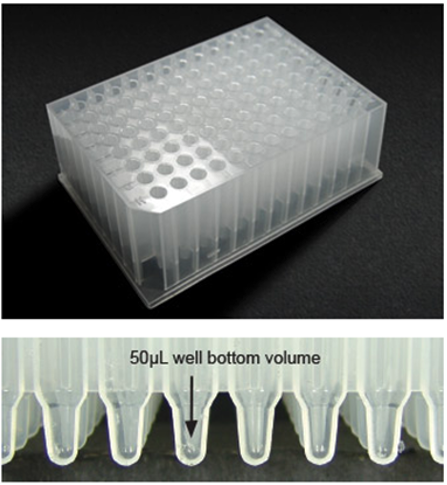
For high-throughput laboratories, 96-well plates have become an essential tool for efficient sample handling. Compared with chromatography vials, they offer important advantages in cost savings, automation compatibility, and workflow consistency. Well plates support automated pipetting, reduce consumable use, and simplify sample tracking, making them valuable in analytical, pharmaceutical, and research environments.
Different plate formats can support different stages of a workflow. Laboratories may begin with a 1 mL or 2 mL plate for initial sample preparation and later transfer material into smaller-volume formats for reconstitution or final analysis. However, each transfer step increases the risk of error, wasted time, and sample loss. Chrom Tech’s TrueTaper Well Plates are designed to reduce or eliminate these transfer steps, helping improve both recovery and precision.
Optimized Sample Volumes with TrueTaper Plates
Chrom Tech’s TrueTaper 96-well plates feature precision-tapered wells designed to minimize residual volume and support flexible sample handling. These plates are available in both 1 mL and 2 mL well volumes, with tapered bottoms that hold approximately 50 µL in the 1 mL plate and 100 µL in the 2 mL plate.
Depending on injector needle depth and handling method, the TrueTaper design can support accurate recovery at micro-volume levels as low as 3 µL. This versatility allows laboratories to handle both larger and smaller sample volumes in the same plate format, reducing the need for intermediate transfers and improving reproducibility.
By combining low dead volume with high total well capacity, TrueTaper plates provide a practical solution for workflows that require both high-volume processing and efficient low-volume recovery.
| Distance From Bottom (mm) | 1 mL TrueTaper Plate (96-0001T) Volume (µL) |
2 mL TrueTaper Plate (96-0002T) Volume (µL) |
|---|---|---|
| 1 | 3 | 4 |
| 2 | 8 | 12 |
| 3 | 14 | 20 |
| 4 | 21 | 30 |
| 5 | 29 | 41 |
| 6 | 37 | 52 |
| 7 | 47 | 65 |
| 8 | 59 | 79 |
| 9 | 79 | 94 |
| 10 | 106 | 112 |
| 11 | 134 | 139 |
| 12 | 162 | 178 |
| 13 | 191 | 236 |
| 14 | 220 | 296 |
| 15 | 248 | 357 |
| 16 | 277 | 418 |
| 17 | 307 | 479 |
| 18 | 336 | 541 |
| 19 | 365 | 602 |
| 20 | 395 | 664 |
Reducing Sample Loss During Workflow Transitions
One of the most effective ways to improve sample recovery is to minimize the number of times a sample must be moved between containers. Every transfer step can introduce pipetting error, residual loss, and contamination risk. Using a tapered well plate that supports both early-stage preparation and final recovery helps streamline the workflow and preserve sample integrity.
This is especially important in LC-MS sample preparation, where limited biological samples, expensive standards, or trace analytes may require the most complete recovery possible.
Solutions for Samples Incompatible with Plastic Plates
Some analytes are not ideally suited for polypropylene well plates. Hydrophobic peptides and other adsorption-prone compounds may bind to plastic surfaces, which can reduce signal intensity and cause inconsistent quantitation.
For these samples, Chrom Tech offers a Glass Vial Insert 96-Well Plate System. This hybrid design combines the inert surface properties of glass with the automation compatibility of a standard 96-well plate format.
Glass insert systems are well suited for sensitive applications where low analyte binding, consistent recovery, and reproducibility are critical.
Well Plate Selection and Technical Support
Whether your laboratory needs an in-stock replacement plate or an optimized solution for a new analytical method, Chrom Tech offers well plate options designed for a range of throughput and recovery requirements. Plate geometry, working volume, and material selection all play an important role in maximizing recovery and maintaining workflow consistency.
Chrom Tech’s chromatography specialists can assist with product selection, compatibility questions, and technical recommendations to help match the right plate to your application.