
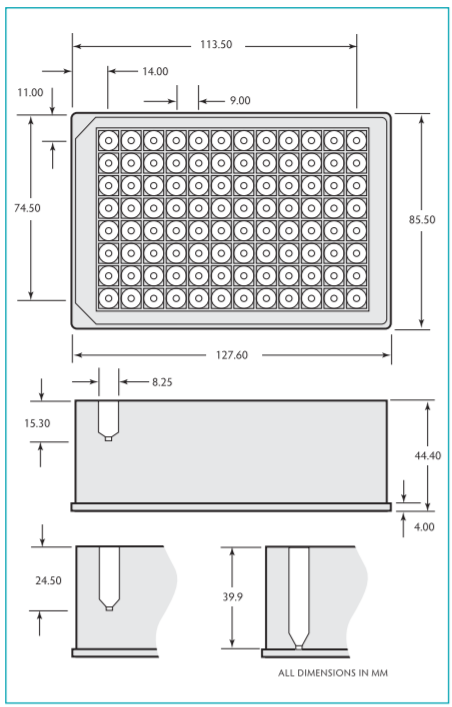

In laboratory science, precision and consistency are essential. The 96-well plate is one of the most widely used microplate formats in analytical, biological, and high-throughput laboratory workflows. Understanding its dimensions is important because plate compatibility affects automation, reproducibility, and instrument performance.
ANSI/SBS standards provide the framework for standard microplate dimensions. These standards help ensure that 96-well plates fit properly across a wide range of laboratory systems, including readers, liquid handlers, washers, and robotic platforms. By standardizing the external footprint, laboratories can improve workflow efficiency and reduce compatibility issues between instruments and consumables.
Understanding the 96-Well Plate Format
A standard 96-well plate contains 96 individual wells arranged in an 8 × 12 grid. This layout supports a wide range of applications, including high-throughput screening, cell culture, fluorescence assays, luminescence assays, absorbance measurements, and many plate-based preparation workflows.
The format is widely used because it offers a balance between throughput, manageable sample volume, and compatibility with automated and manual laboratory processes.
Why ANSI/SBS Standards Matter
ANSI/SBS standards are important because they create dimensional consistency across manufacturers and laboratory systems. This standardization allows microplates to be used reliably across different platforms without repeated adjustments or specialized hardware.
These standards support several important goals:
- Dimensional compatibility with plate-based instruments
- Defined tolerances for precision and repeatability
- Material and design consistency for reliable laboratory use
By following ANSI/SBS guidelines, laboratories can reduce errors, improve reproducibility, and maintain more efficient workflows across a wide range of experiments.
Standard 96-Well Plate Dimensions
A standard 96-well plate typically measures:
- Length: 127.76 mm
- Width: 85.48 mm
- Well-to-well spacing: 9 mm center-to-center
These external dimensions are what make 96-well plates broadly compatible with automated laboratory systems. While the plate footprint is standardized, the base height may vary slightly depending on plate design and manufacturer.
Well Geometry: Round vs Square Wells
Although the overall plate footprint stays the same, well geometry can vary. The two most common options are round wells and square wells, and each offers different performance advantages.
Round wells are often preferred when efficient vortexing or mixing is important because the curved walls support smoother circular flow and reduce sample collection in corners. This can improve sample homogeneity during shaking or mixing.
Square wells maximize the internal usable space within the same plate footprint. Because the corners extend farther toward the boundaries of the well spacing, square wells typically provide greater total and working volume than round wells. For this reason, square wells are often selected when higher sample capacity is needed.
Well Diameter and Volume Considerations
Typical round wells in lower-volume plates—often around 1 mL or less—are commonly about 6.4 mm in diameter. In larger common-wall round well formats, such as some 2 mL round well plates, the diameter may be as large as 8.5 mm.
Important well-related characteristics include:
- Well geometry: round or square
- Well diameter: often about 6 to 8 mm depending on design
- Volume capacity: depends on plate height, well depth, and geometry
If a laboratory is using a friction-fit sealing mat, well diameter becomes especially important because the sealing interaction depends on the internal well opening. For other sealing methods, this dimension is often less critical.
Materials, Colors, and Plate Customization
For chromatography and LCMS applications, 96-well plates are commonly made from virgin polypropylene without mold release agents. Another option is a glass insert system in a polymer plate format when sample compatibility with plastic is a concern.
Plates are also available in a variety of colors and transparency levels. These options can influence assay performance and visualization. For example, more translucent plates improve visual inspection, while black or white plates are often used to optimize luminescence or fluorescence measurements.
Common plate customizations include:
- Materials: polypropylene, glass inserts in polymer plate systems, and polystyrene for specialty applications
- Colors: clear, black, white, and tinted options
- Coatings: low-binding options for specialized workflows
Applications and Benefits of Standardized 96-Well Plates
Standardized 96-well plates are used across many laboratory workflows because they combine versatility, compatibility, and efficiency. Common applications include:
- High-throughput screening
- Cell culture
- Fluorescence, luminescence, and absorbance assays
- Analytical sample preparation
- Automation-driven laboratory workflows
The main benefits of ANSI/SBS-standardized plates include:
- Efficiency for large-scale testing and assay setup
- Reproducibility across laboratories and instruments
- Versatility across different applications and platforms
Choosing the Right 96-Well Plate
Selecting the right 96-well plate depends on the specific needs of the workflow. Important factors include:
- Material – polypropylene for high-throughput and LCMS workflows, glass inserts for chemical compatibility
- Well geometry – round wells for mixing, square wells for higher capacity
- Color and optical properties – based on the detection method
- Coatings – when reduced binding or other specialized performance is needed
Matching plate design to the workflow helps improve reliability, efficiency, and analytical performance in daily laboratory use.
The Value of Standardization in Laboratory Workflows
Standardized 96-well plate dimensions improve compatibility, reduce instrument setup problems, and support reproducible scientific results. ANSI/SBS standards allow laboratories to integrate manual and automated processes more efficiently while maintaining dependable experimental performance across platforms.