
InfinityLab Poroshell 120
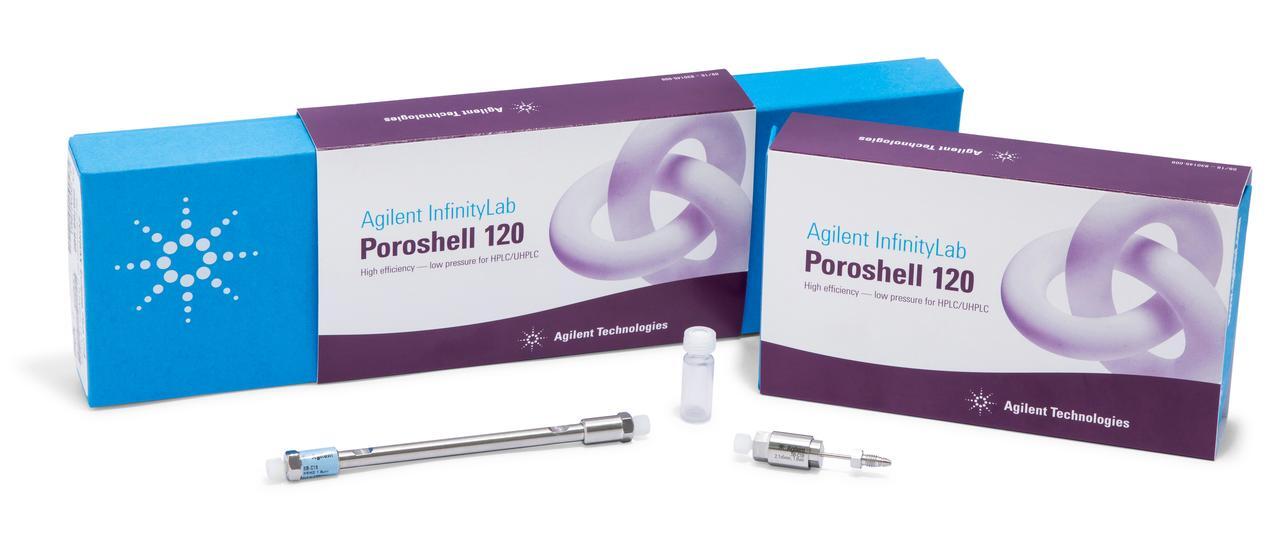
Agilent Poroshell 120 Reversed Phase HPLC Columns
Agilent InfinityLab Poroshell 120 columns deliver high efficiency, fast separations, and reduced backpressure—making them the trusted choice for both conventional LC and UHPLC systems. Their unique solid-core design and 2 µm frit construction allow reliable performance even with challenging or dirty samples.
- Up to 50% lower backpressure than sub-2 µm particles—ideal for 400/600 bar LC and UHPLC systems.
- High-speed performance from a solid core with a porous outer layer that enhances mass transfer and resolution.
- Tight particle size distribution for excellent precision, reproducibility, and peak shape.
Multiple Particle Sizes for Any Method
The Poroshell 120 family is available in 1.9 µm, 2.7 µm, and 4 µm formats—supporting everything from high-speed UHPLC analysis to robust routine HPLC workflows. Whether separating small polar analytes or complex mixtures, Poroshell chemistries provide the selectivity and speed required for modern labs.
Convenient Kits for Method Validation
For quality-control workflows, Agilent offers method validation kits containing columns from three different manufacturing lots. Add a “K” to any Poroshell part number to streamline lot-to-lot reproducibility testing.
Poroshell 120 HILIC Options for Polar Compounds
The newest Poroshell 120 HILIC phases are engineered for fast, high-efficiency separation of polar and highly charged compounds using standard LC systems.
- HILIC-Z — Zwitterionic phase offering excellent peak shape for highly charged compounds under high-pH or elevated-temperature conditions.
- HILIC-OH5 — Poly-hydroxy fructan phase providing orthogonal selectivity for difficult polar analytes.
Why Choose Agilent Poroshell 120?
- High efficiency and resolution across all LC platforms.
- Rugged performance with dirty or complex samples.
- Long column lifetime and consistent batch-to-batch reproducibility.
- Versatile chemistries supporting reversed-phase, HILIC, and polar workflows.
For help selecting the right Poroshell 120 column, contact our technical support team .
Agilent InfinityLab Poroshell 120 EC-C18 is a general-purpose reversed-phase column that pairs superficially porous particle (solid-core) efficiency with a broadly applicable C18 selectivity. It’s designed to deliver UHPLC-level resolution at lower backpressure than fully porous sub-2 µm columns—ideal for method development, method transfer, and routine QC.
- You want a “first-choice” C18 for acids, bases, and neutrals
- You need high efficiency on 400–600 bar systems (without moving to sub-2 µm fully porous)
- You want predictable, broadly compatible reversed-phase retention
- You’re optimizing pharmaceutical QC / impurity profiling workflows
Compared to conventional 3–5 µm fully porous C18 columns, EC-C18 increases efficiency and shortens run time. Compared to sub-2 µm fully porous UHPLC columns, it often achieves similar resolution with reduced pressure and improved robustness.
| Separation Mode | Reversed phase |
| Particle Technology | Superficially porous particle (solid core + porous shell) |
| Pore Size | 120 Å |
| Temperature Limit | 60 °C |
| pH Range | 2.0 – 8.0 |
| Endcapped | Yes |
| Carbon Load | 10% |
| Surface Area | 130 m²/g |
| USP Designation | L1 |
Poroshell 120 EC-C8 provides the same solid-core efficiency as EC-C18 but with a shorter alkyl ligand for reduced hydrophobic retention. This is often the fastest route to shorten run times when C18 retains hydrophobic compounds too strongly, while keeping the method in a familiar reversed-phase mode.
- C18 methods are too retentive or require steep gradients
- You want faster elution while maintaining reversed-phase selectivity
- You need high efficiency without changing solvents or pH
EC-C8 is generally less retentive than EC-C18. If you have adequate resolution on C18 but long cycle times, C8 is a practical selectivity-conserving shortcut to speed.
| Separation Mode | Reversed phase |
| Particle Technology | SPP (solid-core) |
| Pore Size | 120 Å |
| Temperature Limit | 60 °C |
| pH Range | 2.0 – 8.0 |
| Endcapped | Yes |
| Carbon Load | 5% |
| Surface Area | 130 m²/g |
| USP Designation | L7 |
Poroshell 120 Aq-C18 is designed for challenging polar compounds and mobile phases with very high aqueous content. It improves retention of polar analytes in reversed-phase conditions and supports operation at elevated temperatures, helping stabilize retention and peak shape in low-organic or 100% aqueous methods.
- Polar analytes elute too early on standard C18
- You need stable retention in high-aqueous / very low organic mobile phases
- You want to retain polar and nonpolar analytes together in one RP method
- You use elevated temperature to improve mass transfer and peak shape
Compared to conventional C18 phases, Aq-C18 emphasizes polar retention under aqueous conditions. If your RP method shows poor polar retention or unstable early peaks at high water content, Aq-C18 is a targeted fix without switching to HILIC.
| Separation Mode | Reversed phase (polar-retentive C18) |
| Particle Technology | SPP (solid-core) |
| Pore Size | 120 Å |
| Temperature Limit | 90 °C |
| pH Range | 1.0 – 8.0 |
| Endcapped | Yes |
| Carbon Load | Proprietary |
| Surface Area | 130 m²/g |
| USP Designation | L1 |
Poroshell 120 SB-C18 is built for strong stability under aggressive acidic conditions and elevated temperature. It is frequently selected for low-pH methods where robustness and lifetime are the priority, while still benefiting from solid-core efficiency for fast, high-resolution separations.
- Your method operates at low pH and needs long-term stability
- You run elevated temperatures (up to 90 °C) for speed or viscosity reduction
- You want robust C18 selectivity for routine QC under harsh conditions
Compared to EC-C18, SB-C18 is a “ruggedness first” C18 choice for harsher conditions. If your low-pH method is chewing up standard C18 columns, SB-C18 is often the stability upgrade.
| Separation Mode | Reversed phase |
| Particle Technology | SPP (solid-core) |
| Pore Size | 120 Å |
| Temperature Limit | 90 °C |
| pH Range | 1.0 – 8.0 |
| Endcapped | No |
| Carbon Load | 9% |
| Surface Area | 130 m²/g |
| USP Designation | L1 |
Poroshell 120 SB-C8 combines reduced retention (C8) with a rugged, stability-focused design for low-pH workflows. It’s a practical choice when you need speed and stability together, especially for hydrophobic compounds that retain too strongly on C18 at low pH.
- You need faster elution than C18 under acidic conditions
- Low-pH methods require improved column lifetime
- You want robust reversed-phase selectivity for routine runs
| Separation Mode | Reversed phase |
| Particle Technology | SPP (solid-core) |
| Pore Size | 120 Å |
| Temperature Limit | 80 °C |
| pH Range | 1.0 – 8.0 |
| Endcapped | No |
| Carbon Load | 5.5% |
| Surface Area | 130 m²/g |
| USP Designation | L7 |
Poroshell 120 CS-C18 is engineered for extended stability at higher pH while maintaining a familiar reversed-phase C18 retention profile. It’s a strong choice when you need high-pH selectivity control (to manipulate ionization state) without giving up speed or efficiency.
- You need high-pH operation for ionizable compounds (improve selectivity or peak shape)
- Your method runs in buffered pH conditions above typical silica limits
- You want a C18 workflow without switching to polymeric columns
| Separation Mode | Reversed phase |
| Particle Technology | SPP (solid-core) |
| Pore Size | 100 Å |
| Temperature Limit | 90 °C |
| pH Range | 1.0 – 11.0 |
| Endcapped | Yes |
| Carbon Load | Proprietary |
| Surface Area | 95 m²/g |
| USP Designation | L1 |
Poroshell 120 HPH-C18 is designed to maintain performance across a broad pH window up to pH 11, making it a practical C18 option for high-pH method development where selectivity and peak shape depend on analyte ionization.
- You want a high-pH-capable C18 for ionizable analytes
- Changing pH is part of your selectivity strategy
- You need solid-core speed and efficiency with pH flexibility
| Separation Mode | Reversed phase |
| Particle Technology | SPP (solid-core) |
| Pore Size | 100 Å |
| Temperature Limit | 60 °C |
| pH Range | 2.0 – 11.0 |
| Endcapped | Yes |
| Carbon Load | Proprietary |
| Surface Area | 95 m²/g |
| USP Designation | L1 |
Poroshell 120 HPH-C8 combines reduced retention (C8) with broad pH flexibility up to pH 11. It’s often selected when you need both speed and pH-driven selectivity control for ionizable compounds.
- You need faster elution than C18 but also want high-pH flexibility
- Hydrophobic analytes retain too strongly on C18 under high-pH buffered conditions
- You want robust method development space across pH
| Separation Mode | Reversed phase |
| Particle Technology | SPP (solid-core) |
| Pore Size | 100 Å |
| Temperature Limit | 60 °C |
| pH Range | 2.0 – 11.0 |
| Endcapped | Yes |
| Carbon Load | Proprietary |
| Surface Area | 95 m²/g |
| USP Designation | L7 |
Poroshell 120 Bonus-RP is a polar-embedded reversed-phase chemistry designed to improve retention and peak shape for more polar analytes while maintaining classic RP behavior. It can reduce issues like poor early-peak resolution and can help when you need more polar retention without going full HILIC.
- Polar analytes have weak retention on standard C18
- You need improved peak shape for polar/ionizable compounds in RP
- You want an orthogonal RP option that still feels “C18-like” operationally
| Separation Mode | Reversed phase (polar-embedded) |
| Particle Technology | SPP (solid-core) |
| Pore Size | 120 Å |
| Temperature Limit | 60 °C |
| pH Range | 2.0 – 8.0 |
| Endcapped | Yes |
| Carbon Load | 9.5% |
| Surface Area | 130 m²/g |
| USP Designation | L60 |
Poroshell 120 PFP provides alternative selectivity beyond alkyl phases, commonly improving separation of aromatic, halogenated, and structurally similar compounds. PFP chemistries often change elution order versus C18/C8, which can solve coelutions without changing pH or mobile phase class.
- Critical pairs coelute on C18/C8 and you need a selectivity “reset”
- You are separating aromatic, halogenated, or positional isomers
- You want orthogonal RP selectivity without moving to HILIC
| Separation Mode | Reversed phase (alternative selectivity) |
| Particle Technology | SPP (solid-core) |
| Pore Size | 120 Å |
| Temperature Limit | 60 °C |
| pH Range | 2.0 – 8.0 |
| Endcapped | Yes |
| Carbon Load | 5.1% |
| Surface Area | 130 m²/g |
| USP Designation | L43 |
Poroshell 120 Phenyl-Hexyl adds aromatic selectivity (π–π interactions) on a solid-core platform, making it a go-to “selectivity rescue” phase when aromatic compounds or isomers coelute on C18.
- Aromatic analytes coelute on C18/C8
- You need an alternate retention order without changing pH
- You are resolving structural/positional isomers
- You want orthogonal RP selectivity for LC-MS workflows
| Separation Mode | Reversed phase (aromatic selectivity) |
| Particle Technology | SPP (solid-core) |
| Pore Size | 120 Å |
| Temperature Limit | 60 °C |
| pH Range | 2.0 – 8.0 |
| Endcapped | Yes |
| Carbon Load | 9% |
| Surface Area | 130 m²/g |
| USP Designation | L11 |
Poroshell 120 SB-Aq is engineered for strong reversed-phase performance under high-aqueous conditions, including 100% water. It is designed to improve retention and peak shape for polar compounds while resisting issues associated with highly aqueous mobile phases.
- Your method uses very high aqueous content (including 100% water)
- You need improved polar retention in a reversed-phase workflow
- You want an aqueous-stable alternative to standard C18/C8 phases
| Separation Mode | Reversed phase (aqueous-stable) |
| Particle Technology | SPP (solid-core) |
| Pore Size | 120 Å |
| Temperature Limit | 80 °C |
| pH Range | 1.0 – 8.0 |
| Endcapped | No |
| Carbon Load | Proprietary |
| Surface Area | 130 m²/g |
| USP Designation | L96 |
Poroshell 120 EC-CN is a cyanopropyl phase that can be used in reversed-phase for alternative selectivity (especially for polar to mid-polar compounds) and in normal-phase for strong retention and peak shape for nonpolar analytes. It’s a versatile choice when you need a different interaction profile than C18/C8.
- You need alternate selectivity for polar/midpolar compounds in RP
- You want dual-mode flexibility (RP or NP) using one chemistry family
- C18/C8 cannot resolve the selectivity problem
| Separation Mode | Reversed phase / Normal phase (dual-mode) |
| Particle Technology | SPP (solid-core) |
| Pore Size | 120 Å |
| Temperature Limit | 60 °C |
| pH Range | 2.0 – 8.0 |
| Endcapped | Yes |
| Carbon Load | 3.5% |
| Surface Area | 130 m²/g |
| USP Designation | L10 |
Poroshell 120 HILIC-Z targets highly polar and charged analytes using hydrophilic interaction chromatography (HILIC), on a solid-core platform that improves efficiency and helps manage pressure. It is designed for rugged performance under high pH or high temperature, supporting orthogonal selectivity versus reversed-phase methods.
- Polar analytes do not retain in reversed-phase
- You need strong retention of highly polar or charged compounds
- LC-MS workflows require high organic mobile phases (HILIC conditions)
- You want orthogonal selectivity to C18/C8 without ion-pairing
| Separation Mode | HILIC |
| Particle Technology | SPP (solid-core) |
| Pore Size | 100 Å |
| Temperature Limit | 80 °C |
| pH Range | 2.0 – 12.0 |
| Endcapped | No |
| Carbon Load | Proprietary |
| Surface Area | 95 m²/g |
| USP Designation | L114 |
Practical note: HILIC methods require sufficient equilibration time after gradient changes; stable water content and buffer strength are key for reproducibility.
Poroshell 120 HILIC provides a general HILIC option for retention of polar compounds under high organic conditions. It delivers orthogonal selectivity versus reversed-phase and is commonly used for polar metabolites, small polar pharmaceuticals, and hydrophilic impurities.
- You need HILIC retention for polar compounds
- Reversed-phase does not retain early-eluting polar peaks
- You want an orthogonal separation mode to validate selectivity
| Separation Mode | HILIC |
| Particle Technology | SPP (solid-core) |
| Pore Size | 120 Å |
| Temperature Limit | 60 °C |
| pH Range | 1.0 – 8.0 |
| Endcapped | No |
| Carbon Load | N/A |
| Surface Area | 130 m²/g |
| USP Designation | L3 |
Poroshell 120 HILIC-OH5 provides an alternative selectivity to other HILIC phases for polar analytes, useful when a standard HILIC chemistry does not deliver the desired retention order or peak shape. It is commonly used for polar method development and orthogonal confirmation.
- You need a different HILIC selectivity than standard HILIC phases
- Polar compounds require improved retention order or peak shape
- You want orthogonal selectivity for method robustness
| Separation Mode | HILIC |
| Particle Technology | SPP (solid-core) |
| Pore Size | 120 Å |
| Temperature Limit | 45 °C |
| pH Range | 1.0 – 7.0 |
| Endcapped | Proprietary |
| Carbon Load | Proprietary |
| Surface Area | 130 m²/g |
| USP Designation | L86 |
Note: HILIC-OH5 and Poroshell 120 chiral phases are typically pressure-limited versus many RP Poroshell formats—verify system and method limits before scaling flow.
Poroshell 120 Chiral-V is a chiral stationary phase designed for enantiomeric separations across multiple modes (reversed-phase, polar ionic, normal phase, or polar organic). It is often selected for complex basic and neutral compounds where chiral recognition requires multiple interaction mechanisms.
- You need a broad-utility chiral phase for diverse compound classes
- Basic or complex analytes require strong chiral recognition
- You want flexibility across multiple separation modes during screening
| Separation Mode | Chiral (RP / polar ionic / NP / polar organic) |
| Chiral Selector | Vancomycin |
| Pore Size | 120 Å |
| Temperature Limit | 45 °C |
| pH Range | 2.5 – 7.0 |
| USP Designation | L88 |
Poroshell 120 Chiral-T is a teicoplanin-based chiral stationary phase widely used for enantiomeric separations, especially for compound classes such as beta blockers, amino acids, and related polar/ionizable structures. It supports reversed-phase, polar ionic, and polar organic modes for screening and optimization.
- You are screening chiral separations for polar/ionizable analytes
- Compounds resemble beta blockers, amino acids, profens, or hydroxyl acids
- You want multiple mode options for method development
| Separation Mode | Chiral (RP / polar ionic / polar organic) |
| Chiral Selector | Teicoplanin |
| Pore Size | 120 Å |
| Temperature Limit | 45 °C |
| pH Range | 2.5 – 7.0 |
| USP Designation | L63 |
Poroshell 120 Chiral-CD uses a cyclodextrin-based chiral selector to provide chiral recognition often effective for compounds that fit inclusion/host-guest interaction profiles. It is commonly applied to select stimulants, fungicides, and protected amino acids using reversed-phase or polar organic modes.
- Chiral analytes match cyclodextrin-friendly structures (inclusion behavior)
- You are screening stimulants, fungicides, or protected amino acids
- You want an orthogonal chiral selector to complement glycopeptide phases
| Separation Mode | Chiral (RP / polar organic) |
| Chiral Selector | Hydroxypropylated β-cyclodextrin |
| Pore Size | 120 Å |
| Temperature Limit | 45 °C |
| pH Range | 3.0 – 7.0 |
| USP Designation | L45 |
Poroshell 120 Chiral-CF uses a cyclofructan-based chiral selector that is commonly effective for primary amines. It supports polar organic or normal-phase modes and is often used as a targeted chiral screening tool when amine functionality drives chiral recognition.
- Your target analytes are primary amines or amine-rich structures
- You want a cyclofructan selector as an orthogonal chiral option
- You plan to run polar organic or normal-phase screening conditions
| Separation Mode | Chiral (polar organic / normal phase) |
| Chiral Selector | Isopropyl cyclofructan (CF6) |
| Pore Size | 120 Å |
| Temperature Limit | 45 °C |
| pH Range | 2.5 – 7.0 |
| USP Designation | N/A |
Product List
| SKU | Name | LC Column Phase | Particle Size | Inner Diameter (ID) | Length |
|---|---|---|---|---|---|
SKU
695970-706
|
Name
695970-706 - Poroshell 120, HPH-C8, 4.6 x 100 mm, 4 um, LC column
|
LC Column Phase
HPH-C8
|
Particle Size
4 um
|
Inner Diameter (ID)
4.6 mm
|
Length
100 mm
|
SKU
695970-506T
|
Name
695970-506T - Poroshell HPH-C8, 3X100 mm, 4 um, with Column ID
|
LC Column Phase
HPH-C8
|
Particle Size
4 um
|
Inner Diameter (ID)
3 mm
|
Length
100 mm
|
SKU
695970-506
|
Name
695970-506 - Poroshell 120, HPH-C8, 3 x 100 mm, 4 um, LC column
|
LC Column Phase
HPH-C8
|
Particle Size
4 um
|
Inner Diameter (ID)
3 mm
|
Length
100 mm
|
SKU
693975-706T
|
Name
693975-706T - Poroshell HPH-C8, 4.6X150 mm, 2.7 um, with Column ID
|
LC Column Phase
HPH-C8
|
Particle Size
2.7 um
|
Inner Diameter (ID)
4.6 mm
|
Length
150 mm
|
SKU
693975-506T
|
Name
693975-506T - Poroshell HPH-C8, 3X150 mm, 2.7 um, with Column ID
|
LC Column Phase
HPH-C8
|
Particle Size
2.7 um
|
Inner Diameter (ID)
3 mm
|
Length
150 mm
|
SKU
690970-706T
|
Name
690970-706T - Poroshell HPH-C8, 4.6X250 mm, 4 um, with Column ID
|
LC Column Phase
HPH-C8
|
Particle Size
4 um
|
Inner Diameter (ID)
4.6 mm
|
Length
250 mm
|
SKU
690970-706
|
Name
690970-706 - Poroshell 120, HPH-C8, 4.6 x 250 mm, 4 um, LC column
|
LC Column Phase
HPH-C8
|
Particle Size
4 um
|
Inner Diameter (ID)
4.6 mm
|
Length
250 mm
|
SKU
693970-706T
|
Name
693970-706T - Poroshell HPH-C8, 4.6X150 mm, 4 um, with Column ID
|
LC Column Phase
HPH-C8
|
Particle Size
4 um
|
Inner Diameter (ID)
4.6 mm
|
Length
150 mm
|
SKU
693970-706
|
Name
693970-706 - Poroshell 120, HPH-C8, 4.6 x 150 mm, 4 um, LC column
|
LC Column Phase
HPH-C8
|
Particle Size
4 um
|
Inner Diameter (ID)
4.6 mm
|
Length
150 mm
|
SKU
690970-506T
|
Name
690970-506T - Poroshell HPH-C8, 3X250 mm, 4 um, with Column ID
|
LC Column Phase
HPH-C8
|
Particle Size
4 um
|
Inner Diameter (ID)
3 mm
|
Length
250 mm
|
SKU
690970-506
|
Name
690970-506 - Poroshell 120, HPH-C8, 3 x 250 mm, 4 um, LC column
|
LC Column Phase
HPH-C8
|
Particle Size
4 um
|
Inner Diameter (ID)
3 mm
|
Length
250 mm
|
SKU
693970-506T
|
Name
693970-506T - Poroshell HPH-C8, 3X150 mm, 4 um, with Column ID
|
LC Column Phase
HPH-C8
|
Particle Size
4 um
|
Inner Diameter (ID)
3 mm
|
Length
150 mm
|