Idex Static and Mixers

Idex Mixing Tees

IDEX Static Mixing Tees & Micro Static Mixing Tees

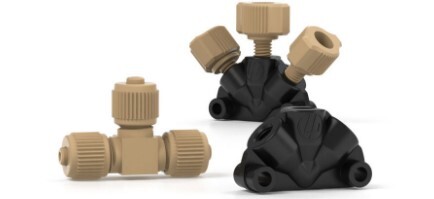
IDEX Static Mixing Tees and Micro Static Mixing Tees are engineered to efficiently combine fluid streams in microbore, analytical, and low-flow chromatography systems. Designed with low internal volume and optimized internal geometry, these mixing tees promote consistent gradient formation while minimizing back pressure and band broadening.

Static Mixing Tees
  • PEEK body with two-piece fingertight fittings
  • Low swept volume of 2.2 µL (includes frit volume)
  • Designed for 0.5–3 mL/min flow rates

Static Mixing Tees are ideal for microbore and analytical gradient HPLC applications. The center port incorporates a 10 µm UHMWPE or stainless steel frit that enhances mixing while maintaining low back pressure—typically only 10–20 PSI (0.7–1.4 bar) within the specified flow range. These tees feature 0.020" (0.50 mm) thru-holes and are rated to a maximum pressure of 5,000 PSI (345 bar).

Micro Static Mixing Tees
  • Constructed from inert PEEK and PCTFE
  • Ultra-low swept volume of 0.95 µL
  • Optimized for 20–250 µL/min flow rates

Micro Static Mixing Tees use a precision-engineered internal geometry to efficiently mix two fluid streams into a single, homogeneous output at low flow rates. A 0.5 µm porosity PEEK frit in the center port enhances mixing while adding a maximum of only 20 PSI (1.4 bar) of back pressure. These tees are rated to 5,000 PSI (345 bar) with direct 1/16" OD tubing connections, or up to 4,000 PSI (276 bar) when used with capillary tubing and NanoTight™ fittings.

Part No Description Tubing OD Threads Thru-Hole Swept Vol. Pressure Rating
PEEK STATIC MIXING TEE
U-466 Tee, 10 µm UHMWPE Frit 1/16" 10-32 Coned 0.020" (0.50 mm) 2.2 µL 5,000 PSI (345 bar)
U-466S Tee, 10 µm SS Frit 1/16" 10-32 Coned 0.020" (0.50 mm) 2.2 µL 5,000 PSI (345 bar)
PEEK MICRO STATIC MIXING TEE
M-540 Micro Static Mixing Tee 1/16" 5/16-24 Coned 0.010" (0.250 mm) 0.95 µL 5,000 PSI (345 bar)
M-540A Micro Static Mixing Tee, no Frit 1/16" 5/16-24 Coned 0.020" (0.50 mm) 2.2 µL 5,000 PSI (345 bar)
Note
Turbulent mixing of solvents often increases outgassing. To maintain a bubble-free fluid pathway, we recommend solvent degassing when using this product. The frit incorporated into our U-466 and U-466S Static Mixing Tees is not replaceable. If it becomes clogged, the Mixing Tee must be replaced.

Key Definitions
Static Mixing Tee
A chromatography fitting designed to combine two fluid streams into a single, well-mixed output using an internal frit and optimized flow geometry while maintaining low swept volume.
Micro Static Mixing Tee
A low-volume mixing tee engineered for capillary and microflow applications, providing efficient mixing at low flow rates with minimal back pressure.
Swept Volume
The internal volume of a fitting that is exposed to fluid flow, which can influence dispersion, peak broadening, and gradient accuracy in chromatographic systems.
Internal Frit
A porous element integrated into a fitting that promotes turbulent mixing of fluid streams while controlling particulate flow and maintaining consistent pressure characteristics.
Back Pressure
The resistance to flow introduced by system components such as fittings or frits, typically measured as an increase in system pressure during operation.
NanoTight™ Fittings
A low-dead-volume capillary connection system designed for precise alignment and secure sealing of fused silica and capillary tubing in high-performance chromatography applications.
Frequently Asked Questions
What is a static mixing tee used for in HPLC?
Static mixing tees are used to combine two mobile-phase streams and improve gradient mixing. Their internal geometry—often incorporating a frit—promotes rapid mixing while keeping swept volume low to preserve chromatographic performance.
What is the difference between a Static Mixing Tee and a Micro Static Mixing Tee?
Static Mixing Tees are designed for microbore or analytical HPLC flow ranges, while Micro Static Mixing Tees are optimized for capillary and microflow applications where minimal swept volume and efficient mixing at low flow rates are critical.
Why is low swept volume important in mixing tees?
Low swept volume minimizes dispersion and band broadening, which is especially important for fast gradients, narrow-bore columns, and LC-MS workflows where peak shape and sensitivity matter.
Do static mixing tees increase system back pressure?
Yes, static mixing tees can add some back pressure, particularly when a frit is used. In most systems, the added pressure is modest, but it should be considered for low-flow and capillary LC applications.
When should a Micro Static Mixing Tee be used?
Micro Static Mixing Tees should be used in low-flow, capillary, or nano LC setups where efficient mixing and minimal internal volume are required to maintain sensitivity and chromatographic integrity.
What materials are commonly used in IDEX static mixing tees?
IDEX static mixing tees are commonly manufactured from inert polymers such as PEEK (and in some designs PCTFE components), providing excellent chemical resistance and electrical isolation for demanding analytical and LC-MS workflows.