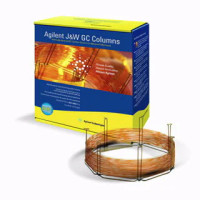
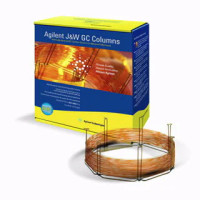
DB-UI 8270D

Agilent DB-UI 8270D GC Columns
Agilent J&W DB-UI 8270D columns are engineered to deliver exceptional peak shape, inertness, and sensitivity for the trace-level analysis of active semivolatile organic compounds (SVOCs) targeted under EPA Method 8270D. These columns feature advanced Ultra Inert deactivation, which minimizes active-site interactions responsible for adsorption, tailing, and analyte breakdown—ensuring reliable performance even for highly reactive or polar SVOCs.
Leveraging refined manufacturing processes, optimized surface chemistry, and improved coating technologies, DB-UI 8270D provides superior column-to-column reproducibility without compromising bleed performance or altering stationary phase selectivity. This allows laboratories to achieve high-confidence quantitation, stable baselines, and long-term method consistency across diverse environmental and industrial matrices.
Every DB-UI 8270D column undergoes Agilent’s rigorous individual QC testing using a suite of challenging semivolatile analytes, including propanoic acid, pyridine, 1,2-butanediol, 1-chloro-2-fluorobenzene, and m/p-xylene. These compounds are analyzed at low oven temperatures (45 °C) and low on-column masses (5–10 ng) to verify optimal peak shape, ensuring the column meets the demanding sensitivity requirements of EPA 8270D workflows.
As an authorized distributor of Agilent GC columns, Chrom Tech provides DB-UI 8270D as a robust, high-performance solution for laboratories conducting trace-level SVOC analysis with maximum precision and consistency.
Leveraging refined manufacturing processes, optimized surface chemistry, and improved coating technologies, DB-UI 8270D provides superior column-to-column reproducibility without compromising bleed performance or altering stationary phase selectivity. This allows laboratories to achieve high-confidence quantitation, stable baselines, and long-term method consistency across diverse environmental and industrial matrices.
Every DB-UI 8270D column undergoes Agilent’s rigorous individual QC testing using a suite of challenging semivolatile analytes, including propanoic acid, pyridine, 1,2-butanediol, 1-chloro-2-fluorobenzene, and m/p-xylene. These compounds are analyzed at low oven temperatures (45 °C) and low on-column masses (5–10 ng) to verify optimal peak shape, ensuring the column meets the demanding sensitivity requirements of EPA 8270D workflows.
As an authorized distributor of Agilent GC columns, Chrom Tech provides DB-UI 8270D as a robust, high-performance solution for laboratories conducting trace-level SVOC analysis with maximum precision and consistency.