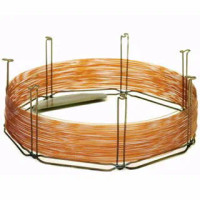
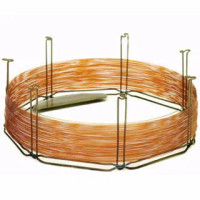
DB-225

Standard Polysiloxane GC Columns

Agilent J&W DB-225 is a highly selective GC column specifically engineered for food, nutritional, agricultural, and lipid-analysis applications. Featuring a specialized (50%-cyanopropyl)-methylpolysiloxane stationary phase, DB-225 delivers exceptional resolution for fatty acid methyl esters (FAMEs), including both cis- and trans-isomers, making it an ideal choice for detailed fatty acid profiling and regulatory food testing.

This precision-engineered column is bonded, crosslinked, and solvent-rinsable for long-term durability and stable performance under repeated sample injections and temperature cycling. DB-225 is closely equivalent to USP phase G19 and can serve as a direct replacement for HP-225 column types used in legacy or regulated methods requiring this specific polarity and selectivity profile.

With an operating temperature range of 40 to 220/240 °C, DB-225 provides flexibility for a wide variety of FAME workflows, including AOAC, AOCS, and international food-testing methods. Its optimized polarity enables improved separation of geometric and positional isomers that often coelute on lower-polarity phases, resulting in cleaner chromatograms and more accurate quantitation. This is critical for nutritional labeling, food authenticity testing, and detailed lipid characterization.

Key Definitions â–¸
(50%-Cyanopropyl)-Methylpolysiloxane Phase
A polar stationary phase incorporating 50% cyanopropyl functional groups. This chemistry provides strong polarity-based interactions and superior selectivity for separating fatty acid methyl esters (FAMEs), including cis- and trans-isomers.
USP Phase G19
A United States Pharmacopeia stationary-phase classification used in compendial, food, and pharmaceutical methods. DB-225 is equivalent to USP G19, making it a direct substitute for methods requiring this phase, including older HP-225 methods.
Fatty Acid Methyl Esters (FAMEs)
Chemical derivatives of fatty acids created through transesterification to make them suitable for GC analysis. FAMEs are essential in nutritional labeling, food authenticity testing, lipid profiling, and biodiesel characterization.
Cis- and Trans-Isomers
Geometric isomers differing in the orientation around a double bond. DB-225’s polarity-enhanced stationary phase provides the resolution needed to distinguish cis and trans FAME pairs for precise lipid analysis.
Bonded and Crosslinked Construction
A chemically reinforced stationary-phase design that improves thermal stability, reduces bleed, and allows solvent rinsing without damaging the stationary phase—ideal for high-throughput food and FAME workflows.
Frequently Asked Questions â–¸
What applications are DB-225 columns best suited for?
DB-225 is optimized for food and nutritional analysis, especially fatty acid methyl esters (FAMEs). Its stationary-phase polarity provides excellent resolution for cis- and trans-isomers, making it ideal for lipid profiling, nutritional labeling, food authenticity testing, and biodiesel analysis.
Why is DB-225 commonly used for FAME analysis?
The (50%-cyanopropyl) stationary phase interacts strongly with polar functional groups, improving separation of saturated, unsaturated, geometric, and positional FAME isomers. This results in cleaner chromatograms and more accurate quantitation.
Is DB-225 equivalent to any USP stationary phases?
Yes. DB-225 is equivalent to USP phase G19, making it suitable for compendial and regulated methods requiring this selectivity. It also serves as a direct replacement for HP-225 columns in legacy workflows.
Can DB-225 be used for GC/MS applications?
Yes. DB-225 is bonded, crosslinked, and low-bleed, making it fully compatible with GC/MS workflows, especially when analyzing thermally sensitive or closely eluting FAME isomers.
What are the advantages of the bonded and crosslinked design?
Bonding and crosslinking improve thermal stability, reduce bleed, and allow solvent rinsing without damaging the stationary phase. This increases durability and enhances long-term performance for high-throughput FAME workflows.