CP-Chirasil Val
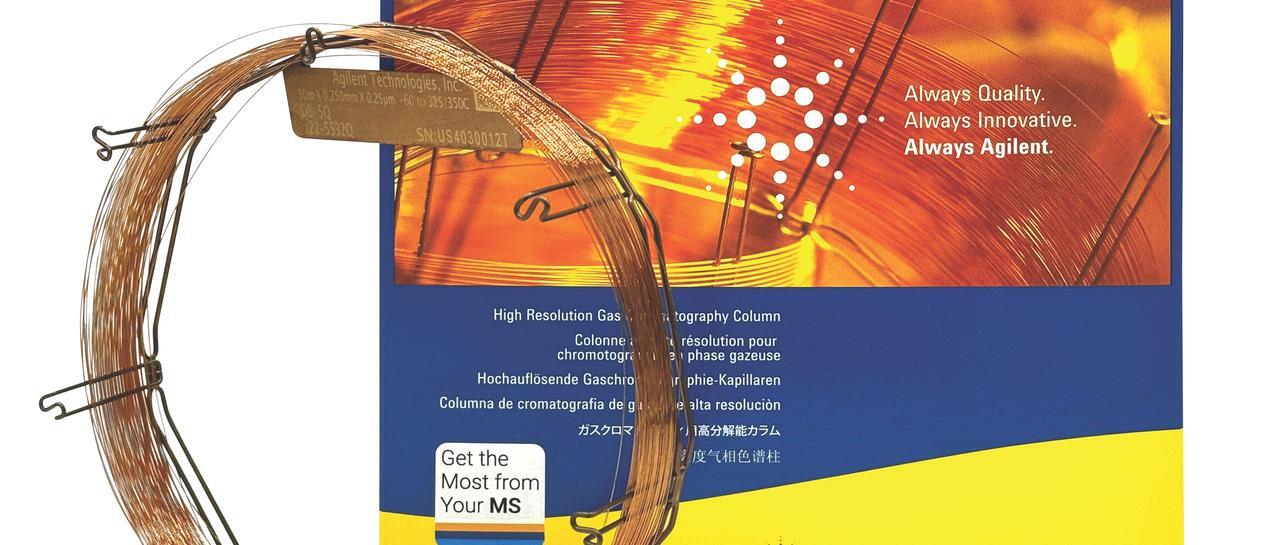
Agilent CP-Chirasil Val GC Columns
Agilent J&W CP-Chirasil Val GC columns are engineered for high-precision separation of optically active compounds, with exceptional suitability for chiral amino acid analysis. Featuring a valine-based chiral stationary phase, these columns deliver strong enantioselective interactions that enable clear distinction between D- and L-amino acids as well as a wide variety of other chiral molecules encountered in food chemistry, pharmaceuticals, forensics, and biochemical research.
CP-Chirasil Val columns exhibit significantly lower bleed levels than many traditional chiral phases, supporting improved sensitivity and stable baselines even for trace-level quantitation. With a maximum operating temperature of 200 °C (both isothermal and programmed), the column provides the thermal robustness needed for complex sample matrices while maintaining high chiral selectivity and reproducibility.
Both antipodes of the Chirasil Val phase are available, enabling analysts to choose the optimal enantiomeric configuration for their application. On Chirasil-L-Val, D-amino acids elute before L-amino acids; on Chirasil-D-Val, the order is reversed. This predictable and customizable elution behavior is especially valuable when determining optical purity, as selecting the phase on which the minor enantiomer elutes first allows for the highest possible detection sensitivity and confidence in quantitation.
CP-Chirasil Val columns exhibit significantly lower bleed levels than many traditional chiral phases, supporting improved sensitivity and stable baselines even for trace-level quantitation. With a maximum operating temperature of 200 °C (both isothermal and programmed), the column provides the thermal robustness needed for complex sample matrices while maintaining high chiral selectivity and reproducibility.
Both antipodes of the Chirasil Val phase are available, enabling analysts to choose the optimal enantiomeric configuration for their application. On Chirasil-L-Val, D-amino acids elute before L-amino acids; on Chirasil-D-Val, the order is reversed. This predictable and customizable elution behavior is especially valuable when determining optical purity, as selecting the phase on which the minor enantiomer elutes first allows for the highest possible detection sensitivity and confidence in quantitation.