CP-Chirasil-Dex CB
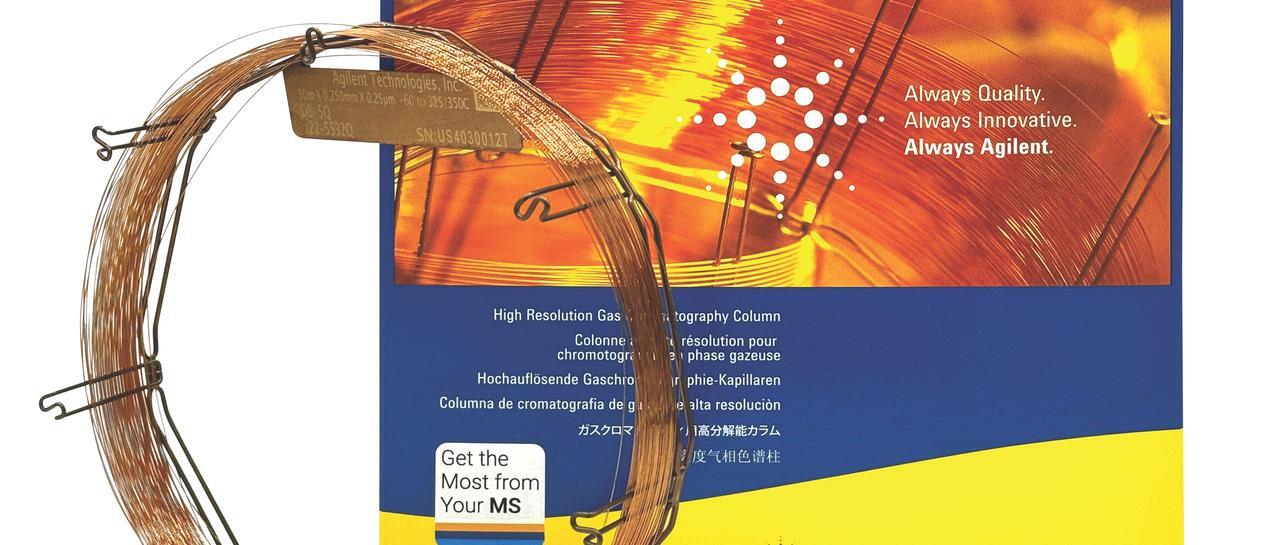
Agilent CP-Chirasil-Dex CB GC Columns
Agilent J&W CP-Chirasil-Dex CB GC columns feature β-cyclodextrin directly bonded to a dimethylpolysiloxane backbone, creating a highly uniform chiral stationary phase with exceptional stability and reproducibility. By chemically anchoring the cyclodextrin to the polymer matrix, CP-Chirasil-Dex CB prevents phase migration within the coating—a common issue in non-bonded chiral phases—resulting in homogeneous enantioselectivity across the entire column.
This direct-bonded architecture provides the highest resolution of enantiomeric isomers, delivering sharp, reproducible separations for chiral compounds across flavors, fragrances, specialty chemicals, pharmaceuticals, and environmental analyses. The enhanced structural stability also extends the usable lifetime of the β-cyclodextrin phase, maintaining consistent enantiomeric recognition and retention behavior even during long-term, high-throughput use.
CP-Chirasil-Dex CB supports elution of polar chiral analytes at relatively low temperatures, reducing thermal stress on thermally labile compounds and improving quantitation of delicate or trace-level isomers. Its compatibility with all common injection techniques—including split, splitless, on-column, and PTV—makes it a versatile and high-performance choice for laboratories requiring reliable, high-resolution chiral GC separations.
This direct-bonded architecture provides the highest resolution of enantiomeric isomers, delivering sharp, reproducible separations for chiral compounds across flavors, fragrances, specialty chemicals, pharmaceuticals, and environmental analyses. The enhanced structural stability also extends the usable lifetime of the β-cyclodextrin phase, maintaining consistent enantiomeric recognition and retention behavior even during long-term, high-throughput use.
CP-Chirasil-Dex CB supports elution of polar chiral analytes at relatively low temperatures, reducing thermal stress on thermally labile compounds and improving quantitation of delicate or trace-level isomers. Its compatibility with all common injection techniques—including split, splitless, on-column, and PTV—makes it a versatile and high-performance choice for laboratories requiring reliable, high-resolution chiral GC separations.