Anion Exchange
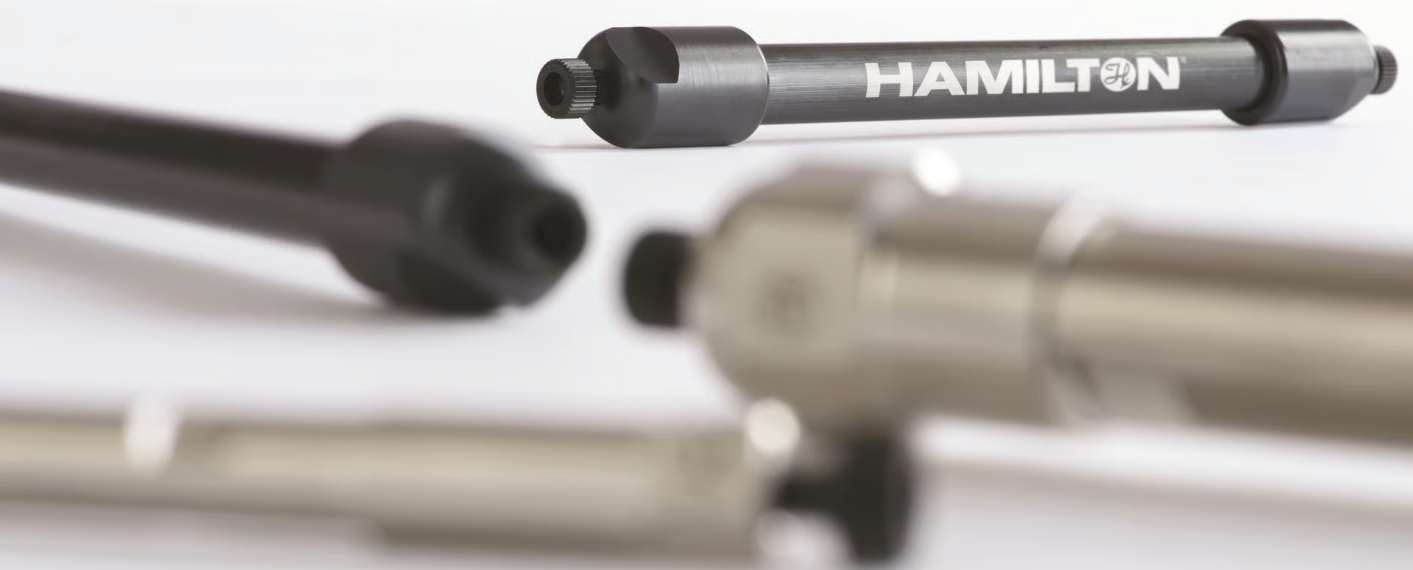
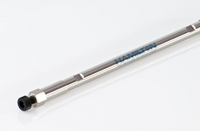
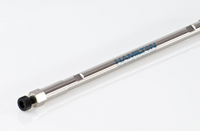
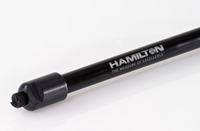
Hamilton Anion Exchange Columns
Hamilton’s anion exchange columns are engineered for high-performance separations of ionic and ionizable analytes using strong, highly controlled ion-exchange interactions. In anion exchange chromatography, the stationary phase carries a positively charged surface that selectively retains negatively charged species. The greater the negative charge of the analyte, the stronger the interaction with the stationary phase—resulting in increased retention and enhanced resolution.
Elution is precisely modulated by adjusting the mobile phase pH, ionic strength, and, to a lesser degree, temperature. Raising ionic strength or altering pH disrupts the electrostatic interactions between analytes and the stationary phase, allowing compounds to elute in a predictable order. Because Hamilton uses robust polymeric substrates rather than silica, these columns withstand the full pH range (0–14) and elevated temperatures, providing greater flexibility, longer lifetimes, and compatibility with aggressive cleaning conditions.
To support diverse application needs, Hamilton offers six polymeric packing materials for anion exchange separations—each designed with distinct selectivity, capacity, and performance characteristics to optimize method development across environmental, industrial, pharmaceutical, and research laboratories.
Hamilton Anion Exchange Columns — Specifications
| Packing Name | Support Material | Exchange Capacity | Pore Size | Buffer Strength | Applications | Typical Analytes |
|---|---|---|---|---|---|---|
| PRP-X100 | PSDVB* with tri-methyl ammonium exchanger | 0.19 meq/gm | 100 Å | 0.0–0.5 N | Organic & inorganic anions; organic acids; organic/inorganic arsenic species | Halides, polarizable anions, organic acids, organic & inorganic arsenic species |
| PRP-X110 | PSDVB* with tri-methyl ammonium exchanger | 0.11 meq/gm | 100 Å | 0.0–0.5 N | Organic & inorganic anions; organic acids; organic/inorganic arsenic species | Halides, polarizable anions, organic acids, organic & inorganic arsenic species |
| PRP-X500 | Poly(meth-acryl amido-propyl trimethyl-ammonium chloride) | 1.6 meq/gm | Superficially porous | 0.0–2.0 N | Proteins/peptides; single-stranded/double-stranded RNA/DNA | Myoglobin, bovine serum albumin, conalbumin, ovalbumin |
| PRP-X600 | Poly(di-methyl amido-propyl meth-acrylamide) | 1.6 meq/gm | Superficially porous | 0.0–1.0 N | Nucleic acids (ss/ds RNA & DNA); peptides and proteins | Synthetic RNA, DNA oligonucleotides, proteins/peptides, ovalbumin, DNA fragments, oligonucleotides |
| RCX-10 | PSDVB* with tri-methyl ammonium exchanger | 0.35 meq/gm | 100 Å | 0.0–1.0 N | Carbohydrates, polysaccharides, sugar oligomers up to DP8; mono- and disaccharides | Arabinose, galactose, lactose, maltose, sucrose |
| RCX-30 | PSDVB* with tri-methyl ammonium exchanger | 1.0 meq/gm | 100 Å | 0.0–1.0 N | Carbohydrates, polysaccharides, sugar oligomers up to DP8; mono- and disaccharides | Arabinose, galactose, lactose, maltose, sucrose |
*PSDVB is Poly(styrene-divinylbenzene)
Temp limits: pH 1–7.9 Temp. 5–60 °C; pH 8–13 Temp. 5–30 °C
Mobile phase limits: pH 1–13, 0–100% aqueous, organic modifier
Max pressure: 5,000 PSI
Hamilton PRP-X100 & PRP-X110 Columns — Anion Exchange
Hamilton PRP-X100 and PRP-X110 are highly stable, inert anion-exchange columns designed for dependable ion chromatography performance across a wide range of systems—including dedicated IC instruments and HPLC platforms configured for ion analysis. Advances in modern polymer chemistry deliver rugged column construction with higher separation efficiencies than earlier generations, supporting consistent retention and reproducible peak shape in routine and demanding workflows.
These columns are well suited for systems using suppressed and non-suppressed conductivity as well as electrochemical, UV, and ICP-MS detection. For laboratories currently relying on wet chemical or colorimetric testing, ion chromatography can reduce sample pretreatment while improving accuracy and precision of results.
Typical Analytes
Halides, polarizable anions, organic acids, and organic/inorganic arsenic species.
Applications
Separation and quantitation of organic and inorganic anions, organic acids, and organic/inorganic arsenic species in analytical and research workflows.
Industries
Pharmaceutical, environmental, medical research, and food & beverage laboratories.
| PRP-X100 | PRP-X110 | PRP-X110S | |||
|---|---|---|---|---|---|
| Size (mm) | 5 µm | 10 µm | 12–20 µm | 7 µm | 7 µm |
| 21.2 x 250, 100 Å | — | — | 79353 | — | — |
| 4.6 x 250 PEEK | 79181 | 79455 | — | 79741 | — |
| 4.6 x 150 PEEK | 79174 | 79354 | — | 79738 | — |
| 4.1 x 250 SS | — | 79433 | — | 79734 | 79735 |
| 4.1 x 150 SS | 79812 | 79434 | — | 79732 | 79733 |
2) Prep/Semiprep Starter Kit includes 1 holder, 1 cartridge
Hamilton PRP-X500 & PRP-X600 Columns — Anion Exchange
Hamilton PRP-X500 is a superficially porous polymeric anion exchange column designed for the separation, purification, and isolation of proteins, peptides, and DNA/RNA. The methacrylate polymeric coating provides a more hydrophilic surface, helping reduce hydrophobic-interaction sample losses that can occur with other protein HPLC columns—supporting improved recovery and more consistent results.
PRP-X600 is a superficially porous weak-base anion exchange support that separates DNA oligomers based on negative charge. Because PRP-X600 is a WAX resin, its exchange capacity is pH dependent. Lowering pH can reduce protein binding, which may shorten run time for complete separations in workflows where faster turnaround is required.
Mobile phase composition can be adjusted to tune retention of DNA oligomers. While rapid gradient changes can reduce column efficiency in some cases, biomolecules run in this fashion on PRP-X500 can deliver favorable separation efficiency with much shorter run times.
Typical Analytes
PRP-X500: Myoglobin, bovine serum albumin, conalbumin, ovalbumin
PRP-X600: Synthetic RNA, DNA oligonucleotides, proteins and peptides, ovalbumin, DNA fragments, oligonucleotides
Applications
PRP-X500: Proteins/peptides; single-stranded and double-stranded RNA/DNA
PRP-X600: Nucleic acids including single-stranded/double-stranded RNA and DNA; peptides and proteins
| PRP-X500 7 µm | PRP-X600 7 µm | |
|---|---|---|
| Size (mm) | Part # | Part # |
| 4.6 x 150 PEEK | 79573 | 79189 |
| 4.6 x 50 PEEK | 79474 | 79360 |
| 2.1 x 150 PEEK | — | 79220 |
| Guard Columns & Accessories | ||
| Analytical Guard Cartridge Holder PEEK | 79477 | 79477 |
| Analytical Repl Cartridges PEEK (5/pk) | 79320 | 79362 |
| Analytical Starter Kit¹ PEEK | 79319 | 79361 |
Hamilton RCX-10 & RCX-30 Columns — Anion (Carbohydrate Analysis)
Hamilton RCX-10 and RCX-30 carbohydrate analysis columns are designed for reliable isocratic or gradient separations of carbohydrates. Compared with PRP-X100, RCX-10/RCX-30 offer higher exchange capacity, delivering characteristics better suited for resolving carbohydrate mixtures from simple sugars to more complex sample matrices.
Simple samples containing two or three carbohydrates can often be separated quickly using isocratic conditions, while more complex mixtures may require gradient elution to fully resolve all analytes of interest. When paired with common detection approaches—including conductivity, refractive index (RI), UV, or pulsed amperometric detection (PAD)—mono- and disaccharides can be quantified efficiently with strong reproducibility.
Typical Analytes
Arabinose, galactose, lactose, maltose, and sucrose.
Applications
Carbohydrates, polysaccharides, sugar oligomers up to DP8, and routine mono- and disaccharide analysis.
| RCX-10 7 µm | RCX-30 7 µm | |
|---|---|---|
| Size (mm) | Part # | Part # |
| 4.6 x 250 PEEK | 79388 | 79877 |
| 4.6 x 150 PEEK | — | 79370 |
| 4.1 x 250 SS | 79440 | 79803 |
| Guard Columns & Accessories | ||
| Analytical Guard Column | 79292 | — |
| Analytical Guard Cartridge Holder SS | 32908 | — |
| Analytical Guard Cartridge Holder PEEK | 79477 | 79477 |
| Analytical Repl Cartridges SS (5/pk) | 79463 | — |
| Analytical Repl Cartridges PEEK (5/pk) | 79379 | 79372 |
| Analytical Starter Kit¹ SS | 79462 | — |
| Analytical Starter Kit¹ PEEK | 79378 | 79371 |