Agilent for GPC/SEC

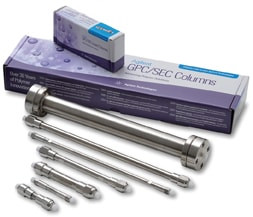
Agilent Columns for GPC and SEC

Agilent GPC and SEC columns deliver accurate, highly reproducible characterization of polymers, plastics, and macromolecules across aqueous, organic, and polar solvent systems. Designed for both gel permeation chromatography (GPC) and size exclusion chromatography (SEC), these columns provide precise separation based on hydrodynamic volume for determining molecular weight and distribution.

Engineered for long lifetime and consistent performance, Agilent’s aqueous and organic GPC/SEC columns support a wide range of polymer analysis workflows—from traditional polystyrene calibration curves to complex copolymers, biopolymers, and specialty materials. Their robust column architecture ensures reliable measurements of polymer size, structure, and branching across diverse sample types.

Whether you are optimizing QC methods or performing detailed research-grade polymer characterization, Chrom Tech offers expert support and trusted Agilent solutions tailored to your solvent compatibility and application needs. For selection assistance or guidance, contact Chrom Tech.

Explore HPLC Columns
Shop HPLC Columns
Explore all column families, modes, applications, and resources in the full pillar guide.

Agilent GPC/SEC Column Categories

Explore genuine Agilent Columns for GPC and SEC
Key Definitions

Gel Permeation Chromatography (GPC)

A size-based chromatographic technique performed in organic solvents to determine the molecular weight distribution of synthetic polymers such as polystyrene, polyolefins, and elastomers.

Size Exclusion Chromatography (SEC)

An aqueous or buffer-based form of GPC used for water-soluble polymers, biopolymers, proteins, and polysaccharides, separating analytes strictly by hydrodynamic volume.

Molecular Weight Distribution (MWD)

The spread of molecular weights in a polymer sample, typically reported as Mn, Mw, Mz, and PDI; GPC/SEC columns are engineered to resolve these distributions precisely.

Calibration Standards

Well-characterized polymers (e.g., polystyrene or pullulan standards) used to establish a calibration curve that enables calculation of molecular weights from retention times.

Mixed-Bed GPC/SEC Columns

Columns containing a blend of pore sizes to yield a broad, smooth calibration curve—ideal for samples containing polymers with wide or unknown molecular weight ranges.

Hydrodynamic Volume

The effective 3D size a polymer occupies in solution; GPC/SEC separations are based on this volume rather than the polymer’s absolute molecular weight.

Pore Size (Å)

The pore diameter of the column packing material, determining the molecular weight range that can be accurately separated; larger pores are required for high-MW polymers and branched structures.

Frequently Asked Questions

What is the difference between GPC and SEC?

GPC refers to gel permeation chromatography performed in organic solvents for synthetic polymers, while SEC refers to aqueous or buffer-based size exclusion chromatography used for water-soluble polymers, proteins, and biopolymers. Both separate analytes strictly by hydrodynamic volume.

How do I choose the right pore size for my polymer?

The pore size must match the molecular weight distribution of the sample: smaller pores for low-MW polymers and larger pores for high-MW polymers, branched structures, or broad polydispersity. Mixed-bed columns are ideal when the molecular weight range is unknown.

Are Agilent GPC/SEC columns compatible with all solvent systems?

Yes—Agilent offers both organic GPC and aqueous SEC column families, each engineered for the appropriate solvent systems. Selecting the correct chemistry ensures stability, accurate results, and long column lifetime.

Can Agilent GPC/SEC columns measure polymer branching and structure?

Yes—GPC/SEC separates polymers by hydrodynamic volume, allowing estimation of structural differences such as branching, compactness, and conformation when paired with suitable calibration standards or multi-detector systems.

Do I need mixed-bed columns for broad molecular weight samples?

Mixed-bed GPC/SEC columns combine multiple pore sizes into a single column, creating a smooth calibration curve ideal for samples with wide, unknown, or complex molecular weight distributions.

How long do Agilent GPC/SEC columns typically last?

When used under recommended solvent and flow conditions, Agilent GPC/SEC columns offer long lifetime and high reproducibility. Proper filtration of samples and mobile phases further extends column durability.

Can these columns be used on any GPC/SEC system?

Yes—Agilent GPC and SEC columns are compatible with most modern chromatographic systems, including those equipped with refractive index, UV, viscometry, and multi-angle light scattering detectors.